
Japandi Art
Kintsugi: The Japanese Art of Mending Broken Pottery
- What Is Kintsugi? The Art of Golden Repair
- A Short History: From the Muromachi Court to the Tea Room
- How Kintsugi Is Made: Urushi, Lacquer, and Gold
- The Market and Value: What Kintsugi Costs and What It Is Worth
- Living With Kintsugi: Broken-Pottery Aesthetics at Home
- Discover Nihonga for Contemporary Spaces
Few ideas in Japanese art travel as well as the one at the heart of this craft: a bowl that shatters is not ruined but unfinished, and the break itself can become the most striking thing about it. The Japanese art of repairing broken pottery with lacquer and gold is called kintsugi (金継ぎ, literally “golden joinery”), and over the past decade it has moved from the quiet world of the tea room into design journals, museum exhibitions, and the shelves of collectors well beyond Japan.
For an international audience, kintsugi sits at an unusual crossroads. It is at once a conservation technique with centuries of documented practice, a philosophy about imperfection and time, and an aesthetic object that looks remarkable in a pared-back modern interior. This guide explains what kintsugi is, where it came from, how it is actually made, what it costs to commission, and how a mended vessel reads in a real living or commercial space.
Throughout, the emphasis is on what a collector, designer, or buyer actually needs to know: which materials signal authenticity, what is legend versus documented history, what a repair realistically costs, and how to care for a gold-seamed piece once it is in daily life.
What Is Kintsugi? The Art of Golden Repair
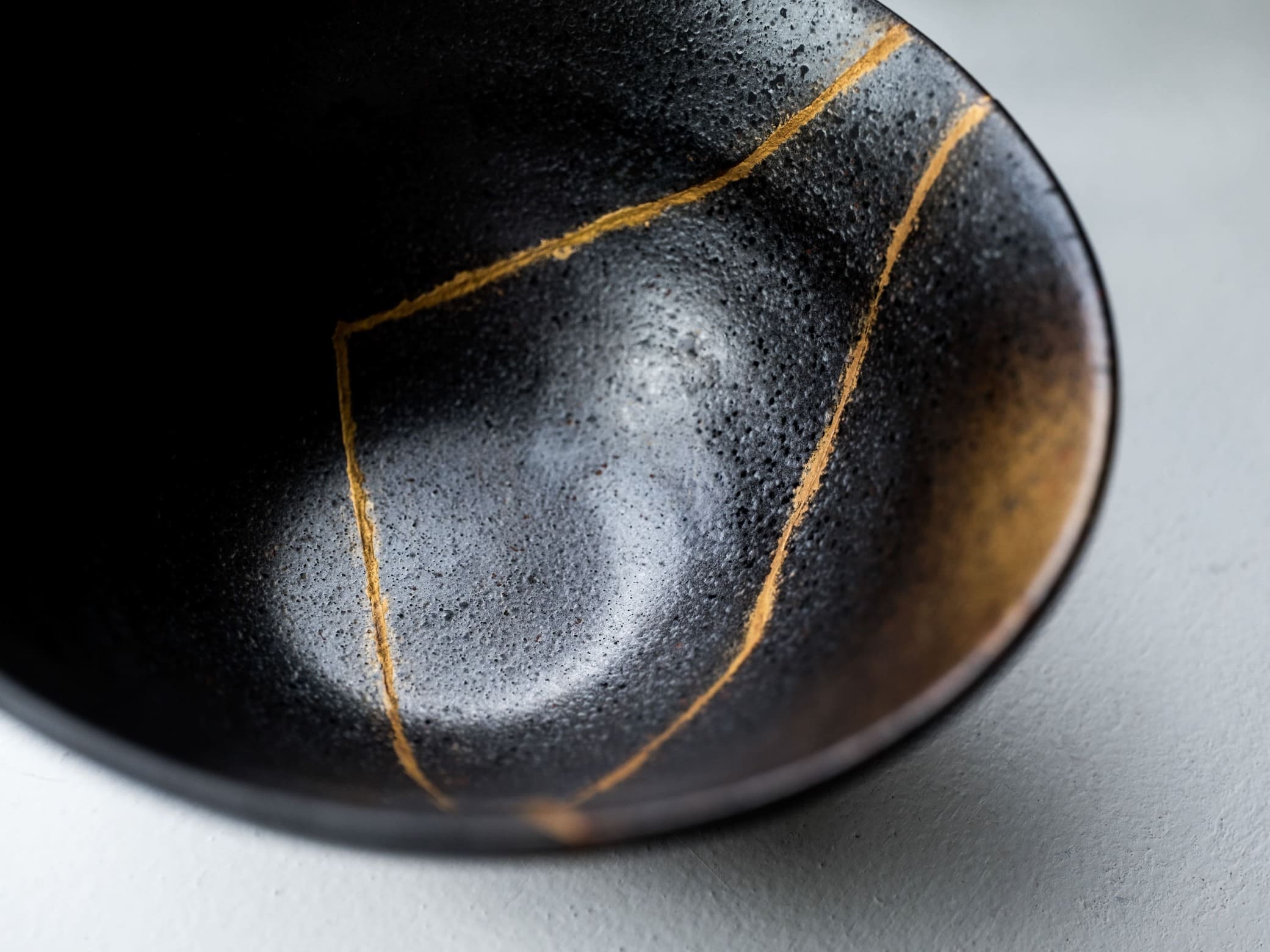
Kintsugi is the practice of rejoining broken ceramic with a natural lacquer adhesive and then highlighting the mended seams with powdered precious metal, most often gold. Rather than disguising the damage, the technique draws attention to it, so that the network of repaired cracks becomes a deliberate part of the object’s appearance. The result is a piece whose history is written on its surface in fine gold lines.
Kintsugi, Kintsukuroi, and the Vocabulary of Repair
The craft is known by more than one name. Kintsugi joins kin (gold) with tsugi (joinery); the near-synonym kintsukuroi (金繕い, “golden repair”) is also widely used. When silver is the finishing metal the work is sometimes called gintsugi, and when the seam is left as plain lacquer with no metal at all it may be called urushitsugi. These are variations on a single idea rather than separate crafts.
One term worth fixing early is urushi (漆), the Japanese lacquer that makes the whole technique possible. Urushi is the refined sap of the lacquer tree, Toxicodendron vernicifluum, and it has been used in Japan as an adhesive and coating for thousands of years. It is central to everything that follows, because genuine kintsugi is, at root, a lacquer art.
Wabi-Sabi and Mottainai: The Philosophy Behind the Gold
Kintsugi is usually discussed alongside two Japanese ideas. The first is wabi-sabi (侘寂), an aesthetic sensibility that finds beauty in things that are imperfect, weathered, or transient. A repaired bowl, marked by its own life rather than pretending to be flawless, is close to a textbook illustration of the concept.
The second is mottainai (もったいない), a sense of regret at waste and a corresponding respect for keeping useful things in service. Seen through this lens, kintsugi is not only decorative but ethical: it argues that an object is worth saving, and that the labor of saving it can be honored openly rather than hidden. For many contemporary buyers, this is precisely the part of the story that resonates, and it is one reason a single mended vessel can carry so much meaning in a room.
A Short History: From the Muromachi Court to the Tea Room
The repair of pottery with lacquer is far older than the gilded craft we now recognize. Archaeological finds show Japanese artisans using urushi to mend ceramics thousands of years ago, long before any tea ceremony existed. What changed in the late medieval period was not the act of repair but the decision to make it beautiful, and to value the result.
The Bakōhan Legend, and What Actually Survives
The most repeated origin story centers on Ashikaga Yoshimasa (1436–1490), the eighth shogun of the Muromachi period (the era of Japanese history running from 1336 to 1573). According to the tale, Yoshimasa broke a treasured Chinese tea bowl and sent it to China for repair, only to have it returned clamped together with ugly metal staples; dissatisfied, he is said to have asked Japanese craftsmen for something more elegant, and the gold-seamed art of kintsugi was born.
It is a good story, and it is worth handling with care. The bowl at the center of it appears to survive: a Longquan celadon tea bowl of the Southern Song dynasty (13th century), nicknamed Bakōhan (馬蝗絆), roughly “locust clamp,” after the metal braces that hold it. It is held by the Tokyo National Museum and designated an Important Cultural Property. Crucially, the surviving bowl was repaired with metal staples, not gold lacquer, which is why specialists treat the gold-repair origin as legend rather than documented fact. The honest version is more interesting: by Yoshimasa’s day, Japanese taste had already learned to see a visible mend as something that could add to a piece rather than diminish it.
Kintsugi and the Culture of Chanoyu
What is well established is that kintsugi grew up alongside chanoyu (茶の湯), the Japanese tea ceremony, which flourished from the 15th and 16th centuries onward. Tea practice prized humble, irregular wares such as Raku and Korean-style rice bowls, and it placed enormous value on the individual chawan (茶碗, tea bowl). When such a bowl cracked, discarding it was unthinkable; repairing it visibly, and lovingly, fit the entire ethos of the tea room.
Tea culture also explains a famous anecdote: mended wares became so admired that collectors were occasionally suspected of breaking sound pots on purpose, simply to have them returned with gold seams. Whether or not that ever happened, the story captures a real shift in taste, one in which a repair was no longer a flaw to apologize for but a feature to prize.
How Kintsugi Is Made: Urushi, Lacquer, and Gold

Authentic kintsugi is slow, technical, and almost entirely dependent on natural materials. Understanding the process is the single best way to tell genuine work from the quick imitations now sold in craft shops, because the two look superficially similar and behave very differently over time.
The Core Materials
At the heart of the craft is raw lacquer, but a practitioner works with several lacquer-based preparations, each tuned to a different stage of the repair. The most common are summarized below.
| Material | What it is | Role in the repair |
|---|---|---|
| Ki-urushi (raw lacquer) | Filtered sap of the urushi tree | The base ingredient for adhesives, fillers, and finishing coats |
| Mugi-urushi | Raw lacquer mixed with wheat flour and water | A strong glue used to bond fragments back together |
| Sabi-urushi | Raw lacquer mixed with fine clay powder (tonoko) and water | A smooth paste that fills small chips and levels the surface |
| Kokuso | Lacquer thickened with fiber or wood powder | A bulky filler for larger missing sections |
| Metal powders | Gold (kinpun), silver (ginpun), or platinum, often 23–24 karat gold | The final decorative finish dusted onto the seam |
| Furo (or muro) | A humidity-controlled box or cabinet | Where the piece rests while the lacquer hardens |
The Repair Process and the Furo
A traditional repair proceeds in stages, each separated by a hardening period. Fragments are first cleaned and rejoined with mugi-urushi; chips and gaps are then filled with sabi-urushi or, for larger losses, kokuso; the built-up area is smoothed and sealed with refined lacquer; and finally, while the last lacquer layer is still tacky, the metal powder is dusted on and later burnished.
The detail that surprises most newcomers is how urushi sets. It does not dry by evaporation; it hardens, or cures, by absorbing moisture from the air, which is why each layer is left to rest in a furo (室, “bath”) kept at high humidity, often around 75 to 90 percent. A full repair therefore takes weeks, and complex commissions commonly run one to three months from start to finish. This is not slow work by inefficiency; it is slow work by chemistry.
Three Approaches: Crack, Fill, and Yobitsugi
Practitioners describe several repair approaches, and the exact terminology varies from studio to studio. The simplest follows a hairline crack, tracing the original break line in gold-dusted lacquer. A second builds up and gilds a missing chip so that the gap reads as a small golden island within the glaze.
The most dramatic is yobitsugi (呼び継ぎ, “calling-in joinery”), in which a missing section is replaced not by lacquer alone but by a fragment from an entirely different vessel, deliberately mismatched in pattern or color and bound in with gold seams. The effect is a patchwork object that openly celebrates its composite history, and for many collectors a fine yobitsugi piece is the most coveted form of all.
Traditional Versus Modern, and the Question of Food Safety
A practical warning matters here. So-called modern or simplified kintsugi replaces urushi with synthetic epoxy resin and often substitutes imitation gold mica for real metal. These kits are inexpensive and beginner-friendly, but the resins are generally not food-safe, so a piece repaired this way should be treated as display only.
Genuine kintsugi, by contrast, uses natural urushi that becomes inert and food-safe once fully cured, which is why a properly repaired tea bowl can return to use. When evaluating a piece or a service, the presence of real urushi and real precious metal is the line between an heirloom-grade restoration and a decorative quick fix.
The Market and Value: What Kintsugi Costs and What It Is Worth
Kintsugi does not behave like a fine-art market with headline auction records; there is no roster of seven-figure “kintsugi lots.” Instead, the economics divide into two distinct questions: what it costs to have a repair done, and whether a repair changes the value of the object underneath.
Repair Costs and Commissioning
Pricing depends almost entirely on the complexity of the damage, the metals used, and whether the studio works in traditional urushi or a hybrid method. The ranges below reflect published rates from Japanese studios and Western practitioners and should be read as typical guidance rather than fixed quotes.
| Type of work | Typical range (JPY) | Approx. (USD) | Notes |
|---|---|---|---|
| Small chip | From ¥3,300 | From about $22 | Priced by chip size and number |
| Crack | About ¥5,000–10,000 | About $35–70 | Depends on seam length |
| Multi-piece break | About ¥16,500–30,800 | About $110–205 | Rises with number of fragments |
| Western studio commission | Quoted per piece | Often $100–280+ | Heirloom and complex work can run higher |
Beyond commissioned repair, two adjacent markets are worth knowing. Modern synthetic kits are widely sold for under about $30, while genuine urushi-based kits in Japan typically run roughly $80 to $200, reflecting the cost of natural materials. Hands-on workshops, common in cities such as Kyoto and Kanazawa, generally start around $150 for a short private session that sends you home with a piece you have repaired yourself.
Does Kintsugi Add Value?
For most household ceramics, the honest answer is that kintsugi adds meaning rather than money: skilled repair can easily cost more than the open-market price of the bowl it saves, and people commission it anyway because the object matters to them. That emotional logic is the craft’s real engine.
For historically significant wares, the calculus shifts. A celebrated old repair can become part of an object’s identity and provenance, as the staple-mended Bakōhan demonstrates, and within tea culture a distinguished mend has long been treated as a mark of a vessel’s eventful life rather than a defect. The lesson for collectors is to judge each piece on its own terms: the quality of the original ceramic, the skill of the repair, and the coherence of the two together.
Living With Kintsugi: Broken-Pottery Aesthetics at Home
What makes kintsugi so adaptable to contemporary spaces is the quality of its gold. Unlike a printed pattern, a hand-laid metal seam catches and moves with the light, so a single repaired bowl can act as a small, animated focal point on an otherwise quiet shelf, console, or dining table. Against the neutral palettes and natural materials favored in modern interiors, gold-veined ceramic reads as warm and deliberate rather than ornate.
Scale and placement reward a little thought. A small mended chawan invites close looking and suits an intimate setting, an entry niche, a reading corner, a tea station, where guests come near enough to read the seams. A larger repaired vessel can anchor a sideboard or a reception desk in a hospitality setting, where the gold lines do quiet work of signaling craft and care without shouting.
Conservation in a lived-in environment is straightforward but worth respecting. Even food-safe urushi repairs dislike dishwashers, abrasive scrubbing, and prolonged soaking; hand washing and gentle drying preserve both the lacquer and the metal. Display away from harsh, sustained direct sunlight, and a genuine kintsugi piece will hold its luster for generations, which is, after all, the entire point of having mended it.
That same sensibility, an embrace of natural materials, gold worked by hand, and beauty that deepens with time, runs well beyond ceramics. It is the connective tissue between kintsugi and Nihonga (日本画, Japanese-style painting), which builds its surfaces from iwa-enogu (岩絵具, mineral pigments ground from stone) and gold leaf, and which carries the same wabi-sabi attention to texture and light into work made for the wall. For anyone drawn to the gold seam of a repaired bowl, the painted gold of a Nihonga panel is a natural next step in the same visual language.
Discover Nihonga for Contemporary Spaces
Shop carefully selected Nihonga,
curated by experienced Japanese art dealers
for homes and commercial spaces worldwide.