
Japandi Art
Japandi Furniture: A Guide to Choosing It for Your Space


Few interior styles have moved from niche to mainstream as quickly as Japandi. The word itself is a portmanteau of Japanese and Scandinavian, and it describes a hybrid aesthetic that pairs the quiet restraint of Japanese design with the warmth and practicality of Nordic interiors. As a label it gained wide currency in the design press during the late 2010s, but the affinities it draws on are much older, rooted in two cultures that have long prized natural materials, honest construction, and uncluttered space.
For collectors, interior designers, and buyers furnishing homes, hotels, and offices, Japandi furniture has become a reliable foundation. It is calm without being cold, refined without being precious, and unusually forgiving when it comes to mixing old and new. This guide explains where the style comes from, what distinguishes genuine Japandi pieces from generic minimalism, how to choose furniture for real residential and commercial spaces, and why a Japandi interior is one of the most sympathetic settings for original Japanese art.
What Is Japandi Furniture?
Japandi furniture is the meeting point of two design philosophies that, despite the distance between Tokyo and Copenhagen, share a great deal. Both traditions favor solid wood over veneer, function over ornament, and the kind of subtle craftsmanship that rewards a second look. Where they differ, they tend to complement rather than clash, and it is precisely that balance that defines the style.
The Japanese Roots: Wabi-Sabi and Restraint
The Japanese half of Japandi draws heavily on wabi-sabi, the appreciation of beauty in imperfection, age, and impermanence. A wabi-sabi sensibility values the grain that runs unevenly across a tabletop, the soft patina that wood acquires with use, and the deliberate absence of clutter. It descends from centuries of Japanese practice in which a single object is given room to be seen, an idea formalized in the tea ceremony and in residential architecture organized around tatami (rush-mat flooring) and shoji (paper sliding screens).
Equally important is the concept of ma, the considered use of empty space. In a Japanese interior, emptiness is not a gap waiting to be filled; it is an active element that gives the objects around it weight and meaning. Japandi furniture inherits this instinct, which is why a well-composed Japandi room can feel generous even when it contains very little.
The Scandinavian Side: Function and Warmth
The Scandinavian contribution is best understood through two ideas. Hygge is the Danish notion of cozy, unhurried contentment, the comfort of soft textiles, low light, and a chair you genuinely want to sit in. Lagom is the Swedish principle of balanced moderation, neither too much nor too little. Together they soften the austerity that pure Japanese minimalism can sometimes carry.
Scandinavian design also brings a mid-century inheritance of clean silhouettes, tapered legs, and ergonomic comfort, the legacy of makers who treated everyday furniture as serious design. The result of combining the two traditions is furniture that is visually quiet but physically inviting, and that suits the way people actually live.
The Hallmarks of Japandi Furniture
Recognizing authentic Japandi furniture is easier once you know what to look for. The style is less about a single signature shape than about a coherent set of choices in material, color, proportion, and detail. The following sections describe the qualities that distinguish considered Japandi pieces from interchangeable minimalist ones.
Materials and Craftsmanship
Natural, tactile materials are the heart of Japandi. Light and mid-toned woods such as oak and ash dominate, often alongside darker walnut for contrast. Bamboo, rattan, and cane appear in seating and storage; linen, wool, and cotton soften upholstery and bedding; and ceramic, stone, and matte metal accents complete the palette. Charred cedar, known in Japanese as yakisugi (sometimes marketed in English as shou sugi ban), turns up in statement pieces and cladding for its deep, weatherproof finish.
Craftsmanship matters as much as the material itself. Japandi favors visible, honest construction, exposed joinery, hand-finished surfaces, and finishes that let the grain breathe rather than burying it under high gloss. The table below summarizes the materials you are most likely to encounter and where they typically appear.
| Material | Character | Typical use |
|---|---|---|
| Oak and ash | Pale, straight-grained, durable | Tables, chairs, casegoods |
| Walnut | Warm, dark, contrasting | Accent pieces, sideboards |
| Bamboo and rattan | Light, textural, renewable | Seating, screens, storage |
| Linen and wool | Matte, soft, breathable | Upholstery, cushions, throws |
| Stoneware and stone | Tactile, earthy, matte | Lamps, vessels, tabletops |
| Yakisugi (charred cedar) | Deep, textured, matte black | Statement furniture, cladding |
Palette, Proportion, and Negative Space
The Japandi palette is muted and earth-derived: warm whites, oatmeal, clay, taupe, soft charcoal, and the natural tones of wood. Color is used sparingly and almost always in a desaturated key, so that a single deeper accent, the black of a lacquered tray or the green of a plant, registers clearly against the calm background.
Proportion tends toward the low and the horizontal, an echo of Japanese floor-level living, with platform beds, low tables, and seating that sits closer to the ground than its Western equivalents. Negative space is preserved deliberately. A Japandi room is edited rather than decorated, and the discipline of leaving surfaces clear is what allows each piece to be appreciated on its own terms.
Forms and Joinery
Forms are simple but rarely severe. Edges are often softened, corners eased, and legs lightly tapered, so that even rectilinear pieces feel approachable. The best Japandi furniture treats joinery as a quiet ornament in its own right, letting a well-cut joint or a peg become a visible mark of how the object was made. This honesty of construction is the thread that ties the Japanese and Scandinavian halves of the style together.
Choosing and Styling Japandi Furniture for Real Spaces
Japandi works because it scales. The same principles that quiet a small apartment can bring coherence to a large hotel lobby, provided the furniture is chosen with the room’s function in mind. The sections below address the practical questions that come up when buying for residential and commercial interiors, including what to expect at different price points and how to care for natural materials over time.
Living Rooms and Residential Interiors
In a home, Japandi furniture rewards restraint. A low sofa in oatmeal linen, a solid-oak coffee table, and one or two woven or ceramic accents will usually do more than a fuller arrangement. Because the palette is so calm, lighting becomes a primary design tool: warm, layered, low-level light flatters matte wood and textile far more than bright overhead fixtures. Leaving wall and floor space open is not a shortfall to be corrected but the point of the style.
For buyers weighing cost, it helps to think in tiers. Genuine, well-made Japandi furniture is an investment, but the range is wide, and the table below gives a general sense of the market rather than fixed prices, which vary by maker, region, and timber.
| Tier | Approx. range (USD) | What to expect |
|---|---|---|
| Entry / mass-market | $300–$1,200 per piece | Veneer or engineered wood, Japandi-inspired forms |
| Mid-market | $1,200–$4,000 per piece | Solid hardwood, better joinery, considered finishes |
| Artisan / designer | $4,000 and above | Hand-built solid wood, signed or limited pieces |
Hospitality and Commercial Settings
In hotels, restaurants, offices, and showrooms, Japandi offers a calm, premium atmosphere that photographs well and ages gracefully. The neutral palette suits high-traffic public areas because it does not date quickly and absorbs wear without looking shabby. For commercial buyers, durability is the deciding factor: solid hardwoods, dense upholstery fabrics, and robust finishes hold up to constant use far better than veneered or lightly built alternatives.
Scale and sightlines matter here. A lobby or a large open-plan office benefits from a few generously sized anchor pieces and clear circulation rather than many small items, which preserves the sense of ma that gives the style its composure even at commercial scale.
Caring for Natural Materials
The natural materials that make Japandi appealing also ask for sensible care. Solid wood prefers stable humidity and indirect light; strong, direct sun can fade and dry timber over time, so positioning furniture away from unshaded windows protects both color and structure. Oiled and lightly finished surfaces benefit from periodic re-oiling rather than aggressive cleaning. Linen and wool should be kept out of prolonged damp. None of this is onerous, and the patina that wood and textile develop with attentive use is, in the wabi-sabi spirit, part of the appeal rather than a flaw.
How Japandi Interiors Frame Japanese Art
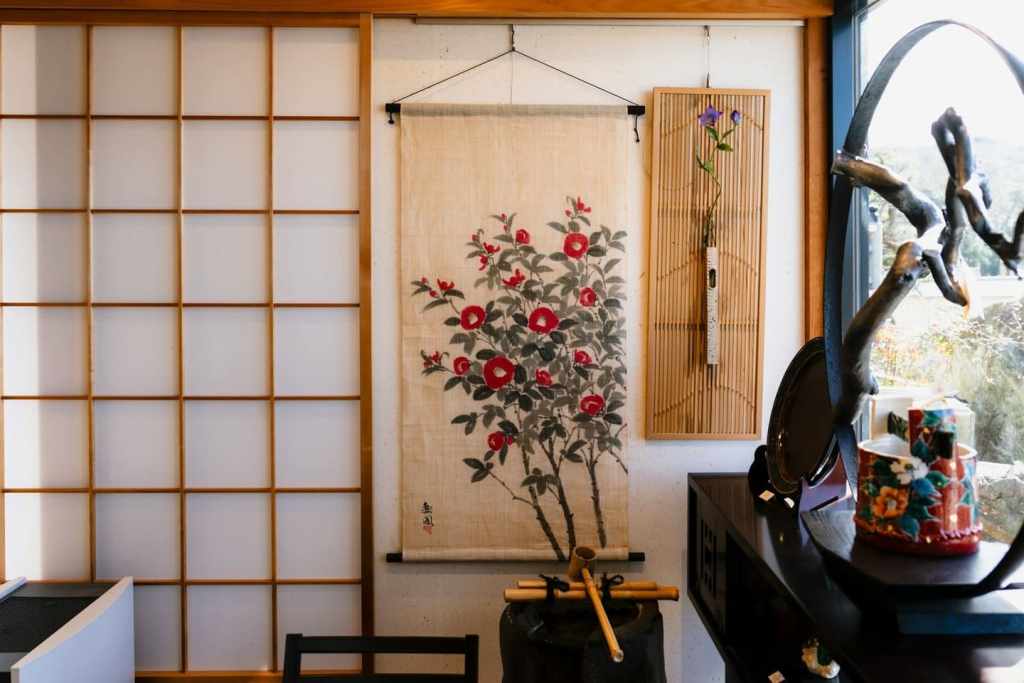
The reason Japandi matters to art buyers, and not only to furniture buyers, is that it creates the ideal conditions for showing Japanese art. The same restraint that governs the furniture, the open walls, the muted palette, the low and even light, is exactly what original Japanese paintings were made to inhabit. Nowhere is this clearer than with Nihonga.
The Role of Negative Space
Japanese painting has always treated empty space as a compositional force. Traditional formats such as the kakejiku (hanging scroll) and the byōbu (folding screen) were designed to be read against expanses of plain paper, silk, or gold, and to be hung or placed where the eye could rest around them. A cluttered wall fights this logic; a Japandi wall extends it. The discipline of leaving room, which can feel counterintuitive in a maximalist interior, is native to both the furniture and the art.
Pairing Nihonga with a Japandi Interior
Nihonga is Japanese-style painting made with traditional materials rather than Western oils or acrylics. Its pigments are iwa-enogu, mineral colors ground from stone and minerals, bound with nikawa (an animal-glue medium) and applied to washi (handmade Japanese paper) or silk, often alongside sumi (carbon ink), gofun (a white made from shell), and gold or silver leaf. The result is a surface that is characteristically matte, granular, and quietly luminous, qualities that read beautifully in exactly the kind of soft, layered light a Japandi room provides.
The palettes align almost without effort. The earthy mineral tones of iwa-enogu, the warm whites of gofun, and the restrained shimmer of gold leaf sit naturally against oak, linen, and clay. In low light, leaf and mineral pigment catch and release illumination in a way that gives a calm room a focal point without disturbing its composure. For a residential living room, a single Nihonga work above a low console can do the work of an entire gallery wall. In a hotel lobby or a corporate reception, a larger format or a folding screen brings cultural depth and a sense of place that mass-produced décor cannot replicate.
This is the natural endpoint of a Japandi scheme. Once the furniture, palette, and light are in place, the room is essentially asking for the right piece of art to complete it, and Japanese painting answers that request more fluently than almost anything else.
Discover Nihonga for Contemporary Spaces
Shop carefully selected Nihonga,
curated by experienced Japanese art dealers
for homes and commercial spaces worldwide.