
Ink & Calligraphy
Sumi-e: A Guide to Japanese Ink Painting

Sumi-e (墨絵), the Japanese art of ink painting, is one of the most quietly powerful traditions in East Asian art. With nothing more than black ink, a single brush, and a sheet of paper or silk, a sumi-e master can suggest a misted mountain, a heron lifting from a riverbank, or the bend of bamboo under snow. The medium is unforgiving — each stroke is final, recorded on absorbent paper that allows no second attempt — and that economy is precisely what gives the form its power.
For international collectors, interior designers, and buyers furnishing modern residential and commercial spaces, sumi-e occupies an unusual position. It is at once deeply traditional and strikingly contemporary: monochrome, restrained, attentive to negative space, and capable of carrying a wall on its own. This guide introduces sumi-e in its full context — origins, technique, lineage, current market, and the practical considerations that come with living alongside ink paintings — so that the work can be understood, evaluated, and acquired with confidence.
Origins and Spirit of Sumi-e
The word sumi-e combines sumi (ink) with e (painting), and the tradition is also referred to as suibokuga (水墨画), literally “water-ink painting.” Although the form is intimately associated with Japan, its roots lie in China, where ink painting flourished during the Tang (618–907) and especially the Song (960–1279) dynasties. Chinese literati painters — scholar-officials who painted as a contemplative practice rather than a profession — developed many of the techniques and subjects that would later define the Japanese tradition.
From Chinese Roots to Japanese Refinement
Ink painting entered Japan in earnest during the Kamakura (1185–1333) and Muromachi (1336–1573) periods, transmitted largely by Zen Buddhist monks who travelled between Japanese and Chinese monasteries. Works arrived as gifts, study objects, and devotional images, and Japanese monk-painters began to copy and then reinvent the idiom. By the fifteenth century, Japan had produced its own ink painting tradition with a distinct sensibility — sparer, more atmospheric, and often more dramatic in its handling of empty space than its Chinese models.
The major patrons of this development were the Ashikaga shōguns and the great Zen temples of Kyoto, particularly the Gozan (“Five Mountains”) network. Painters like Josetsu, Tenshō Shūbun, and above all Sesshū Tōyō (1420–1506) established the Japanese voice in ink. Sesshū’s travels to Ming-dynasty China, his exposure to contemporary Chinese masters, and his subsequent return to Japan produced landscapes — most famously the long handscroll Sansui chōkan (“Long Landscape Scroll,” 1486) — that became canonical models for generations.
Zen Buddhism and the Aesthetics of Ink
Sumi-e is inseparable from Zen practice. The discipline of a single, irreversible brushstroke; the cultivation of stillness before the work begins; the willingness to leave most of the paper untouched — all of these reflect Zen ideas about presence, impermanence, and the meaningful use of emptiness. The Japanese term ma (間) describes the charged interval between things: the silence between notes, the pause between gestures, the unpainted expanse around a heron’s wing. In sumi-e, ma does as much work as ink.
This is why a small ink painting of a single bamboo stem can occupy a wall as confidently as a much larger canvas in another tradition. The viewer’s eye completes the image; the paper itself becomes part of the composition. Understood this way, sumi-e is not minimalist by accident but by long, deliberate philosophical design.
Materials and Techniques of Sumi-e
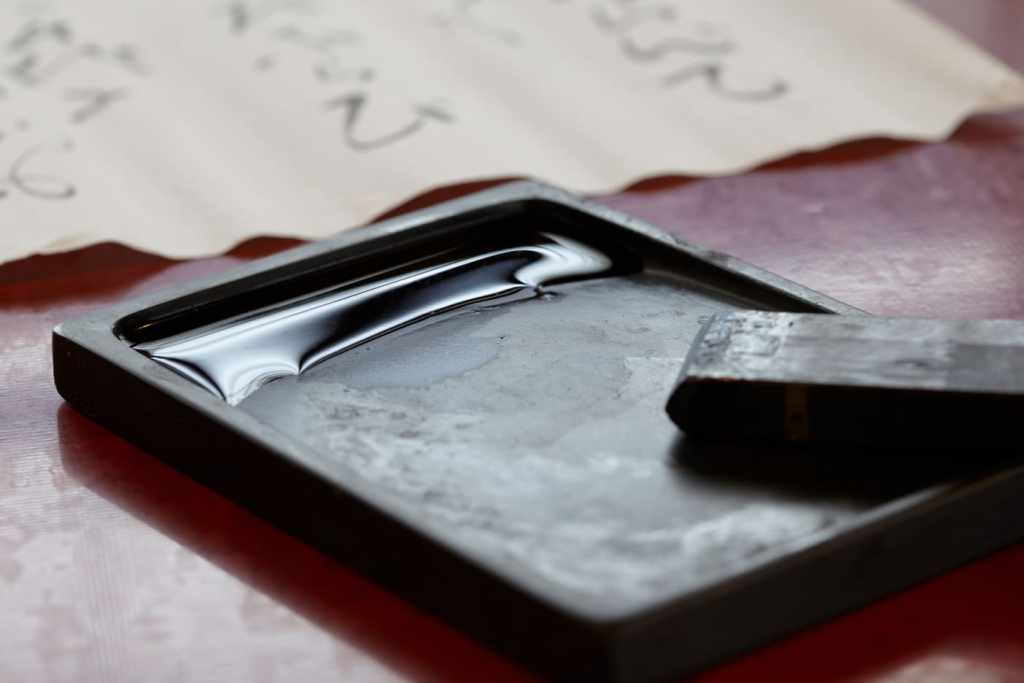
Few art forms place such weight on so few materials. The traditional toolkit, known collectively as the Four Treasures of the Studio (bunbō shihō, 文房四宝), consists of ink, brush, inkstone, and paper. Each has been refined over a thousand years of practice, and each shapes the final work in specific, visible ways.
The Four Treasures: Sumi, Fude, Suzuri, Washi
Sumi, the ink itself, is traditionally produced as a solid stick made from soot — collected from burning either pine wood (shōen-boku) or vegetable oils (yuen-boku) — bound with nikawa, an animal-hide glue, and often perfumed with camphor or other natural fragrances. Pine-soot ink tends to read as a cooler, slightly blue-toned black; oil-soot ink is warmer and glossier. The painter grinds the stick on a suzuri (inkstone) with a small reservoir of water, controlling concentration with great precision.
The fude (brush) is typically made from animal hair — wolf, weasel, goat, deer, sometimes horse — bound into a tapering tuft that holds an enormous amount of ink and releases it with controlled variation. A single brush, well-charged, can produce a gradation from saturated black at the tip to the palest grey along the stroke’s edge. The paper, washi, is made from the inner bark fibres of plants such as kōzo (paper mulberry), gampi, or mitsumata. Its absorbency is decisive: washi receives ink instantly, recording every hesitation and acceleration of the hand.
Core Techniques and Brushwork
Sumi-e techniques are organized around the behaviour of ink on paper. Haboku (破墨, “broken ink”) layers ink of different tones, allowing each to bleed slightly into the next to suggest atmospheric depth — mountains receding into mist, for example. Hatsuboku (溌墨, “splashed ink”) is bolder: the artist works with very wet, dilute ink in rapid, almost improvisational gestures, letting form emerge from controlled accident. Sesshū’s late Haboku sansui (1495) is the canonical example, a landscape that dissolves into pure tonal gesture without losing its sense of place.
Beyond these named methods, sumi-e is defined by the relationship between line and wash, between “bone” and “flesh” in the traditional vocabulary. A single bamboo leaf is rendered in one decisive stroke that begins narrow, swells, and tapers; the wash that suggests its body is laid in with a separate, larger brush. Mastery is measured less by complexity than by economy: how much can be conveyed with how little.
The Four Gentlemen and Other Core Subjects
Although sumi-e ranges across landscape, figure, and religious subjects, a small cluster of motifs — the so-called Four Gentlemen (shikunshi, 四君子) — has long served as both training material and finished work. These are the orchid (ran), bamboo (take), plum blossom (ume), and chrysanthemum (kiku), each associated with a Confucian virtue and each demanding a different kind of brushwork. Pine, crane, heron, sparrow, carp, and the seasonal landscape complete the working repertoire. The constraint is part of the discipline: within a tightly defined subject set, the painter’s hand and intelligence become legible.
Major Sumi-e Artists Through History
The history of sumi-e in Japan is dense with named masters, schools, and lineages. A short survey cannot do them justice, but the following figures and movements anchor the field and continue to shape both scholarship and the secondary market.
Muromachi Founders: Josetsu, Shūbun, Sesshū
Josetsu (active early fifteenth century) is conventionally credited with the founding gesture of Japanese ink painting. His Hyōnen-zu (“Catching a Catfish with a Gourd”), held at Taizō-in within the Myōshin-ji temple complex in Kyoto, is a National Treasure and a Zen kōan in painted form. Tenshō Shūbun (active mid-fifteenth century), Josetsu’s pupil, refined the lyric, atmospheric landscape that would become Japan’s signature contribution to the genre. Sesshū Tōyō, often described as the greatest of all Japanese ink painters, synthesised Chinese influence with a distinctly Japanese sense of structure; his surviving works are concentrated in Japanese museums and major temple collections.
Momoyama and Edo Period Developments
In the Momoyama period (1573–1615), the Kanō school dominated official painting, working in both heavy mineral colour on gold and in pure ink. Kanō Eitoku and Kanō Sanraku produced ink works of monumental ambition, but the towering figure of late-sixteenth-century sumi-e is Hasegawa Tōhaku (1539–1610), whose Shōrin-zu byōbu (“Pine Trees” folding screens), held at the Tokyo National Museum, are perhaps the single most admired ink paintings in Japan. Tōhaku’s pines emerge and disappear into mist with a tenderness that has never quite been equalled.
The Edo period (1603–1868) saw ink painting diversify. Miyamoto Musashi (1584–1645), better known internationally as a swordsman, produced ink works of startling directness, including the often-reproduced “Shrike on a Withered Branch.” The Nanga or bunjinga (“literati painting”) movement, led by figures such as Ike no Taiga (1723–1776) and Yosa Buson (1716–1784), looked back to Chinese scholar-painting and produced a more relaxed, personal, often lyrical use of ink. By the late Edo, Zen monk-painters such as Hakuin Ekaku (1686–1768) and later Sengai Gibon (1750–1837) were producing intentionally rough, charged works that have become favourites of modern collectors.
Modern and Contemporary Sumi-e
The Meiji Restoration (1868) and the rise of Nihonga (Japanese-style painting) as a self-conscious modern category placed sumi-e in a new context: ink remained foundational to Nihonga practice, but it now coexisted with mineral pigments, gold, and Western compositional influences. Twentieth-century artists such as Yokoyama Taikan (1868–1958) and Hishida Shunsō (1874–1911) developed mōrō-tai, a deliberately blurred, atmospheric handling that pushed ink-and-wash technique in a new direction.
In the postwar period, Tōko Shinoda (1913–2021) brought a calligraphic, abstract sensibility to sumi ink that resonated with international audiences and placed her work in institutional collections including the Museum of Modern Art, New York. A range of contemporary artists, both inside Japan and across the global diaspora, continue to work in pure ink or in hybrid practices that draw on sumi-e’s vocabulary while engaging contemporary subjects.
The Sumi-e Market: Auctions, Prices, and Value Drivers
The market for sumi-e is segmented, and understanding the segments is essential before any acquisition. At the top sit named pre-modern masters whose works are almost entirely housed in Japanese museums and major temples; below them, a substantial market exists in Edo-period works, Zen monk paintings, and modern and contemporary ink. Auction houses including Christie’s, Sotheby’s, and Bonhams handle the top of the international market, while Tokyo houses such as Mainichi Auction and Shinwa serve the domestic trade.
Indicative Price Ranges
The following ranges are indicative rather than exhaustive, drawn from public auction results at major international and Japanese houses across recent years. Individual results vary widely with condition, provenance, and quality.
| Segment | Typical Range (USD) | Notes |
|---|---|---|
| Unattributed Edo-period sumi-e | $500 – $5,000 | Condition and subject sensitive; later remountings common |
| Edo Zen monk paintings (Hakuin, Sengai and circle) | $3,000 – $80,000+ | Wide range; firmly attributed Hakuin or Sengai works at the top end |
| Nanga / bunjinga (Ike no Taiga, Buson and peers) | $5,000 – $250,000+ | Major signed works can substantially exceed the upper figure |
| Kanō and Hasegawa school ink | $20,000 – $500,000+ | Museum-quality works rarely reach the open market |
| Modern Nihonga ink (Taikan, Shunsō and peers) | $10,000 – $300,000+ | Provenance and exhibition history are decisive |
| Tōko Shinoda | $5,000 – $200,000+ | Strong international market, particularly since the mid-2010s |
| Living contemporary ink and sumi-e artists | $1,000 – $50,000+ | Highly variable; primary gallery and studio sales also relevant |
What Drives Value
Five factors do the heaviest work in pricing sumi-e. The first is attribution: a signed and sealed work by a documented hand, with corroborating literature, sits in an entirely different market than an unattributed period piece. The second is condition. Ink on paper is fragile; foxing, water staining, restored tears, and faded inscriptions all reduce value, sometimes substantially. The third is mounting, which for hanging scrolls (kakejiku) and folding screens (byōbu) is itself an art form; original or sympathetic remountings preserve value, careless ones erode it.
The fourth driver is provenance and exhibition history. Works that have passed through important Japanese collections, been published in standard reference catalogues, or appeared in major museum exhibitions carry a premium that can be considerable. The fifth, and most subjective, is quality within an artist’s oeuvre: a great Tōhaku and a routine Tōhaku-school piece are different objects entirely, and the gap is not subtle.
Sumi-e in Contemporary Interiors
One of the reasons sumi-e has travelled so well into international collecting is that it asks very little of the room around it and gives a great deal back. A single ink scroll can compose an entryway. A pair of folding screens can structure an open-plan living space. The palette — black ink on cream washi, occasionally with a touch of mineral pigment or gold — sits comfortably with almost any architectural vocabulary, from a Kyoto townhouse to a Mayfair flat to a Singapore hotel lobby.
Scale, Format, and Mounting
Sumi-e is acquired in three principal formats. Hanging scrolls (kakejiku) are designed to be rotated seasonally and displayed one at a time, traditionally in a tokonoma alcove; in a contemporary interior, a single scroll on a plain wall reads with the same intentionality. Folding screens (byōbu), typically in two-panel or six-panel configurations, function as architecture — they define space as much as they decorate it, and they are particularly effective in hospitality and corporate environments where a freestanding gesture is needed. Album leaves and framed works on paper offer a smaller, more intimate scale suitable for studies, libraries, or private rooms.
Scale matters more than buyers often expect. A Tōhaku-school landscape conceived as a sliding door panel (fusuma) operates at architectural scale; an Edo-period Zen circle (ensō) on a small square of paper is a quiet, private object. Matching format to room is the first design decision and arguably the most important.
Light, Conservation, and Living with Ink
Ink on paper or silk is light-sensitive and humidity-sensitive. UV-filtering glazing for framed works, low ambient light levels (museums typically aim for around 50 lux on works on paper), and stable relative humidity in the range of roughly 50 to 60 percent are the baselines that protect the work over time. Hanging scrolls are traditionally rotated — displayed for several weeks at a time, then rolled and stored in their wooden boxes (kiribako) — which both preserves the silk mounting and allows a collection to be experienced as a sequence rather than as wallpaper.
In hospitality and commercial contexts, careful glazing and lighting design make sumi-e perfectly viable even in heavily trafficked spaces. The work is, in a sense, designed for daily life: scrolls have lived in Japanese homes for centuries, in rooms with sliding doors, charcoal braziers, and seasonal humidity. With modest precautions, they continue to do so anywhere in the world.
For collectors and design professionals drawn to this aesthetic, sumi-e is a natural entry point into a wider Japanese painting tradition. Many of the same materials, sensibilities, and compositional habits — ink, washi, the disciplined use of empty space — carry directly into modern Nihonga, where they meet mineral pigments, metal leaf, and contemporary subject matter without losing the discipline of the brush.
Discover Nihonga for Contemporary Spaces
Shop carefully selected Nihonga,
curated by experienced Japanese art dealers
for homes and commercial spaces worldwide.