
Japandi Art
Japanese Art Paintings: A Guide to Styles, History & Value

Japanese art paintings encompass a remarkably wide field, from ink-wash landscapes painted by Zen monks in the fifteenth century to mineral-pigment compositions hanging in contemporary collectors’ homes today. For international buyers, the breadth of the tradition is both the appeal and the obstacle. The same phrase — “Japanese painting” — can describe a Muromachi-period hanging scroll, an Edo-period folding screen lavished with gold leaf, a nineteenth-century woodblock print after a painter’s design, or a large-format work executed last year in a Tokyo studio using pigments ground from semi-precious stones.
This guide is written for collectors, interior designers, art advisors, and serious enthusiasts who want a clear orientation across the major categories of Japanese art paintings. It covers the historical schools and their visual signatures, the materials that distinguish the tradition from Western practice, the artists driving today’s market, the practical questions that arise during acquisition, and the considerations that come into play when bringing a work into a residential or commercial space.
The aim is to give you a working framework: enough vocabulary to read a catalogue entry, enough market context to evaluate what you are being offered, and enough sensitivity to the medium to plan how a work will live in a real room. Where helpful, Japanese terms appear in Hepburn romanization with a short gloss on first use.
What Defines Japanese Art Paintings?
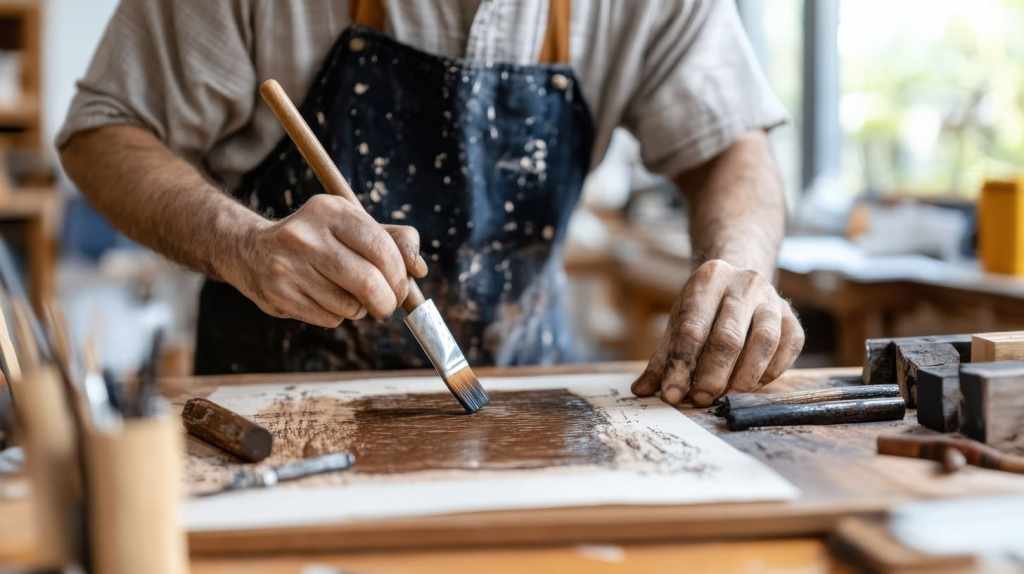
Before sorting Japanese paintings into schools and movements, it helps to understand what unites them as a tradition. The defining characteristics are material rather than stylistic: a preference for absorbent paper or silk supports, water-based binders, mineral and organic pigments rather than oils, and formats designed for specific architectural and social settings. These technical foundations explain why a Japanese painting reads differently on the wall than a Western oil — softer, often more luminous, and visually integrated with the space rather than asserting itself against it.
Traditional Formats and How They Read in a Space
Japanese painting has historically been made for display in a built environment, and the formats reflect that. The kakemono or kakejiku — a hanging scroll mounted with silk borders — was traditionally hung in the tokonoma, the alcove that anchors a tatami room, and rotated seasonally. Its vertical proportions and mounted brocade still translate well to contemporary interiors, where a single scroll can act as a focal point in a hallway, study, or quiet corner.
The byōbu, or folding screen, comes in two-panel, four-panel, six-panel, and occasionally eight-panel configurations. Pairs of six-panel screens were the dominant large-format painting throughout the Edo period (1603–1868), commissioned for reception rooms in merchant homes, temples, and castles. Today they function exceptionally well as room dividers, statement pieces in hotel lobbies, or large horizontal compositions to be hung flat against a wall behind glass.
Fusuma — sliding-door panels — and emakimono, the horizontal handscroll designed to be unrolled section by section, are formats less often encountered outside Japan but worth knowing for context. Shikishi (square paper, often gold-leaf-grounded) and tanzaku (vertical poem strips) are smaller, intimate formats favored by collectors building a layered display.
Materials: Sumi Ink, Mineral Pigments, Washi, and Silk
The materials of Japanese painting account for much of its visual character. Sumi — ink ground from a solid stick of pine soot or oil soot bound with animal glue — produces tonal variation from deep velvety black to soft silver-gray. Iwa-enogu, mineral pigments ground from semi-precious stones such as azurite (gunjō), malachite (rokushō), and cinnabar, sit on the surface as particles that catch and refract light. The coarser the grind, the more granular and jewel-like the finish; finer grinds yield a smoother, more saturated tone.
Gofun, a white pigment made from ground oyster or scallop shell, provides ground layers and highlights. Nikawa, animal-skin glue, serves as the binder for both ink and pigments. Kinpaku (gold leaf) and ginpaku (silver leaf) are applied to the support before painting in the case of decorative screens; the leafing isn’t a frame around the picture but a structural part of it, reflecting ambient light through the composition.
The support is almost always washi (handmade Japanese paper, typically from kōzo mulberry, gampi, or mitsumata fibers) or kinu (silk woven specifically for painting). Both are absorbent, which means the painter’s marks are committed: there is little correction, and the trace of the brush remains visible. This material reality shaped centuries of training in brush handling and economy of mark-making.
Major Schools and Movements: From Yamato-e to Nihonga
Japanese painting traditions have evolved over more than a thousand years, with each major school responding to and reinterpreting what came before. The schools below are the ones a collector or designer is most likely to encounter — in museums, in catalogues, and on the market — and recognizing them by sight is the first step toward serious engagement.
Yamato-e and the Court Tradition
Yamato-e — literally “Japanese painting” — emerged in the Heian period (794–1185) as a deliberately native style, distinguished from the Chinese-influenced kara-e that preceded it. Yamato-e introduced narrative subjects drawn from Japanese literature and seasonal landscape conventions, often depicted with a high viewpoint, stylized clouds (suyari-gasumi), and a focus on intimate emotional moments rather than grand vistas. The Tale of Genji handscrolls are the touchstone of the genre. Yamato-e remained influential as a sensibility long after it ceased to be a distinct school.
Suiboku-ga: Ink Painting and the Zen Tradition
Suiboku-ga, also called sumi-e, is the monochrome ink-painting tradition that flourished from the Muromachi period (1336–1573) onward, brought to Japan via Chinese Song- and Yuan-dynasty models and developed within Zen Buddhist monastic culture. The painter-monk Sesshū Tōyō (1420–1506) remains its towering figure; his landscapes and the so-called “haboku” (splashed-ink) compositions taught generations of painters how to suggest mountain, mist, and water with the most economical brushwork.
Suiboku-ga’s restraint and tonal subtlety make it one of the most architecturally compatible categories of Japanese painting for contemporary spaces. A well-mounted ink landscape reads as calm rather than busy, and works at scales from intimate album leaf to multi-panel screen.
The Kanō School
The Kanō school was Japan’s longest-running painting dynasty, serving as official painters to the shoguns from the late fifteenth century through the Meiji Restoration of 1868. Founded by Kanō Masanobu (1434–1530) and developed by his son Motonobu and grandson Eitoku (1543–1590), the school synthesized Chinese-style ink painting with the colorful Yamato-e tradition, producing large-scale screen and wall paintings for castles, temples, and palaces.
The Kanō formula — bold black outline, vivid mineral pigment, gold-leaf ground, monumental subjects of pine trees, tigers, dragons, hawks, and seasonal flowers — defined Japan’s official visual culture for over three centuries. Kanō school works appear regularly at major auctions, with prices ranging from a few thousand dollars for late-period or workshop pieces to seven figures for documented works by leading masters.
Rinpa: Decorative Painting on a Gold Ground
Rinpa (sometimes written Rimpa) is less a continuous school than a recurring sensibility passed across centuries by painters who consciously revived an earlier aesthetic. It begins with Tawaraya Sōtatsu in the early seventeenth century, is consolidated by Ogata Kōrin (1658–1716) — from whom the school takes its name (rin from Kōrin, pa meaning school) — and is revived again in Edo by Sakai Hōitsu (1761–1829) and Suzuki Kiitsu (1796–1858).
Rinpa is immediately recognizable: flat fields of gold or silver leaf, bold compositional rhythms, stylized natural motifs (irises, plum blossoms, waves, cranes), and a deliberate flatness that anticipates modern graphic sensibilities. Rinpa screens are among the most sought-after Japanese paintings in international design, partly because their decorative confidence reads beautifully in contemporary interiors. Kōrin’s “Red and White Plum Blossoms” screens, designated a National Treasure, set the aesthetic benchmark for the school.
Ukiyo-e: The Floating World
Ukiyo-e — “pictures of the floating world” — is the Edo-period genre best known internationally, though most ukiyo-e in circulation today are woodblock prints (mokuhanga) rather than original paintings. The painted versions, executed in ink and color on silk or paper, are rarer and command significantly higher prices than even fine impressions of the most famous prints.
The genre depicts the entertainment districts, kabuki actors, beautiful women (bijin-ga), landscapes, and historical and mythological subjects. Katsushika Hokusai (1760–1849), Utagawa Hiroshige (1797–1858), and Kitagawa Utamaro (1753–1806) remain the central figures. Hokusai’s “Under the Wave off Kanagawa” — the Great Wave — has become one of the most reproduced images in the world; superb early impressions have exceeded $2 million at Christie’s New York in recent sales (2023).
For the painting market specifically, hanging scrolls (nikuhitsu ukiyo-e) by named ukiyo-e masters are scarce and prized; condition, signature, and seal verification are decisive.
Nihonga: Japanese-Style Painting in the Modern Era
Nihonga is the term coined in the Meiji period (1868–1912) to describe paintings that continued the traditional Japanese methods and materials in distinction from yōga, Western-style oil painting that had begun to flood into Japan. The philosopher and curator Okakura Tenshin (also known as Okakura Kakuzō) and the American art historian Ernest Fenollosa were central to the movement’s founding, championing a modernized Japanese painting as a vehicle for cultural identity.
The first generation of modern Nihonga painters — Yokoyama Taikan (1868–1958), Hishida Shunsō (1874–1911), Shimomura Kanzan (1873–1930), and Kawai Gyokudō (1873–1957) — experimented with the moro-tai or “vague” style, dissolving outline into atmosphere in a way that responded to Western Impressionism while remaining grounded in iwa-enogu and washi. The twentieth-century lineage runs through Higashiyama Kaii (1908–1999), Hirayama Ikuo (1930–2009), Matazo Kayama (1927–2004), and continues today with internationally collected artists such as Hiroshi Senju (b. 1958), known for his large-scale waterfall paintings on fluorescent-mineral grounds.
Nihonga occupies an unusual market position: it is the living continuation of the classical Japanese painting tradition, executed with the same materials that artists used five hundred years ago, but produced by contemporary artists working at the scale and ambition of contemporary art. For collectors who want a work that speaks both to heritage and to the present, Nihonga is the natural answer.
Contemporary Japanese Paintings and the Global Market
The international visibility of Japanese contemporary painting expanded dramatically in the early twenty-first century, driven by a small number of artists whose work crossed easily between the gallery system, biennials, fashion collaborations, and pop culture. Understanding the contemporary market helps frame where Nihonga and other traditional categories sit in relation to it.
Postwar Movements: Gutai and Mono-ha
Gutai, founded in 1954 in Osaka by Yoshihara Jirō, was Japan’s first internationally recognized postwar avant-garde movement. Its painters — among them Shiraga Kazuo, Tanaka Atsuko, and Motonaga Sadamasa — pushed paint as physical material to extremes, and the group has been the subject of major international rediscovery since the 2010s, with corresponding price growth at evening sales.
Mono-ha (“School of Things”), emerging around 1968–1970, was less a painting movement than a sculptural and conceptual one, but its leading figure Lee Ufan (b. 1936) is a painter as well as a sculptor, and his austere, repetitive brushstroke paintings are among the most expensive contemporary East Asian works on the market.
Today’s Most Collected Names
Yayoi Kusama (b. 1929) is the highest-profile Japanese artist of the era, and her Infinity Nets and pumpkin paintings have set auction records that place her among the most valuable living artists in any market. Major Infinity Net canvases have sold in the high seven and low eight figures at evening sales by Christie’s, Sotheby’s, and Phillips since the late 2010s.
Yoshitomo Nara (b. 1959), whose deceptively cute and quietly defiant child figures have a vast international following, set a record when “Knife Behind Back” (2000) sold at Sotheby’s Hong Kong in October 2019 for HK$195.7 million (approximately US$24.9 million). Takashi Murakami (b. 1962), whose Superflat theory connected Edo-period flatness directly to anime and otaku culture, remains a market presence at multiple price tiers.
Among Nihonga painters, Hiroshi Senju has built the most consistent international following, with major waterfall and cliff paintings entering institutional collections and private homes in the US, Europe, and Asia. His work is a useful reference point for buyers who want contemporary Nihonga at scale.
Auction Trends and Price Drivers
The major auction venues for Japanese paintings are Christie’s, Sotheby’s, Phillips, and Bonhams (in Hong Kong, New York, London, and Paris), with strong domestic markets at Mainichi Auction, Shinwa, and SBI Art Auction in Tokyo. Price drivers across all categories are familiar: condition, signature and seal authentication, provenance (especially documented exhibition or publication history), rarity within an artist’s body of work, scale, and subject matter. For contemporary names, market momentum and gallery representation add a further layer.
Reading Quality and Value: What Collectors Look For
Whether you are considering an Edo-period scroll, a Meiji Nihonga, or a contemporary painting, a consistent set of questions applies. The framework below is what experienced dealers and curators walk through, and it scales from a $2,000 acquisition to a major commission.
Condition, Provenance, and Documentation
For paintings on silk or paper, condition is more nuanced than for oil on canvas. Foxing (small brown spots from microbial activity), water staining, insect damage, and old restorations all affect value, and most antique scrolls show some of these to a degree. What matters is whether the damage is confined to the mount or extends into the painted surface, whether prior restoration has been done sympathetically, and whether the work has been stored flat or rolled (long-term rolled storage causes characteristic horizontal creases). A skilled mounter (hyōgu-shi) can address many issues, but invasive restoration carries its own costs and risks.
Provenance — the documented chain of ownership — matters across all tiers. A tomobako, the signed wooden storage box that accompanies many Japanese paintings, often carries the artist’s title and seal on the lid and serves as a primary attribution document. Exhibition history, publication in catalogues, and prior auction records all strengthen a work’s market position.
Price Ranges by Category
The table below offers indicative ranges to orient new buyers. Actual prices vary widely with condition, attribution, and individual significance, but the bands give a working sense of where each category sits.
| Category | Typical Range (USD) | Notes |
|---|---|---|
| Ukiyo-e prints, common subjects, later impressions | $500 – $5,000 | Condition and impression quality dominate |
| Ukiyo-e prints, fine impressions of iconic designs | $5,000 – $500,000+ | Early Hokusai, Hiroshige, Sharaku at the top |
| Edo-period scrolls, anonymous or minor school | $1,000 – $25,000 | Subject and condition lead |
| Major Edo school works (Kanō, Rinpa, Maruyama-Shijō) | $10,000 – $1,000,000+ | Documented attribution is decisive |
| Meiji–Shōwa Nihonga, lesser-known artists | $1,000 – $20,000 | Strong sleeper category |
| Modern Nihonga masters (Taikan, Shunsō, Gyokudō, Kaii) | $20,000 – $500,000+ | Tomobako and exhibition history important |
| Contemporary Nihonga, established living artists | $3,000 – $150,000 | Scale and material complexity drive price |
| Blue-chip contemporary (Kusama, Nara, Murakami, Lee Ufan) | $50,000 – $25,000,000+ | Auction-led; period and subject critical |
Attribution and Authentication
Attribution work for older Japanese paintings involves reading the signature (rakkan), the seals (inshō), the brushwork, the materials, and the mounting. For major-school works, specialists examine these alongside known reference works and any associated documents. For modern and contemporary artists, authentication committees, gallery records, and signed certificates are typical reference points; for Nihonga in particular, a signed tomobako greatly simplifies the process. Reputable dealers will provide condition reports and authentication documentation as a matter of course.
Japanese Art Paintings in Residential and Commercial Interiors
Japanese paintings translate exceptionally well into contemporary residential and commercial interiors, but the medium has its own logic, and the most successful installations respect it. The points below come up repeatedly in real installation scenarios — from private homes to hospitality, corporate, and wellness environments.
Scale, Light, and Placement
The vertical proportions of a hanging scroll suit narrow walls and transition spaces — entryways, stairwell landings, the wall beside a bed — better than the broad horizontal walls that Western paintings often occupy. A pair of six-panel screens, by contrast, can anchor a wide wall in a living area or hotel lobby, or function as a freestanding divider. Nihonga and ink paintings tend to read best in indirect daylight or warm, low-Kelvin artificial light; mineral pigments come alive when raking light catches their granular surface, while harsh overhead spots flatten them.
Mounted scrolls hang from a single hook and require minimal hardware. Framed Nihonga, increasingly common for contemporary works, can be specified with UV-filtering museum glass to reduce light damage and to suit interiors where humidity fluctuates.
Conservation in Lived-In Environments
The traditional materials of Japanese painting — washi, silk, animal-glue-bound mineral pigments — are durable when treated with reasonable care, but they are sensitive to extremes. Direct sunlight will fade indigo and certain organic dyes over time; very dry environments (modern HVAC at low humidity in winter) can cause silk and paper to crack; very humid environments encourage mold. The practical target is moderated indoor conditions: stable temperature, relative humidity in the 45–60 percent band, and protection from direct sun.
For traditional scrolls, periodic rotation — taking the work down and rolling it for storage between displays — is the historical norm, and it extends the life of the painting. For framed contemporary Nihonga in a residential setting, the practice is closer to that of any work on paper: away from south-facing windows, away from heat sources, and inspected periodically.
Choosing Between Antique, Modern, and Contemporary
The choice across periods is partly aesthetic and partly practical. Antique scrolls and screens carry historical weight and patina, but require more conservation attention and respond better to traditional or transitional interiors. Meiji and Shōwa Nihonga sits at an attractive middle point — old enough to feel established, recent enough to be in stable condition with documented provenance. Contemporary Nihonga is the most flexible category for modern interiors: the format conventions are looser, scales run from intimate to architectural, and the works are made with current materials and storage in mind.
For commercial environments — hospitality, corporate, restaurants, wellness — contemporary Nihonga and modern ink painting tend to be the most practical choices, since durability, scale, and the absence of complex conservation rituals are real operational factors. For private homes, the choice is more open, and many serious collections layer all three periods.
Japanese art paintings reward sustained looking, and they reward an interior environment that gives them room to be seen. Whether you are building a first collection, advising a client, or selecting works for a hotel or office, the same orientation applies: understand the school, read the materials, verify the documentation, and place the work where its light and scale can register. From there, the tradition opens up.
Discover Nihonga for Contemporary Spaces
Shop carefully selected Nihonga,
curated by experienced Japanese art dealers
for homes and commercial spaces worldwide.