
Nihonga & Japanese Painting
Naoshima: A Guide to Japan’s Original Art Island
Ask a well-traveled collector to name the single most affecting way to experience contemporary art in Japan, and the answer is rarely a museum in Tokyo. It is an island. In the calm waters of the Seto Inland Sea (Setouchi, the sheltered sea between the main islands of Honshu, Shikoku, and Kyushu), a cluster of small, formerly industrial islands has become one of the most celebrated art destinations on earth.
When people search for the “Japanese art island,” they almost always mean Naoshima and its neighbors. Over roughly three decades, a depopulated copper-smelting island in Kagawa Prefecture was transformed, building by building, into a place where world-class architecture, contemporary installation, and the rhythms of rural island life are inseparable.
This guide explains how that transformation happened, which museums and installations justify the journey, how the Setouchi Triennale fits into the picture, and how to plan a visit that rewards a serious eye. It closes by looking at what these islands quietly teach about living with Japanese art at home.
How Naoshima Became Japan’s Art Island
Naoshima’s reputation did not arrive by accident. It is the result of a sustained, single-minded patronage project that paired one collector’s vision with one architect’s discipline over more than thirty years. Understanding that backstory is the key to reading the islands well.
From Copper Smelter to Benesse Art Site
For much of the twentieth century, the islands of the Seto Inland Sea bore the costs of Japan’s industrialization. Naoshima hosted a copper refinery; nearby Inujima was scarred by a copper smelter that operated only briefly before closing; Teshima later became notorious for illegal industrial waste dumping. As young people left for the cities after World War II, these islands aged and emptied.
The turning point came in the late 1980s, when Soichiro Fukutake, head of the publishing and education company that became Benesse Holdings, began developing the southern end of Naoshima as a place for art and contemplation. The umbrella project, Benesse Art Site Naoshima, now spans Naoshima, Teshima, and Inujima, and its guiding idea is captured in the company’s own motto, “benesse,” from the Latin for living well.
Rather than importing a finished collection into a conventional gallery, the project commissioned site-specific works and buildings tuned to the landscape. The aim was never tourism alone; it was the slow regeneration of island communities through culture, an idea that has since been copied from the Greek islands to rural China.
Tadao Ando and the Architecture of Light
If Fukutake supplied the vision, the architect Tadao Ando gave it form. Ando, a self-taught Osaka native and one of the most decorated architects alive, has designed ten structures for Benesse Art Site Naoshima, a body of work he has been adding to since the project’s earliest years.
Ando’s signature material is board-formed exposed concrete, and his true medium is natural light. On Naoshima he repeatedly buries buildings in the hillside so that they barely disturb the skyline, then carves apertures that let the sun move across the galleries through the day and the seasons. The result is that the architecture is not a neutral container for the art; it is part of the work, and the experience changes depending on the hour you arrive.
Naoshima, Teshima, and Inujima: One Archipelago, Many Visions
It helps to think of the “art island” as an archipelago rather than a single place. Naoshima is the flagship and the easiest to reach. Teshima, a short ferry hop away, is quieter and greener, with terraced rice fields and a single, unforgettable building. Inujima, smaller still and reached from the Okayama side, centers on the ruins of its old smelter.
Each island carries a distinct mood, and dedicated visitors treat them as a trilogy. A common rhythm is two or three days based near Takamatsu or on Naoshima itself, with day trips out to Teshima and Inujima by ferry.
The Museums and Installations Worth Crossing the Sea For

Source:benesse artsite naoshima(https://benesse-artsite.jp/art/chichu.html)
The islands reward slow looking. The following are the anchor sites, roughly in the order a first-time visitor tends to encounter them. Several require timed-entry reservations, so confirm details before you travel.
Chichu Art Museum
The Chichu Art Museum (chichu meaning “in the earth”), opened in 2004, is the spiritual center of Naoshima and, for many, the reason to come. Designed by Ando and built almost entirely underground, it holds permanent installations by just three artists: Claude Monet, Walter De Maria, and James Turrell.
The Monet gallery houses several large Water Lilies canvases from the artist’s late Giverny years, shown in a shadowless, naturally lit room you enter barefoot. De Maria’s monumental “Time/Timeless/No Time” occupies a soaring stepped chamber, while Turrell’s light works, including “Open Field” and “Open Sky,” dissolve the boundary between perception and architecture. An adjoining garden is planted with species drawn from Monet’s own Giverny, closing the loop between painting and place.
Benesse House Museum
Opened in 1992, the Benesse House Museum was the first of Ando’s island buildings and remains one of the most generous. It combines a museum with a hotel under a single concept of art, architecture, and nature in coexistence, so that overnight guests can wander the galleries after the day-trippers have left on the last ferry.
Set on high ground above the sea, the museum holds works by international names alongside outdoor sculpture scattered across the coastline. Staying on-site is one of the few ways to experience the art in near silence, which is part of why rooms book out far in advance.
Lee Ufan Museum and the Ando Museum
The Lee Ufan Museum, which opened in 2010, is a collaboration between Ando and the Korean-born artist and theorist Lee Ufan, a central figure in the Mono-ha (literally “school of things”) movement that explored raw materials such as stone, steel, and glass in spare arrangements. The semi-subterranean building stages Lee’s restrained paintings and sculptures against concrete and sky.
In the village of Honmura, the small Ando Museum, opened in 2013, occupies a century-old wooden townhouse with a concrete interior inserted inside it. It functions as a primer on Ando’s career and on the Naoshima project itself, a useful first or last stop.
Naoshima New Museum of Art
The newest anchor is the Naoshima New Museum of Art, which opened on 31 May 2025 near the Honmura district. It is Ando’s tenth structure on the island: a three-story building, with two floors below ground and one above, holding four galleries and a café with views across the Seto Inland Sea.
Unlike the island’s older institutions, which lean toward Western and Japanese modern masters, the new museum is devoted to contemporary art from across Asia, including Japan. Under director Akiko Miki, its opening program featured commissioned and site-specific works by artists such as Takashi Murakami, Cai Guo-Qiang, Do Ho Suh, N. S. Harsha, and Aida Makoto. For collectors tracking the Asian contemporary market, it is the most significant addition to the islands in over a decade.
Teshima Art Museum and Inujima Seirensho
On Teshima, the Teshima Art Museum (2010) is less a museum than a single immersive work. Designed by architect Ryue Nishizawa of the firm SANAA with artist Rei Naito, it is a low concrete shell shaped like a droplet of water, open to the sky through two large oculi. The sole installation, Naito’s “Matrix,” consists of water that wells up from the floor and travels in unpredictable rivulets, a quiet meditation on time, weather, and life that many visitors describe as their most moving stop.
On Inujima, the Inujima Seirensho Art Museum (2008) was built within the preserved ruins of the island’s early-twentieth-century copper refinery. Architect Hiroshi Sambuichi designed it to run largely on natural energy, using the heat-retaining brick and stone of the old works, while artist Yukinori Yanagi installed pieces that incorporate fragments of the writer Yukio Mishima’s former home. It is the islands’ most powerful statement on industry, memory, and regeneration.
The Art House Project, the Bath, and Kusama’s Pumpkins
Not all of the art sits behind ticket gates. Since 1998, the Art House Project in Honmura has converted empty traditional houses into permanent installations by artists including Tatsuo Miyajima, James Turrell, and Hiroshi Sugimoto, so that the village itself becomes a gallery you walk through.
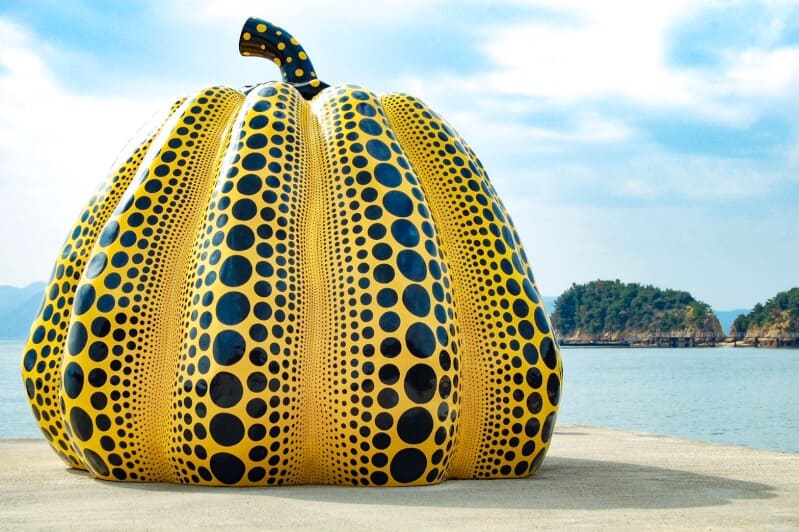
Nearby, the artist Shinro Ohtake turned a public bathhouse into a working artwork, the cheerfully chaotic “I Love Yu,” where visitors can actually bathe surrounded by his collage of salvaged imagery. And no account of the islands is complete without Yayoi Kusama’s two outdoor pumpkins: the yellow one perched on a pier on the Benesse side, and the red one greeting arrivals at Miyanoura Port. The yellow pumpkin, first installed in 1994, was swept into the sea by a typhoon in 2021 and later restored, a reminder that even the most photographed art here lives at the mercy of the weather.
The Setouchi Triennale: Japan’s Island Art Festival
The islands are rewarding year-round, but every three years they swell into a single sprawling exhibition. The Setouchi Triennale (Setouchi Kokusai Geijutsusai) is among the world’s most ambitious site-specific art festivals, and it has done as much as the permanent museums to put the region on the global map.
How the Triennale Works
First held in 2010 and staged every three years under the direction of Fram Kitagawa with Fukutake as general producer, the Triennale spreads commissioned works across roughly seventeen islands and port areas of the Seto Inland Sea. The 2025 edition, the sixth, ran under the theme “Restoration of the Sea” and gathered artists from more than twenty countries.
Crucially, the festival is split into three seasonal sessions rather than running continuously, with a combined total of 107 days across the year. A multi-site passport (priced around 4,000 to 5,000 yen, or roughly 30 US dollars, for the 2025 edition) covers entry to many of the festival artworks, though several flagship museums require separate admission.
| 2025 Session | Dates |
|---|---|
| Spring | 18 April – 25 May 2025 |
| Summer | 1 – 31 August 2025 |
| Autumn | 3 October – 9 November 2025 |
Visiting During — or Outside — the Festival
A Triennale year offers the widest range of work and a charged, communal atmosphere, but it also brings crowds, full ferries, and booked-out lodging. Many of the most popular installations from past festivals become permanent fixtures, so the off-years are far from empty.
For a calmer, more contemplative visit focused on the architecture and the permanent collections, traveling between festival years is often the connoisseur’s choice. The next full edition is expected in 2028, following the festival’s regular three-year cycle.
Planning a Visit: Access, Timing, and Practicalities
The islands are remote by design, and that remoteness is part of the experience. A little logistical planning goes a long way, because ferry schedules and reservation systems shape what you can realistically see in a day.
Getting to the Islands
Most visitors approach from one of two gateways. From the Shikoku side, Takamatsu in Kagawa Prefecture offers frequent ferries to Naoshima, Teshima, and beyond. From the Honshu side, travelers reach Uno Port in Okayama Prefecture by train via Okayama city, then cross to Naoshima or Teshima by ferry. Inujima is most easily reached from the Okayama coast.
On Naoshima itself, a local bus connects the ports with the Benesse area, and rental bicycles are popular for the gentler routes. Distances are small, but the hilly southern end and the timed museum entries mean it is easy to underestimate how long a thorough day takes.
When to Go, Tickets, and Reservations
Spring and autumn offer the most comfortable weather; the summer months are hot and humid, and winter ferry schedules thin out. Increasingly, the major Benesse facilities require advance, timed-entry reservations, and popular sites such as the Chichu Art Museum can sell out, so booking online before arrival is strongly advised.
The table below summarizes the principal art facilities and what each is known for, as a planning reference.
| Facility | Opened | Architect / key artist | What to see |
|---|---|---|---|
| Benesse House Museum (Naoshima) | 1992 | Tadao Ando | Museum-hotel; indoor and coastal works |
| Chichu Art Museum (Naoshima) | 2004 | Tadao Ando | Monet, De Maria, Turrell underground |
| Inujima Seirensho Art Museum | 2008 | Hiroshi Sambuichi / Yukinori Yanagi | Art within a former copper refinery |
| Teshima Art Museum | 2010 | Ryue Nishizawa / Rei Naito | Single water-droplet installation |
| Lee Ufan Museum (Naoshima) | 2010 | Tadao Ando / Lee Ufan | Mono-ha paintings and sculpture |
| Ando Museum (Naoshima) | 2013 | Tadao Ando | Concrete inside a historic townhouse |
| Naoshima New Museum of Art | 2025 | Tadao Ando | Contemporary Asian art, four galleries |
What the Art Islands Teach About Living With Japanese Art
For all their international roster of artists, the Seto Inland Sea islands are deeply Japanese in sensibility. Their lesson is about relationship: how a work converses with natural light, with the seasons, with the texture of the wall behind it and the silence of the room around it. The art is never separated from its setting; the setting completes it.
That principle sits at the heart of Nihonga, the modern tradition of Japanese-style painting that uses mineral pigments (iwa-enogu, literally “rock pigments”) bound on paper or silk. Like the islands, a fine Nihonga work changes with the light, its layered minerals catching the morning differently than the dusk, and it asks for breathing room rather than clutter. Collectors and interior designers who fall for Naoshima often find they are responding to exactly the qualities a Japanese painting can bring into a home or a hospitality space: calm, depth, and a quiet dialogue with the room.
You do not need to live by the Seto Inland Sea to bring that feeling indoors. A single well-chosen Japanese work, hung where the daylight can move across it, can give a living room, a lobby, or an office the same sense of considered stillness that makes the art islands unforgettable. If the islands have left you wanting to live with that sensibility rather than simply visit it, the next step is to look at the work itself.
Discover Nihonga for Contemporary Spaces
Shop carefully selected Nihonga,
curated by experienced Japanese art dealers
for homes and commercial spaces worldwide.