
Japandi Art
Dragons in Japanese Art: Symbolism, History and Value
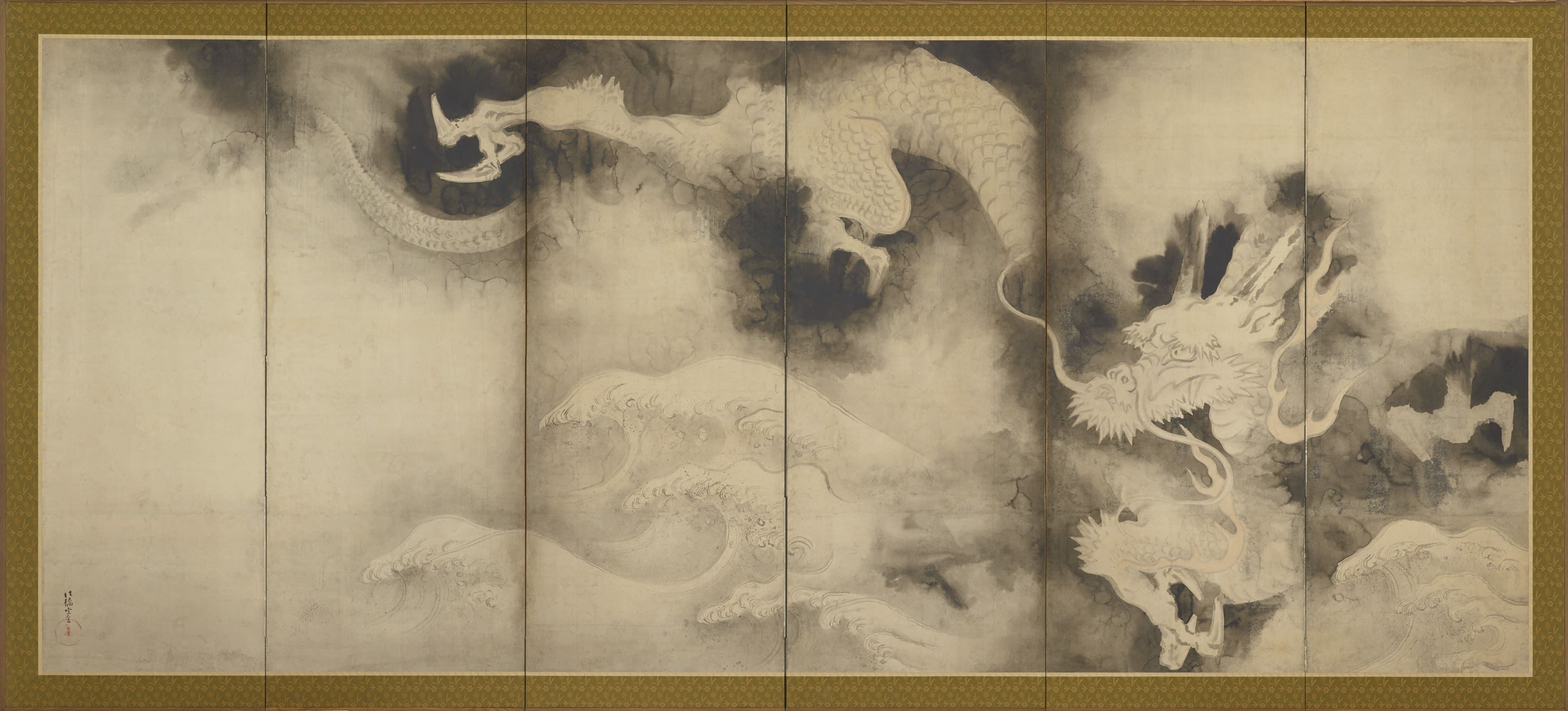

Few motifs carry as much weight in Japanese art as the dragon. It coils across temple ceilings in Kyoto, surges through ink on sixteenth-century folding screens, curls around the shoulder of a Meiji cloisonné vase, and reappears, stripped back and abstracted, in contemporary Nihonga (Japanese-style painting made with traditional mineral pigments). For collectors and designers approaching the subject from outside Japan, the dragon is often the first image that signals “this is Japanese art” — and also the one most easily misread.
The Japanese dragon, ryū (also read tatsu), is not the hoard-guarding monster of European legend. It is a benevolent water deity, a bringer of rain, a guardian of Buddhist teaching, and an emblem of ascent and transformation. Understanding that difference changes how you look at a painting, how you value it, and where you hang it.
This guide covers the origins of the dragon in Japanese art, its development across the major schools and mediums, its continuing life in Nihonga, and what the current market looks like for buyers. It closes with practical advice on scale, lighting, and conservation for anyone placing a dragon work in a home, gallery, hotel or office.
Where the Japanese Dragon Comes From
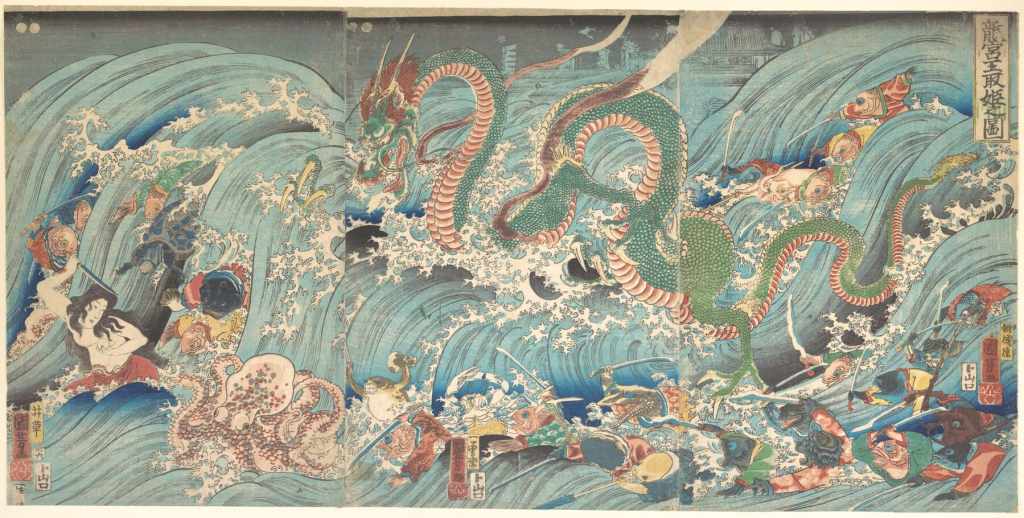
Source:The Metropolitan Museum of Art(https://www.metmuseum.org/art/collection/search/45281)
The dragon is not native to Japanese belief in its familiar serpentine form. It arrived from the Asian continent, largely through China and the Korean peninsula, alongside Buddhism in the sixth and seventh centuries, and merged with indigenous water-serpent cults already present in the archipelago. What emerged was a hybrid: a Chinese-derived body carrying Japanese meanings.
In Buddhist iconography, the dragon absorbed the role of the nāga, the serpent spirits of Indian tradition who protect the Dharma. Dragons appear among the hachibushū, the eight classes of supernatural beings who guard Buddhist law, and they are depicted attending sermons, guarding sutras, and carrying the sacred jewel, hōju, in one claw. That protective function explains why dragons are painted where they are — above the heads of assembled monks, at the threshold of sacred space.
Ryūjin and the Dragon as Water Deity
Japan’s earliest chronicles, the Kojiki (712) and Nihon Shoki (720), describe a sea deity whose undersea palace, Ryūgū-jō, later becomes firmly associated with the dragon king Ryūjin. The dragon commands tides and rainfall, and for an agricultural society dependent on monsoon rains, this was not decorative symbolism but a matter of survival.
Rain-petition rituals at temples and shrines frequently invoked dragons, and the motif remains embedded in place names, festival floats, and the roof-ridge dragons of temple architecture. Even the dragon’s association with fire prevention follows from this logic: a water deity painted on a wooden building is insurance against the flames that repeatedly destroyed Japan’s great temples.
How to Read a Japanese Dragon
Classical descriptions, inherited from Chinese sources, assemble the dragon from parts of nine creatures — the head of a camel, horns of a deer, eyes of a demon, neck of a snake, belly of a clam, scales of a carp, claws of an eagle, paws of a tiger, ears of an ox. Painters treated this as a flexible grammar rather than a checklist, but the components recur reliably enough to be useful in identification.
One convention often cited is claw count: Chinese imperial dragons generally carry five claws, Korean dragons four, and Japanese dragons three. The rule holds often enough to be a helpful first read, though exceptions are common and it should never be used alone to assign origin. Far more reliable indicators are brushwork, paper or silk type, mounting style, pigment behavior, and inscription.
Two further pairings are worth knowing. The dragon rising through clouds, unryū, signifies ascent and spiritual attainment. The dragon paired with a tiger, ryūko, sets water against wind and east against west — a cosmological balance inherited from Chinese thought and made into one of the most enduring formats in Japanese screen painting.
Dragons Through Japanese Art History
The dragon is one of the few motifs that runs unbroken from medieval Zen monasteries to contemporary studios, adapting to each era’s materials and audiences. Tracking that arc helps a buyer understand why two dragon paintings made three centuries apart can look so unalike and sit at completely different price points.
| Period | Dates | Where dragons appear |
|---|---|---|
| Asuka–Nara | 538–794 | Buddhist sculpture, temple fittings, imported continental objects |
| Heian | 794–1185 | Sutra decoration, lacquer, court textiles |
| Kamakura–Muromachi | 1185–1573 | Zen ink painting, hanging scrolls, temple ceilings |
| Momoyama–Edo | 1573–1868 | Folding screens, fusuma sliding doors, ukiyo-e prints, sword fittings |
| Meiji–Taishō | 1868–1926 | Export cloisonné, Satsuma ware, metalwork, early Nihonga |
| Shōwa to present | 1926– | Large-scale Nihonga, temple commissions, contemporary reinterpretation |
Ink Painting and the Temple Ceiling
The dragon reached its first great Japanese expression in monochrome ink, suiboku-ga, imported from Song and Yuan China and taken up by Zen monk-painters from the fourteenth century. Ink suited the subject: a dragon is mostly weather. Wet washes become cloud and mist, dry drag-strokes become scale and claw, and the creature half-emerges and half-dissolves — which is precisely the theological point.
Sesson Shūkei (c. 1504–c. 1589), working far from Kyoto in eastern Japan, produced dragon-and-tiger screens now in the Cleveland Museum of Art that show the format at full force: turbulent ink, a tiger braced against wind, a dragon boiling out of cloud on the facing screen. Tawaraya Sōtatsu, founder of what would become the Rinpa lineage, painted a pair of six-panel screens of dragons and clouds, now in the Freer Gallery of Art in Washington, in which the ink is pooled and blotted with astonishing freedom.
The most spectacular dragons, though, are overhead. Zen lecture halls, hattō, are frequently painted with a dragon on the coffered or circular ceiling, so the creature appears to rain the Dharma down on those below. Kanō Tan’yū (1602–1674) completed the ceiling dragon at Myōshin-ji in Kyoto in 1656, a vast circular composition known as the happō nirami no ryū, the dragon that glares in eight directions — its eyes appear to follow you as you cross the floor.
The tradition is still alive. Dōmoto Inshō painted the hattō ceiling dragon at Tōfuku-ji in 1934. Kayama Matazō completed a ceiling dragon for Tenryū-ji in 1997. Koizumi Junsaku painted the twin-dragon Sōryū-zu at Kennin-ji in 2002 for the temple’s 800th anniversary, and a further ceiling dragon at Kenchō-ji in Kamakura in 2003. For anyone building a reference eye, these halls are the single most efficient study trip in Japan.
The Kanō School, Rinpa and the Edo Eccentrics
Under the Momoyama warlords and then the Tokugawa shogunate, the Kanō school became the official painting academy, and dragons moved onto gold-ground screens and fusuma — the sliding paper doors that partition a Japanese interior. Here the dragon became a statement of authority in reception rooms, scaled to architecture rather than to the hand.
Against that orthodoxy, Edo-period individualists pushed the motif somewhere stranger. Soga Shōhaku (1730–1781) painted a monumental dragon in clouds across eight sliding-door panels in 1763, a work now in the Museum of Fine Arts, Boston, and conserved and re-exhibited there in the 2000s. It is deliberately excessive — a grinning, splay-clawed creature rendered in slashing ink — and it demonstrates how much room the tradition left for personality.
For buyers, this period matters because it set the formats that still circulate: the hanging scroll, kakejiku, for seasonal rotation in an alcove; the two- or six-panel folding screen, byōbu; and the fusuma panel, which is increasingly remounted and framed for Western walls.
Ukiyo-e, Tattoo and the Popular Dragon
Woodblock prints carried the dragon out of temples and castles and into the hands of Edo townspeople. Utagawa Kuniyoshi (1797–1861) is the pivotal figure: his warrior series illustrating the Chinese novel Suikoden, begun in the late 1820s, showed heroes with elaborately tattooed bodies and helped ignite a fashion for irezumi, Japanese tattooing, in which the dragon remains a central motif to this day.
Katsushika Hokusai (1760–1849) returned to dragons repeatedly, including painted works from the final year of his life in which a dragon rises through cloud past Mount Fuji. Late Hokusai dragons are among the most sought-after brush paintings in the field, and original examples are firmly in museum and top-tier private collection territory.
Prints are the accessible entry point into dragon imagery. They are also where condition and impression quality do the most work in determining value — two copies of the same design can differ in price by a factor of ten.
Meiji Export Arts: Cloisonné, Satsuma and Metalwork
After 1868, Japan’s decorative-arts workshops produced technically extraordinary objects for international exhibitions and the export market, and the dragon was a favored motif because it read as unmistakably Japanese to foreign buyers. Cloisonné, shippō, in which colored enamels are fired within wire cells, produced dragon vases of extreme refinement; work by leading ateliers commands a substantial premium over anonymous production.
Satsuma ware, with its crackled cream glaze and dense overglaze enamel and gilt decoration, includes a large body of dragon-decorated export pieces, some with raised slip modeling. Quality here ranges from museum-grade Kyoto and Yokohama studio work to mass-produced early twentieth-century wares, and the price spread reflects that. Sword fittings — tsuba guards, menuki, kozuka — and the small carved toggles known as netsuke also carry dragons in miniature, and offer a route into Japanese art for collectors with limited wall space.
The Dragon in Nihonga
Nihonga is the term coined in the Meiji period (1868–1912) to distinguish painting in traditional Japanese materials and methods from yōga, Western-style oil painting then being introduced. It is not a style so much as a material discipline, and it is the living tradition in which most contemporary Japanese dragon paintings are made.
What Nihonga Is, in Material Terms
A Nihonga painter works with iwa-enogu, mineral pigments ground from semi-precious stones and minerals — azurite for blue, gunjō; malachite for green, rokushō — sorted by particle size, since coarser grinds give deeper, more granular color and finer grinds give paler, smoother tones. Whites come from gofun, made from calcined and aged oyster shell. Blacks come from sumi, ink made from soot and animal glue.
These powders have no binder of their own. The painter mixes them with nikawa, a warm animal-hide glue, and applies them in layers to washi paper or silk, often over grounds of gold or silver leaf, kinpaku and ginpaku. The result is a surface with real physical depth: pigment sits on the support as crystalline particles that catch and scatter light rather than absorbing it the way oil paint does.
This matters for a dragon in particular. Scales rendered in coarse mineral pigment over leaf shift visibly as you move past the painting or as daylight changes through the day. A Nihonga dragon is not a fixed image; it is a surface that behaves differently at nine in the morning and at nine at night.
Modern and Contemporary Dragon Painters
The Meiji reform of Japanese painting, driven by Okakura Kakuzō and Ernest Fenollosa and realized by painters including Kanō Hōgai and Hashimoto Gahō, deliberately revisited classical subjects with new spatial and atmospheric handling. Hashimoto Gahō’s dragon-and-tiger screens of 1895, in the Seikadō Bunko Art Museum collection and designated an Important Cultural Property, are the emblematic example — the old ryūko format rebuilt with modern depth and light.
In the twentieth century, Kawabata Ryūshi (1885–1966) argued for painting scaled to public exhibition halls rather than to the intimate alcove, a shift that suits dragon subjects well and anticipates how such works are hung in contemporary architecture. The temple ceiling commissions by Dōmoto Inshō, Kayama Matazō and Koizumi Junsaku extend the same monumental line into the modern era.
Today the dragon remains active in Nihonga at every scale, from intimate scrolls to panel works several meters across. Contemporary treatments range from close study of Edo precedent to near-abstract compositions in which the dragon is implied by the movement of cloud and the placement of a single eye. For a buyer, this breadth is useful: the motif can be sourced in a register that suits a traditional tea room or a minimal, concrete-walled lobby.
The Market for Japanese Dragon Art
Dragon subjects sit slightly above comparable works in the same medium and by the same hand, because demand for the motif is broader than demand for Japanese art generally. Buyers who would not otherwise consider a Japanese painting will consider a dragon, and that widened pool shows up in the hammer price.
There is also a calendar effect. The dragon is the fifth animal of the twelve-year zodiac cycle; 2024 was a Year of the Dragon, tatsu-doshi, and the next falls in 2036. Japanese museums routinely mount New Year exhibitions built around the year’s zodiac animal, and dealer and auction supply tends to concentrate in the year preceding and the year of the dragon. Buying outside that window is often the better value play.
What Actually Drives Price
Attribution is the first driver. A documented work by a named master is in a different market from a competent anonymous Edo-period scroll, even when the anonymous work is the more striking image. Authenticated Kanō-school and named-literati works carry large premiums, and unsigned temple-workshop paintings — often very fine — do not.
Format and scale come second. A pair of six-panel screens is worth considerably more than a single screen, and pairs that have been separated lose value on both halves. Fusuma panels remounted as framed works are more saleable internationally than unmounted panels, though purists prefer original mountings retained.
Condition is third and is frequently decisive. Foxing (brown spotting), water staining, silk embrittlement, flaking mineral pigment, and old restoration all reduce value, and the cost of professional Japanese-trained conservation is high enough that a cheap damaged work is rarely a bargain. Finally, provenance — exhibition history, publication, and an inscribed storage box — can move a price by a large multiple.
Indicative Price Bands by Category
The ranges below reflect patterns observed in international Japanese art sales at houses including Christie’s, Sotheby’s and Bonhams, and Tokyo auctions such as Shinwa Auction and Mainichi Auction, roughly over 2019–2025. They are orientation figures, not appraisals; individual results vary widely with condition, attribution and provenance, and exceptional works exceed these bands substantially.
| Category | Typical range (USD) | Notes |
|---|---|---|
| Ukiyo-e dragon prints, later impressions | $300–$2,500 | Condition and impression quality dominate |
| Ukiyo-e, fine early impressions by major names | $3,000–$25,000+ | Kuniyoshi and Hokusai designs lead |
| Anonymous Edo-period ink dragon scrolls | $600–$6,000 | Often temple or workshop production |
| Signed Edo-period school paintings | $8,000–$80,000+ | Attribution documentation is critical |
| Meiji cloisonné dragon vases | $2,000–$40,000+ | Named ateliers command large premiums |
| Satsuma-style dragon wares | $300–$15,000 | Huge quality spread; studio marks matter |
| Netsuke and sword fittings with dragons | $500–$20,000+ | Carver attribution drives the top end |
| Contemporary Nihonga, emerging to mid-career | $2,000–$30,000 | Scale, leaf ground and pigment grade affect cost |
| Contemporary Nihonga, established names | $30,000–$250,000+ | Large panel works and museum-exhibited pieces |
Two practical notes. Import duties, shipping for oversized screens, and conservation-grade framing can add meaningfully to landed cost, particularly for panel works. And for works acquired in Japan, exchange-rate movement over the past several years has materially changed effective pricing for overseas buyers, which is worth confirming at the point of purchase rather than assuming.
Authentication, Condition and Provenance
Japanese paintings are typically signed with a written signature and one or more seals, rakkan, impressed in red. Seals can be researched against published compendia, but they are also the easiest element to copy, so they support rather than establish attribution.
The storage box is part of the object. A tomobako is a box made or inscribed by the artist; a hakogaki is an authenticating inscription on the box, sometimes by the artist, sometimes by a later authority such as a temple abbot or a recognized specialist. A credible box inscription with a matching work is one of the strongest signals available outside formal scholarly authentication, and boxes should never be discarded or separated.
For condition, examine the work in raking light for pigment lift and creasing, check silk for splitting along fold lines, and look for retouching where mineral pigment has been reapplied over a loss. On ceramics and cloisonné, check rims and foot for restoration under ultraviolet light. Any serious dealer will accommodate these inspections, and a clear condition report should be provided in writing before purchase.
Living With a Dragon: Scale, Light and Placement
A dragon is a directional image. It moves — ascending, coiling, emerging — and that motion determines where the work belongs in a room far more than its dimensions do. Hung badly, a dragon fights the architecture; hung well, it organizes the entire space around its trajectory.
The other governing quality is palette. Most historical dragon paintings are monochrome or near-monochrome ink, sometimes over gold or silver leaf. This makes them unusually compatible with contemporary interiors: black, warm grey and metallic neutral sit comfortably against concrete, oak, plaster, stone and linen, and they do not compete with existing color schemes the way a saturated painting does.
Residential Interiors
In a home, the natural placements are the ones that give the viewer distance and a moment of pause: the wall facing a stairway landing, the end of a hallway, above a low console in an entrance, or the long wall of a living room viewed from a seated position. Because dragon compositions usually read upward or diagonally, a vertical scroll works well in a narrow space where a horizontal painting would feel cramped.
Scale guidance is simple. A hanging scroll of roughly 180–200 cm total mounted length suits a standard wall and can be rotated seasonally, which is the traditional Japanese practice and also extends the life of the work. A two-panel screen can stand freely as a room divider or be wall-mounted; six-panel screens need around three meters of clear wall and a viewing distance of at least four meters to be seen properly.
Avoid the fireplace wall. Heat, soot and the dramatic temperature swings above a working fireplace are among the worst conditions for paper, silk and glue-bound pigment, whatever the framing.
Hospitality and Corporate Spaces
Dragon works perform well in lobbies, private dining rooms, spa reception areas, boardrooms and lift lobbies, where a single strong image has to carry a large volume and be legible at a glance from a distance. For hotels in particular, a dragon signals place and narrative immediately, which is useful in properties trying to communicate a Japanese sensibility without resorting to cliché.
For commercial installation, three factors need early attention. First, security and handling: screens and panels should be mounted on concealed cleats by an art installer, not hung from picture hooks. Second, lighting design: dragon paintings on leaf grounds respond badly to a single hot spotlight, which flattens the surface and creates glare, and far better to diffuse wall-washing at low intensity. Third, environmental control: high-traffic commercial spaces have unstable humidity, and a conservation-grade sealed frame package is usually the right answer for anything that is going to hang permanently.
Where a permanent installation is not appropriate, commissioning or acquiring contemporary Nihonga rather than an antique is often the better decision. New work in traditional materials tolerates modern conditions better, can be made to specified dimensions, and does not place an important historical object at risk.
Conservation in Occupied Rooms
Mineral pigments themselves are chemically stable — that is the great virtue of iwa-enogu, and why Nihonga colors from centuries ago retain their intensity. The vulnerability lies in the nikawa glue binder, the paper or silk support, and the mounting. All three respond to humidity, and rapid swings are more damaging than any particular steady level.
Aim for relative humidity in the range of roughly 50–60 percent and avoid placing works directly in the path of HVAC supply air. Keep light levels low for works on paper and silk — museums typically hold displayed works on paper at or below about 50 lux — and use UV-filtering glazing on framed pieces. Never hang a scroll in direct sunlight, even filtered.
Scrolls benefit from rotation: three to four months on display, then rolled and stored in their box. Roll loosely, never tightly, and let a scroll hang for a short period before and after display so it can relax and acclimatize. Traditional practice includes mushiboshi, an airing of stored works in dry autumn weather, which remains a sound habit for anyone keeping a collection at home.
Choosing a Dragon Work That Holds Up
The dragon endures in Japanese art because it is elastic. It has served as a Buddhist guardian, a rain god, a shogunal power statement, a tattoo design, an export-market showpiece, and a subject for painters working in mineral pigment today. That range is exactly what makes it a good entry point for a collection: you can buy into the motif at several thousand dollars or several hundred thousand, and in almost any medium.
The buying discipline is consistent regardless of budget. Prioritize condition over rarity, insist on written condition reporting, keep the storage box, verify attribution independently of the seal alone, and buy the version of the image that suits the wall you actually have rather than the one that photographs best. A dragon painting selected for a specific room, at the right scale and with the right light, will hold attention for decades.
If the material qualities described here — mineral pigment over leaf, ink that behaves like weather, surfaces that shift with the light in a room — are what draw you to the subject, then contemporary Nihonga is where that tradition is being continued and where works are available to view and acquire now.
Discover Nihonga for Contemporary Spaces
Shop carefully selected Nihonga,
curated by experienced Japanese art dealers
for homes and commercial spaces worldwide.