
Japandi Art
Famous Japanese Tiger Paintings: History, Masters and Value
- Famous Japanese Tiger Paintings at a Glance
- Tigers in Japanese Art: Why Japan Painted a Tiger It Had Never Seen
- Japanese Tiger Painting Masters, from Kano Screens to Nihonga
- Materials and Techniques of Japanese Tiger Painting
- Value of Japanese Tiger Paintings: Price Ranges and Authenticity
- Living with a Tiger Painting in Homes and Commercial Spaces
- Discover Nihonga for Contemporary Spaces

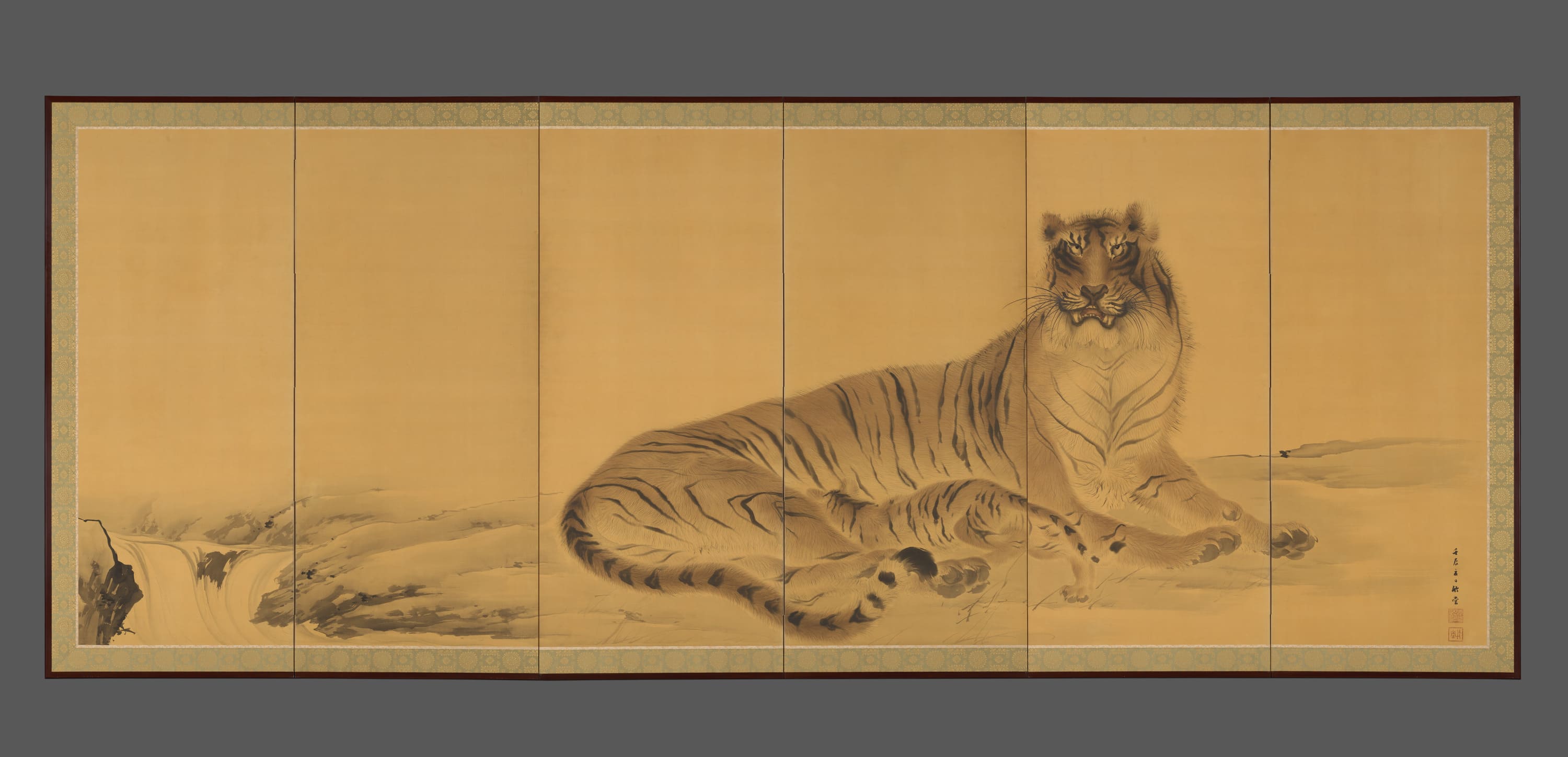
The most famous Japanese tiger paintings were made by artists who had almost never seen a tiger. Tigers are not native to the Japanese archipelago, yet from the Muromachi period onward the tiger (tora) became one of the strongest subjects in Japanese painting. The best-known works include the Dragon and Tiger screens by Hasegawa Tohaku (1606) and Sesson Shukei (about 1546-56), the Kano school tigers at Nanzenji and Nijo Castle, Ito Jakuchu’s Tiger (1755), Maruyama Okyo’s tiger paintings at Kotohiragu, and Nagasawa Rosetsu’s leaping tiger at Muryoji.
All of them draw on Chinese models, above all the Zen ink tiger of Muqi (Mokkei in Japanese). The table below lists the works with artist, period and where they are kept; the sections after it explain the history, the masters, the materials and what these paintings are worth today.
Famous Japanese Tiger Paintings at a Glance
| Work | Artist | Period | Collection |
|---|---|---|---|
| Dragon and Tiger (pair of hanging scrolls) | Muqi (Mokkei), Chinese Chan monk-painter | Southern Song, 13th century | Daitokuji, Kyoto |
| Dragon and Tiger (pair of six-panel screens, ink) | Sesson Shukei | Muromachi, about 1546-56 | Cleveland Museum of Art |
| Dragon and Tiger (pair of six-panel screens, ink on paper) | Hasegawa Tohaku | Momoyama, dated 1606 | Museum of Fine Arts, Boston |
| Tiger Drinking Water (Mizunomi no Tora), fusuma | Attributed to Kano Tanyu | Edo | Kohojo, Nanzenji, Kyoto |
| Tigers in a Bamboo Grove (Chikurin Gunko-zu), fusuma | Kano workshop under Kano Tanyu | Edo, about 1626 | Ninomaru Palace, Nijo Castle, Kyoto (originals in the castle storehouse, reproductions in the rooms) |
| Tiger (hanging scroll, color on silk) | Ito Jakuchu | Edo, 1755 | Los Angeles County Museum of Art (Etsuko and Joe Price Collection); not on public view at last check |
| Tiger Roaring and Summoning the Wind (Kosho seifu-zu) | Maruyama Okyo | Edo, 1786 | Tokyo National Museum |
| Tigers at Play (Yuko-zu), fusuma | Maruyama Okyo | Edo, 1787 | Omote Shoin, Kotohiragu, Kagawa |
| Tiger (fusuma, facing a Dragon) | Nagasawa Rosetsu | Edo, 1786 | Muryoji, Kushimoto, Wakayama (Kushimoto Okyo Rosetsu-kan) |
| Tiger in the Snow (hanging scroll) | Katsushika Hokusai | Edo, 1849 | Private collection |
The Nanzenji, Kotohiragu and Muryoji fusuma are Important Cultural Properties. Because most of these works are fixed to temple and shrine rooms or are rarely displayed, check the opening times of the temple or museum before you travel.
Tigers in Japanese Art: Why Japan Painted a Tiger It Had Never Seen
No wild tiger ever roamed Japan. Before the modern era, Japanese painters knew the animal only from imported Chinese paintings, Korean works, occasional pelts and skulls brought in by trade, and descriptions in literature. That distance explains a trait you notice quickly: many early Japanese tigers have round, almost feline faces, oversized eyes and markings stylized into bold rhythmic patterns. These are not failures of observation. The tiger worked as a symbol first and a zoological subject second, and the best Japanese tigers persuade through the energy of the brush and the drama of the pose, not anatomical accuracy.
The Earliest Tigers: Ancient Japanese Tiger Painting
The oldest tiger in Japanese painting is not a hunting scene but a guardian. In the Takamatsuzuka tomb in Asuka, Nara, built between the end of the seventh century and the beginning of the eighth, the wall paintings include the White Tiger (Byakko) of the west, one of four guardian animals borrowed from Chinese and Korean tomb art. Tigers painted as independent subjects on scrolls and screens come later, with the Zen ink painting of the Muromachi period (1336-1573).
Mokkei’s Tiger and the Chinese and Korean Models
The foundational model is Chinese. The most influential single work in Japan is the pair of hanging scrolls “Dragon and Tiger” attributed to Muqi (Mokkei in Japanese), the thirteenth-century Chan (Zen) monk-painter of the Southern Song dynasty, held at Daitokuji in Kyoto. Muqi’s crouching tiger, emerging from wind-bent bamboo in soft, graded ink, set the template for the Zen-inflected ink tiger in Japan for centuries. Tohaku’s screens carry inscriptions taken from scrolls by Muqi, which he used as a model.
Korea offered a second source. Korean painters of the Joseon dynasty treated the tiger as a guardian figure, and the folk painting genre known as minhwa produced the well-known “magpie and tiger” (kkachi horangi) image, in which a comic, wide-eyed tiger sits beneath a pine with a magpie. Trade through Tsushima and the loot brought back after Toyotomi Hideyoshi’s invasions of Korea in the 1590s helped bring Korean tiger images and pelts into Japanese hands. The legend of the general Kato Kiyomasa hunting tigers in Korea later became a favorite ukiyo-e subject.
The Dragon and the Tiger
The dragon-and-tiger pairing (ryuko) is the single most important format for the tiger in Japanese art. It comes from Chinese cosmology, in which the dragon commands clouds and water and the tiger commands the wind. A Chinese saying, known in Japanese as “ryugin sureba kumo okori, kosho sureba kaze shozu” (“when the dragon chants, clouds arise; when the tiger roars, the wind is born”), sums up the idea of complementary forces. Pairs of six-panel folding screens with a dragon on one and a tiger on the other became a standard commission for temples and warrior households.
Zen, the Zodiac and Protection
Zen painting added the monk Fenggan (Bukan in Japanese) sleeping beside a tamed tiger, often grouped with Hanshan and Shide as the “Four Sleepers,” where the tiger stands for a wild nature calmed by awakened mind. The tiger is also the third animal of the East Asian zodiac; the most recent Year of the Tiger was 2022 and the next is 2034. More generally the tiger is treated as apotropaic, warding off evil, and as a symbol of courage and military strength. These are traditional East Asian associations, not guarantees of any particular effect.
Japanese Tiger Painting Masters, from Kano Screens to Nihonga
The Japanese tiger can be followed across five centuries of schools. Each period left a recognizable type, and anyone who can recognize the type can place an unsigned or doubtfully signed work much more confidently.
Muromachi and Momoyama: Sesson and Tohaku
Among the earliest great Japanese interpretations is the pair of six-panel screens “Dragon and Tiger” by Sesson Shukei, the sixteenth-century ink painter from eastern Japan, now in the Cleveland Museum of Art. The museum dates the pair to about 1546-56 and considers it Sesson’s masterpiece. His tiger, braced against a gale in a bamboo grove whipped by wind, turns Muqi’s quiet menace into full dramatic motion.
Hasegawa Tohaku, one of the defining painters of the Momoyama period (1573-1615), painted a pair of “Dragon and Tiger” screens dated 1606, now in the Museum of Fine Arts, Boston. They show how the Chinese Zen model was scaled up to architectural size for Japanese interiors. Kaiho Yusho, known above all for his monumental ink dragons at Kenninji in Kyoto, worked in the same broad ink idiom.
The Kano Tiger: Power on Gold
The Kano school, the hereditary painting academy that served shoguns and daimyo from the fifteenth to the nineteenth century, created the tiger most people picture: a striped, muscular animal striding through bamboo on a shimmering gold-leaf ground. At Nanzenji in Kyoto the fusuma (sliding door) paintings of the Small Abbot’s Quarters (Kohojo) include the celebrated “Tiger Drinking Water,” traditionally attributed to Kano Tanyu.
At Nijo Castle in Kyoto, the Tozamurai reception rooms of the Ninomaru Palace are decorated with “Tigers in a Bamboo Grove,” painted by the Kano workshop around 1626 under Tanyu’s direction. Several of these animals are leopards, which painters of the time took to be female tigers. Because the tigers were meant to intimidate visitors waiting for an audience with the shogun, the Nijo paintings are among the clearest examples of the tiger as an image of political power. Later Kano painters kept making tigers in scroll and screen formats, and many anonymous Kano-style tigers survive.
Kyoto Individualists: Jakuchu, Shohaku, Okyo and Rosetsu
Eighteenth-century Kyoto produced the most original tigers in Japanese art. Ito Jakuchu’s hanging scroll “Tiger,” dated 1755, shows a stylized tiger with enormous eyes, small ears and massive paws. Jakuchu’s own inscription says that, because there are no ferocious tigers in Japan, he imitated a painting by the Southern Song artist Mao Yi. The scroll, long a highlight of the Etsuko and Joe Price collection, is now at the Los Angeles County Museum of Art.
Soga Shohaku, the eccentric who proclaimed himself heir to the Muromachi Soga school, painted tigers and dragons in wild, splashing ink. His tigers are more caricature than portrait, and genuine Shohaku paintings are scarce and often imitated.
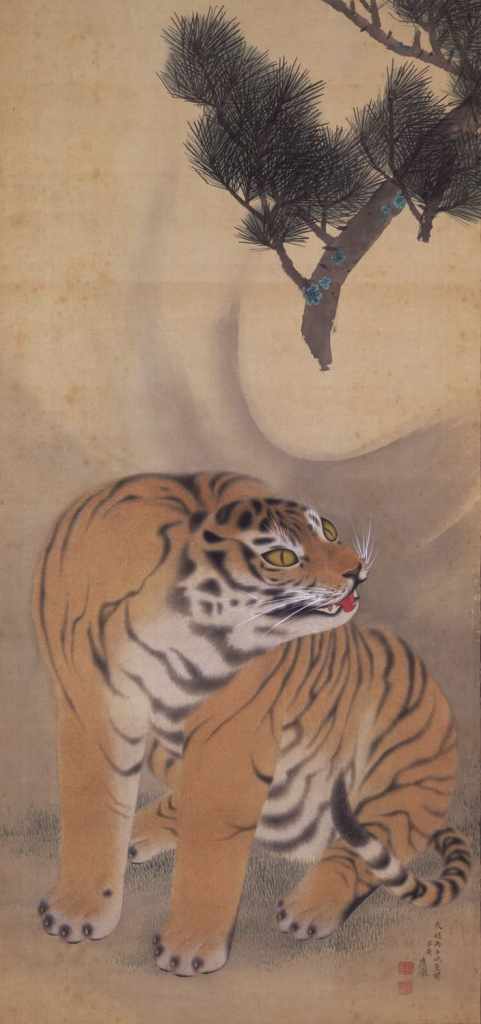
Maruyama Okyo, founder of the Maruyama school and pioneer of painting from direct observation (shasei), brought a new naturalism to the tiger by studying pelts and domestic cats. His most famous tiger program is at Kotohiragu, the Shinto shrine in Kagawa Prefecture, where the Omote Shoin hall contains the “Room of Tigers” with the fusuma cycle “Tigers at Play,” painted in 1787 and designated an Important Cultural Property. Okyo’s tigers are soft-furred and wide-eyed, with a slightly domestic charm.
Okyo’s pupil Nagasawa Rosetsu painted what many consider the most thrilling tiger in Japanese art. In 1786 Rosetsu traveled to the Kii Peninsula on Okyo’s behalf and painted fusuma for Muryoji, a Zen temple in Kushimoto, Wakayama Prefecture. His “Tiger” leaps forward across the sliding doors in a few sweeping ink strokes, facing a “Dragon” on the opposing doors. The panels are Important Cultural Properties, and the temple’s museum, the Kushimoto Okyo Rosetsu-kan, keeps them. A popular interpretation holds that the tiger is really a cat stalking a fish painted in an adjoining room, which gives the work a witty double reading.
Kishi Ganku and the Kishi School
No name is more closely tied to the Japanese tiger on the market than Kishi Ganku (1749 or 1756 to 1838), founder of the Kishi school in Kyoto. Ganku reportedly obtained a tiger skull and paws, and possibly a pelt, which he used to build a more convincing anatomy than earlier painters could manage. His tigers are dense, furry and heavy-bodied, with an intense stare, and “Ganku’s tiger” (Ganku no tora) became a byword. The school carried the subject through the nineteenth century with Kishi Gantai, Kishi Renzan and Kishi Chikudo (1826-1897). The Kishi school is the most accessible entry point to high-quality Edo and early Meiji tiger painting, and also where authenticity questions are most common.
Ukiyo-e Tigers: Kuniyoshi and Hokusai
Ukiyo-e, the woodblock prints and paintings of Edo-period urban culture, used the tiger mostly in heroic narrative. Utagawa Kuniyoshi, the great designer of warrior prints (musha-e), produced vivid images of Watonai (the hero Coxinga of Chikamatsu’s play “The Battles of Coxinga”) wrestling a tiger, and of Kato Kiyomasa confronting tigers in Korea.
Katsushika Hokusai returned to the tiger at the very end of his life. His hanging scroll “Tiger in the Snow,” painted in 1849, the year of his death at about age 89, shows a tiger gazing up into falling snow and is widely read as a meditation on old age. It is in a private collection.
Meiji, Taisho and Modern Nihonga Tigers
After Japan opened to the West, painters could finally see live tigers in traveling menageries and, from 1882, at Ueno Zoo in Tokyo. The Nihonga movement, which modernized Japanese painting while keeping traditional materials, produced a new, observed tiger. Ohashi Suiseki (1865-1945) of Ogaki became famous as a tiger specialist, and “Suiseki’s tiger” is still a recognized market category in Japan. Takeuchi Seiho, the leading Kyoto Nihonga painter of the Meiji and Taisho eras, combined Maruyama-Shijo brushwork with Western observation in his animal subjects, and his pupil Hashimoto Kansetsu also painted animals with great refinement. Nihonga painters continue to take on the tiger today, often around zodiac years, using mineral pigments, gold and silver leaf, and large-format panels.
Materials and Techniques of Japanese Tiger Painting
The base medium of most Japanese tigers is sumi, ink made from soot and animal glue, ground on an inkstone and diluted to give everything from velvety black to the palest gray. Fur is built with fine, repeated strokes known as kegaki (literally “hair drawing”), laid so that the coat looks soft yet volumetric. The strength of a tiger’s kegaki is one of the fastest ways to judge the hand behind it.
Color comes from gofun, a white pigment made from ground oyster or scallop shell used for whiskers, highlights and teeth, and from iwa-enogu, mineral pigments ground from stones such as azurite and malachite and bound with animal glue (nikawa). Kano and later decorative tigers often sit on grounds of gold leaf (kinpaku). Paintings are made on silk (kinu), which gives fine detail but is fragile, or on washi, Japanese paper made from mulberry fiber, which absorbs ink more dramatically.
Formats matter as much as media. The kakejiku (hanging scroll) is rolled for storage and shown seasonally. The byobu (folding screen), usually in pairs of six panels, is the classic ryuko format. Fusuma are architectural and rarely come to market except as panels remounted as screens or framed works.
Value of Japanese Tiger Paintings: Price Ranges and Authenticity
A tiger painting’s value depends on who made it, what it is made of, how it has survived and how well its history is documented. The table gives rough orientation bands for auction results, not valuations; exact figures for any work must be checked against the relevant sale record.
| Category | Typical range (USD) | Notes |
|---|---|---|
| Ukiyo-e tiger prints (Kuniyoshi, Meiji printmakers) | $300-$5,000 | Triptychs, early impressions and good color command the top of the range |
| Anonymous or workshop Kano-style and Kishi-style scrolls | $500-$5,000 | Heavily dependent on condition and painting quality |
| Attributed Kishi school scrolls (Gantai, Renzan, Chikudo) | $2,000-$25,000 | Documented works with strong kegaki sit at the top |
| Authenticated Kishi Ganku tigers | $10,000-$100,000+ | Authentication and hakogaki are critical |
| Meiji-Taisho Nihonga tigers (Suiseki, Seiho circle) | $3,000-$60,000 | Seiho and exhibition works achieve premiums |
| Authenticated Okyo, Shohaku, Rosetsu, Jakuchu tigers | $50,000 to seven figures | Extremely rare at auction; museum-level competition |
| Contemporary Nihonga tigers by living painters | $2,000-$40,000 | Driven by the painter’s exhibition record and scale |
The market has a broad, accessible base of school works and prints and a very thin top of fully authenticated masterpieces. For a buyer furnishing a space, the best value usually lies in well-preserved, attributed Kishi school and Meiji-Taisho Nihonga works, and in contemporary Nihonga by painters with a real exhibition record.
What Moves the Price
Attribution is the dominant factor. A painting catalogued as “by” an artist sells for several times the price of one catalogued as “attributed to” or “school of.” After attribution come the signature and seals, which should be consistent with the artist’s documented period, then format and scale: intact pairs of screens and large, well-composed scrolls fetch more than small or cropped works. Within the genre, a full-bodied tiger in a dynamic pose or a dragon-and-tiger pair usually sells better than a simple head study. Collectors often pay a premium for an intact pair over a separated half.
Hakogaki and Provenance
Japanese paintings are traditionally stored in a wooden box (tomobako), and an inscription on the box (hakogaki) by the artist, the artist’s heir or a recognized authority can greatly support an attribution. Authentication certificates from recognized bodies and appraisals by specialist dealers or scholars are especially important for Ganku, Okyo and Jakuchu. A published collection, a documented exhibition or an old temple or daimyo family origin adds value and reassurance.
Authenticity and Condition
Kishi Ganku’s tigers were copied heavily in his lifetime and afterward, and many “Ganku” tigers on the market are school works, later copies or outright forgeries with added signatures. The same is true, at a higher level, for Okyo, Jakuchu and Shohaku. Warning signs include fur that is mechanically uniform rather than rhythmic, seals that do not match documented examples, and a mismatch between the silk’s age and the claimed date. When a price looks too good for a famous name, the attribution is usually the reason.
Condition problems specific to tiger paintings include abrasion and splitting of silk, especially along the horizontal creases of hanging scrolls; foxing (brown spots from mold and oxidation); flaking of gofun and mineral pigments; and fading of organic colorants. Remounting (soko) by a trained Japanese mounter can stabilize a scroll, but it costs money and should be priced into any purchase. A well-mounted, stable scroll by a lesser hand is often a better purchase for a lived-in space than a fragile, damaged work by a famous name.
Living with a Tiger Painting in Homes and Commercial Spaces
A tiger takes over a room in a way few subjects do. Its gaze, bold markings and associations with protection and strength give it a presence that can be used deliberately, as long as scale, placement and conservation are handled with care.
In a residential entryway (genkan), a single hanging scroll of a seated or watchful tiger fits the traditional role of the tiger as guardian without overwhelming a narrow space. In living rooms, a vertical scroll about 50 to 60 centimeters wide or a pair of two-panel screens works above a low console or in a tokonoma-style alcove. Ink tigers suit minimalist and neutral palettes; gold-ground tigers bring warmth and reflect light in darker spaces. In hotel lobbies, restaurants and reception areas, scale decides: a six-panel screen, a large framed Nihonga panel or a dragon-and-tiger pair reads clearly from across the room. Pairing a tiger with a dragon completes the ryuko balance and suits symmetrical walls or twin entrance doors.
Tone matters too. A snarling Kishi-school tiger suits a dramatic bar or a private study better than a child’s room, while Okyo-style tigers and many modern Nihonga tigers carry a gentler mood that suits family homes and hospitality spaces.
Silk, paper, ink and organic pigments are light-sensitive. Museums keep such works in low, controlled light and stable, moderate humidity, with exact targets varying by institution. At home the principles carry over: avoid direct sunlight, use low-intensity UV-filtered LED lighting, keep scrolls away from air-conditioning vents, kitchens, fireplaces and exterior doors, and avoid sharp swings in humidity, which crack silk and paper. Rotation, the traditional Japanese practice of changing scrolls with the seasons, is also the best conservation strategy: show a tiger scroll for a few months, then roll it in its box while another work takes its place. For commercial spaces with long lighting hours, framed contemporary Nihonga panels behind UV-filtering glazing are often the most durable choice.
From Muqi’s Zen tiger at Daitokuji to Rosetsu’s leaping tiger at Muryoji and today’s Nihonga panels, the tiger in Japanese art has always been meant to change how people feel when they enter a space. Choosing a tiger, or any Nihonga work, for a real room means weighing the same things these painters did: scale, light, mood and the lasting quality of the materials.
Discover Nihonga for Contemporary Spaces
Shop carefully selected Nihonga,
curated by experienced Japanese art dealers
for homes and commercial spaces worldwide.