
Japandi Art
Kintsugi: The Japanese Art of Fixing Broken Pottery
- Kintsugi at a Glance: Fixing Broken Pottery the Japanese Way
- What Is Kintsugi? The Art of Golden Repair
- A Short History: From Lacquer Repair to the Tea Room
- How Kintsugi Is Made: Urushi, Lacquer and Gold
- Real Urushi Kintsugi vs Epoxy Kits: Which Is Which?
- How Much Does Kintsugi Cost, and Is a Mended Piece Worth Money?
- Living With Kintsugi: Display and Care at Home
- Discover Nihonga for Contemporary Spaces
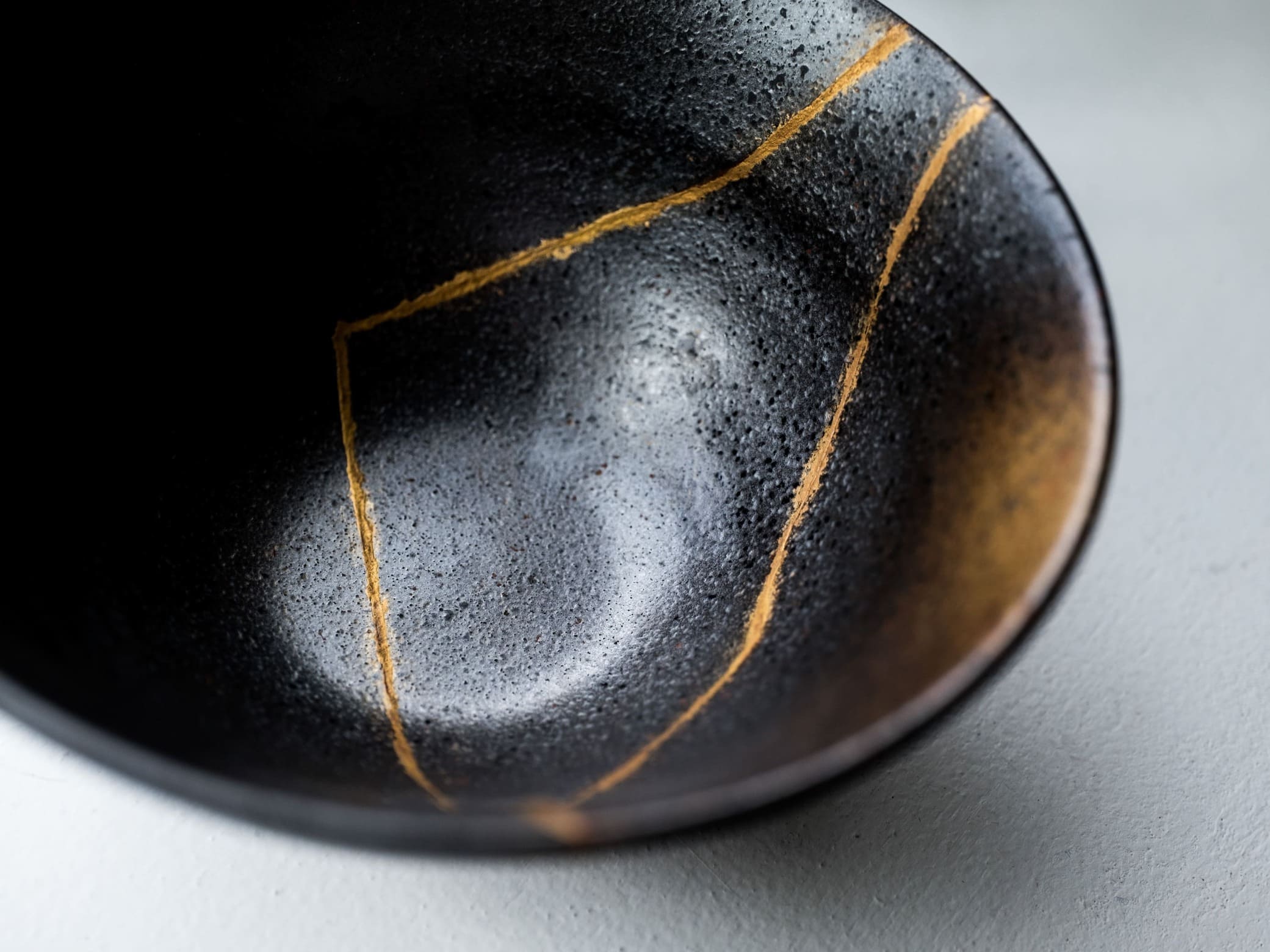
The Japanese art of fixing broken pottery is called kintsugi (金継ぎ, literally “golden joinery”). A cracked, chipped or shattered bowl is glued back together with urushi, the natural lacquer of the lacquer tree, and the seams are dusted with powdered gold so that the repair stays visible. It is also called kintsukuroi (金繕い, “golden repair”), and it is the answer to searches such as “Japanese art of repairing broken pottery” or “Japanese art of fixing broken things.”
This guide covers what kintsugi is, which kinds of damage it repairs, where it came from, how it is made, how real urushi work differs from the epoxy kits sold online, what a repair costs, and whether a mended piece is worth money. It also shows how a gold-seamed bowl looks and lasts in a real home.
Kintsugi at a Glance: Fixing Broken Pottery the Japanese Way
| Question | Short answer |
|---|---|
| What is it called? | Kintsugi (金継ぎ), also kintsukuroi (金繕い); with silver, gintsugi |
| What holds the pieces together? | Urushi lacquer mixed with wheat flour (mugi-urushi), not a modern glue |
| What is the gold for? | Decoration only, applied last over the cured lacquer seam |
| How long does a repair take? | Weeks to a few months, because urushi cures in humid air, not by drying |
| Can it be used for food? | Fully cured urushi is traditionally used on tea and food vessels; most epoxy kits are not |
| Does it add value? | Rarely money; often meaning. It can be neutral or admired on tea ware and hurts export porcelain |
What Is Kintsugi? The Art of Golden Repair
Kintsugi rejoins broken ceramic with a natural lacquer adhesive and then highlights the mended seams with powdered precious metal, most often gold. Rather than disguising the damage, it draws attention to it, so the network of repaired cracks becomes part of the object’s appearance.
Kintsugi, Kintsukuroi and the Vocabulary of Repair
The craft has more than one name. Kintsugi joins kin (gold) with tsugi (joinery); the near-synonym kintsukuroi (金繕い) is also widely used. When silver is the finishing metal the work is called gintsugi (銀継ぎ), and when the seam is finished in plain black or red lacquer with no metal it may be called urushitsugi. These are variations on one idea, not separate crafts, and the terms vary from studio to studio.
The key word is urushi (漆), the refined sap of the lacquer tree, Toxicodendron vernicifluum. It has been used in Japan as an adhesive and coating for thousands of years, and when cured it becomes a hard, waterproof, very durable material. Genuine kintsugi is, at root, a lacquer art: the structural work is all urushi, and the gold is a thin decorative skin added at the end.
Cracked, Chipped or Broken: Types of Damage and Repair
Japanese restorers sort damage into three kinds, and each calls for a different approach. Hibi (ひび) is a hairline crack, kake (欠け) is a chip or small loss, and ware (割れ) is a full break into pieces. If you are looking at cracked Japanese pottery of your own, these are the words a restorer will use. Two more terms describe where the replacement material comes from.
| Term | Meaning | Typical treatment |
|---|---|---|
| Hibi (ひび) | Hairline crack | Thin urushi drawn into the crack, then a fine gold line |
| Kake (欠け) | Chip or small loss | Filled with sabi-urushi (or kokuso for deep losses), shaped, then gilded |
| Ware (割れ) | Break into fragments | Joined with mugi-urushi, seams filled and gilded |
| Tomotsugi (共継ぎ) | Repair using the vessel’s own fragments | Standard reassembly; the repair may be gilded or kept discreet |
| Yobitsugi (呼び継ぎ) | Repair using a fragment from a different vessel | A foreign shard is shaped to fit the loss, producing a patchwork effect |
Yobitsugi (“calling-in joinery”) is the most visually striking form. A missing section of one bowl is replaced with a deliberately mismatched fragment of another, for example blue-and-white porcelain set into a stoneware bowl, and the gold seam outlines the join. Collectors prize a well-matched yobitsugi piece as a small, deliberate collage.
Is Kintsugi the Only Japanese Way to Repair Broken Pottery?
No. Kintsugi is the best known, but Japanese pottery has been repaired in other ways too. Metal staples (kasugai, 鎹) were used on prized wares, and the most famous example is the Bakohan bowl described below. Urushi-only repairs, finished in black or red lacquer without gold, are very common on everyday antique wares. In Japan a cheaper hobby product called shin-urushi (“new urushi”), a synthetic lacquer-like paint, is also sold for home repairs. It is easier to use than real urushi but it is not the natural material.
Wabi-Sabi and Mottainai: The Ideas Behind the Gold
Kintsugi is usually discussed alongside two Japanese ideas. Wabi-sabi (侘寂) finds beauty in the modest, weathered and incomplete, and was central to the tea master Sen no Rikyu’s style of tea. Mottainai (もったいない) expresses regret at waste and respect for keeping useful things in service. Both help explain why a repair is shown rather than hidden.
One caution: the popular idea that kintsugi was a philosophy of “embracing brokenness” is largely a modern interpretation. For historic tea practitioners the motives were practical and connoisseurial: a precious object was saved, and its history became part of its identity.
A Short History: From Lacquer Repair to the Tea Room
Repairing pottery with lacquer is far older than the gilded craft we now recognize. Archaeological finds show Japanese artisans using urushi to mend ceramics thousands of years ago. What changed in the Muromachi period (1336–1573) was the decision to make the repair beautiful and to value the result.
The Bakohan Bowl and the Yoshimasa Legend
The most repeated origin story centers on Ashikaga Yoshimasa (1436–1490), the eighth shogun of the Muromachi period. According to the tale, Yoshimasa cracked a treasured Chinese tea bowl and sent it to China for a replacement; it came back clamped together with metal staples. Dissatisfied, he is said to have asked Japanese craftsmen for something more elegant, and kintsugi was born.
It is a good story and should be handled with care. The bowl appears to survive: a Longquan celadon tea bowl of the Southern Song dynasty (12th to 13th century), nicknamed Bakohan (馬蝗絆), roughly “locust clamp,” after the metal braces that hold it. It is in the Tokyo National Museum and is designated an Important Cultural Property. Crucially, the surviving bowl was repaired with metal staples, not gold lacquer, which is why specialists treat the gold-repair origin as legend and not documented fact. No period source ties Yoshimasa to the invention of kintsugi.
The bowl still matters. It shows that Japanese taste had learned to see a visible mend as something that could add to a piece. The staples became part of the bowl’s fame, which is the same attitude that later made gold seams desirable.
Kintsugi and the Culture of Chanoyu
What is well established is that kintsugi grew up alongside chanoyu (茶の湯), the tea ceremony, which flourished from the 15th and 16th centuries. Tea practice prized humble, irregular wares, from Korean Ido bowls to Japanese Shino, Oribe, Seto, Karatsu and hand-built Raku, and it placed great value on the individual chawan (茶碗, tea bowl). Tea masters such as Sen no Rikyu (1522–1591) and Furuta Oribe (1544–1615) favored rustic, asymmetrical pieces. In that setting a crack or firing flaw could be read as character, and a cracked bowl with a famous owner was not something anyone threw away.
A well-known anecdote tells how the Ido bowl named Tsutsuizutsu (筒井筒) was broken into five pieces in front of Toyotomi Hideyoshi, and how the poet-general Hosokawa Yusai calmed him with a verse adapted from The Tales of Ise. The bowl was repaired and kept its name. Like the Yoshimasa story, the anecdote comes from later tea literature, so it shows how the tea world valued mended bowls rather than recording an exact event. The same culture produced the joke that collectors were occasionally suspected of breaking sound pots on purpose to have them returned with gold seams.
Seppo: The Tea Bowl That Turned a Crack into a Mountain
The most famous gold-repaired work in Japan is probably Seppo (雪峯, “Snowy Peak”), a red Raku tea bowl by Hon’ami Koetsu (1558–1637), made in the early Edo period and designated an Important Cultural Property. It is in the Hatakeyama Memorial Museum of Fine Art in Tokyo. Large cracks that opened in the kiln were filled with gold lacquer, and together with the white glaze running down from the rim they suggest snow on a mountain. The name makes the point: the repair is part of the image.
Koetsu was also a calligrapher and lacquer designer, and with the painter Tawaraya Sotatsu he is traditionally counted as a founder of the Rinpa school of decorative painting. The man who made a gilded crack famous also helped shape the gold-ground look of Japanese painting, a link taken up at the end of this guide. For a scholarly study in English, see the 2008 catalogue Flickwerk: The Aesthetics of Mended Japanese Ceramics, published with the Herbert F. Johnson Museum of Art at Cornell University and the Museum fur Lackkunst in Munster.
How Kintsugi Is Made: Urushi, Lacquer and Gold

Authentic kintsugi is slow, technical and almost entirely dependent on natural materials. Understanding the process is the best way to tell genuine work from the quick imitations sold in craft shops, because the two look alike at first and behave very differently over time.
The Core Materials
At the heart of the craft is raw lacquer, but a practitioner works with several lacquer-based preparations, each suited to a different stage of the repair.
| Material | What it is | Role in the repair |
|---|---|---|
| Ki-urushi (raw lacquer) | Filtered sap of the urushi tree | The base ingredient for adhesives, fillers and finishing coats |
| Mugi-urushi (麦漆) | Raw lacquer kneaded with wheat flour and water | A strong glue that bonds fragments back together |
| Sabi-urushi (錆漆) | Raw lacquer mixed with fine clay or stone powder (tonoko) and water | A smooth paste that fills small chips and levels seams |
| Kokuso (刻苧) | Lacquer thickened with wood powder and fibers | A bulky filler for larger missing sections |
| Bengara-urushi | Urushi colored with red iron oxide | A red ground painted on the seam; it makes the line easier to see and deepens the gold on top |
| Metal powders | Gold, silver or platinum | The final decorative finish dusted onto the seam |
| Muro (室) or urushi-buro (漆風呂) | A humid cabinet or box | Where the piece rests while the lacquer hardens |
The Repair Process and the Muro
A traditional repair proceeds in stages, each separated by a hardening period. Fragments are cleaned and rejoined with mugi-urushi; chips and gaps are filled with sabi-urushi or, for larger losses, kokuso; the built-up area is smoothed and sealed with refined lacquer; and finally, while the last lacquer layer is still tacky, the metal powder is dusted on and later burnished.
The detail that surprises most newcomers is how urushi sets. It does not dry by evaporation; it hardens by taking up moisture from the air, which is why each layer rests in a muro kept humid, commonly cited at around 70 to 80 percent and at about 20 to 25°C. A professional repair of a broken bowl therefore takes weeks, and complex commissions commonly run one to three months from start to finish, although the hands-on work adds up to only a few hours. It is slow work by chemistry, not by inefficiency.
A safety note: uncured urushi is a strong skin irritant. Its active compound, urushiol, is related to the one in poison ivy, and beginners often get a contact rash. Fully cured lacquer is inert and is considered safe to handle.
Gold Powders: Keshifun and Marufun
The gold stage borrows from maki-e (蒔絵, “sprinkled picture”), the lacquer technique of sprinkling metal powder into wet urushi. Two grades dominate. Keshifun (消粉) is an extremely fine, flake-like powder dusted onto nearly dry lacquer. It gives a soft matte-to-satin glow and uses very little gold, but the layer is thin and can wear with frequent handling. Marufun (丸粉) is made of rounded gold particles in graded sizes. It is set into the lacquer, usually fixed with a further coat, and then polished. It is brighter, harder-wearing and much more expensive, and it is the usual choice for high-end restoration and for vessels in regular use.
Real Urushi Kintsugi vs Epoxy Kits: Which Is Which?
The popularity of kintsugi has created a large market for quick “kintsugi kits” that use epoxy resin and mica or brass powder. They can look good in photographs, but they are a different thing, and collectors and buyers should not confuse the two.
| Feature | Traditional urushi kintsugi | Epoxy or synthetic “kintsugi” |
|---|---|---|
| Adhesive | Mugi-urushi (wheat flour and natural lacquer) | Two-part epoxy or cyanoacrylate glue |
| Filler | Sabi-urushi, kokuso | Epoxy putty |
| Metal | Real gold or silver powder | Usually mica, brass or a gold-colored pigment |
| Working time | Weeks to months, humid curing | Hours to a day |
| Food contact | Traditionally used on tea and food vessels once fully cured | Depends on the product; many kits are not rated for food use, so treat the piece as display only |
| Ageing | Gold wears gradually; the lacquer is stable | Brass-based powders can tarnish or darken; some resins yellow |
How to Tell Them Apart
Look at the color and the edges first. Real gold over urushi has a warm, even glow and does not tarnish. Brass-based “gold” can go brown or greenish where it is touched often. Urushi seams usually have a slightly raised, gently rounded profile and a clean edge, while epoxy repairs often show glue spreading beyond the join or a glassy, plastic sheen.
For a valuable piece, ask for documentation. A reputable restorer will say which gold was used, whether the adhesive was mugi-urushi and how long the piece was cured. Auction catalogues often say only “gold lacquer repair,” which does not tell you the age or materials of the repair.
Should You Add Gold Repair to an Antique?
Western museum conservation prefers repairs that are minimal, reversible and clearly distinguishable from the original. Kintsugi meets the third test but not really the first two: cured urushi is hard to remove and gilding is an addition, not a neutral stabilization. Many conservators therefore avoid applying new kintsugi to historic objects, while carefully preserving old kintsugi as part of the object’s history. The practical rule for collectors is to take advice before adding gold to an important antique, especially Chinese porcelain or export ware.
How Much Does Kintsugi Cost, and Is a Mended Piece Worth Money?
Two separate questions sit behind a search such as “money ceramic mend”: what it costs to have a piece repaired, and whether the repair changes what the piece is worth.
Repair Costs and Commissioning
Pricing depends on the complexity of the damage, the metal used and whether the studio works in traditional urushi or a simpler method. Few studios publish full price lists, so the table shows the published figures that could be found and marks the rest as quoted case by case. Dollar figures are approximate and move with the exchange rate.
| Type of work | Published starting price | Notes |
|---|---|---|
| Small chip (up to about 0.5 cm) | From ¥3,300 (about $22) | One Japanese studio’s price list; chips up to about 1 cm start at ¥4,400 and up to about 2 cm at ¥5,500, with the price rising with the number of chips |
| Crack or multi-piece break | By quotation | Depends on seam length and the number of fragments; send photos for an estimate |
| Complex break, yobitsugi or important antique | By quotation | Marufun gold and heirloom work cost considerably more |
| Studio in the United States (one published listing) | $100 for a simple glue-and-brass repair; $180 with lacquer; $280 for traditional kintsugi | The $100 option is not recommended for items that touch food |
Whatever the studio, ask for a written quote that states urushi (not synthetic lacquer), the type of gold powder and the expected waiting time. Studios using real urushi often quote several months (one UK studio lists 8 to 16 weeks), which is normal.
Two adjacent markets are worth knowing. Beginner kits in Japan are commonly sold from about ¥4,000 to ¥10,000, but many starter kits use a synthetic lacquer-like paint, so check whether a kit contains real urushi; sets with real urushi and real gold or silver powder cost considerably more. Hands-on workshops, where you repair a piece yourself, are listed from about ¥15,000 per person in Osaka and ¥22,000 in Tokyo, and private sessions cost more (¥55,000 in one Kyoto listing). Prices change, so check the operator before booking.
Does Kintsugi Add Value?
For most household ceramics, kintsugi adds meaning rather than money. A skilled repair can easily cost more than the open-market price of the bowl it saves, and people commission it anyway because the object matters to them. Gold repair almost never makes a damaged object worth more than an intact example of the same piece.
For historically significant wares the picture shifts. In tea ceramics from the Momoyama and early Edo periods, such as Karatsu, Shino, Oribe, Seto, Hagi and Raku bowls and Korean Ido bowls, a repair is expected and often admired. A well-documented old gold repair can be neutral or part of the object’s identity, as the staple-mended Bakohan and Koetsu’s Seppo show. The value drivers there are the maker or kiln, the period, a poetic name (mei), signed storage boxes (tomobako) and a record of past owners.
For porcelain made for export, imperial Chinese wares and most decorative ceramics, any repair counts as damage, and new gold seams may simply read as a flaw. Judge each piece on its own terms: the quality of the original ceramic, the skill of the repair and how well the two work together.
Living With Kintsugi: Display and Care at Home
What makes kintsugi so adaptable to contemporary spaces is the quality of its gold. A hand-laid metal seam catches and moves with the light, so one repaired bowl can act as a small focal point on a quiet shelf, console or dining table. Against the neutral palettes and natural materials of modern interiors, gold-veined ceramic reads as warm and deliberate rather than ornate.
Gold looks warmest under warm-white light, around 2700–3000K, where it takes on the glow it would have had by lamp light in a tea room; under cool daylight LEDs it can look flat or brassy. Scale and placement reward a little thought. A small mended chawan invites close looking in an entry niche, reading corner or tea station, while a larger vessel can anchor a sideboard or reception desk. The model is the tokonoma (床の間), the display alcove of a traditional Japanese room: one object, plenty of empty space.
Conservation is straightforward. Even food-safe urushi repairs dislike dishwashers, microwaves, abrasive scrubbing and long soaking; hand wash in lukewarm water and dry gently. Keep pieces out of harsh, sustained direct sunlight and away from radiators and air-conditioning vents. In commercial spaces the biggest risk is handling, so use a case or a discreet mount and give staff simple instructions: soft dry cloths only, no chemical cleaners on gold seams.
That same sensibility, natural materials, hand-worked gold and beauty that deepens with time, runs well beyond ceramics. It is the connective tissue between kintsugi and Nihonga (日本画, Japanese-style painting), which builds its surfaces from iwa-enogu (岩絵具, mineral pigments ground from stone) and gold leaf (kinpaku, 金箔) or gold paint (kindei, 金泥). The Rinpa tradition that traces back to Hon’ami Koetsu and Tawaraya Sotatsu used gold as expressive space, the same sensibility that reads a golden crack as a mountain peak. For anyone drawn to the gold seam of a repaired bowl, the painted gold of a Nihonga panel is a natural next step in the same visual language.
Discover Nihonga for Contemporary Spaces
Shop carefully selected Nihonga,
curated by experienced Japanese art dealers
for homes and commercial spaces worldwide.