
Japandi Art
Japanese Art Pieces: A Collector’s Guide to Buying Well
- What Counts as a Japanese Art Piece?
- Nihonga Explained: The Material Logic Behind the Surface
- What Actually Drives the Value of Japanese Art Pieces
- Choosing Japanese Art Pieces for Homes and Commercial Spaces
- Buying, Importing, and Living With the Work
- Building a Collection That Holds Up
- Discover Nihonga for Contemporary Spaces
Search for Japanese art pieces and you will be handed everything from a mass-produced woodblock reproduction to a National Treasure screen that will never legally leave Japan. The category is enormous, the vocabulary is unfamiliar, and the price spread inside a single genre can be four orders of magnitude. That combination makes the field feel opaque to buyers who are otherwise confident in Western art.
It is not opaque once you understand three things: what the main categories actually are, what the market pays for inside each one, and how the physical object behaves in a real room. Japanese art was largely made for architecture — for alcoves, sliding partitions, low sightlines, and filtered light — and that history still governs how the work reads on a wall in London, Los Angeles, or Singapore.
This guide covers the major genres, the material logic of Nihonga (Japanese-style painting made with mineral pigments and animal-glue binder), the specific factors that move price, realistic budget bands, and the practical questions that come up when a work is destined for a residence, a hotel lobby, or a boardroom. Figures are given in USD with JPY where useful, and are drawn from published auction results and observed dealer ranges rather than estimates.
What Counts as a Japanese Art Piece?
The phrase covers at least four distinct markets that rarely overlap in terms of buyers, pricing logic, or conservation needs. Treating them as one category is the single most common mistake new collectors make. A Muromachi-period ink painting and a Yoshitomo Nara drawing are both Japanese art pieces; almost nothing else about acquiring them is similar.
It helps to fix the period vocabulary first, because dealers and catalogues use era names rather than centuries. The Edo period runs 1603–1868, Meiji 1868–1912, Taishō 1912–1926, Shōwa 1926–1989, Heisei 1989–2019, and Reiwa from 2019. A dealer describing a work as “late Edo” is placing it roughly in the first two-thirds of the nineteenth century.
Painting Formats: Scrolls, Screens, and Panels
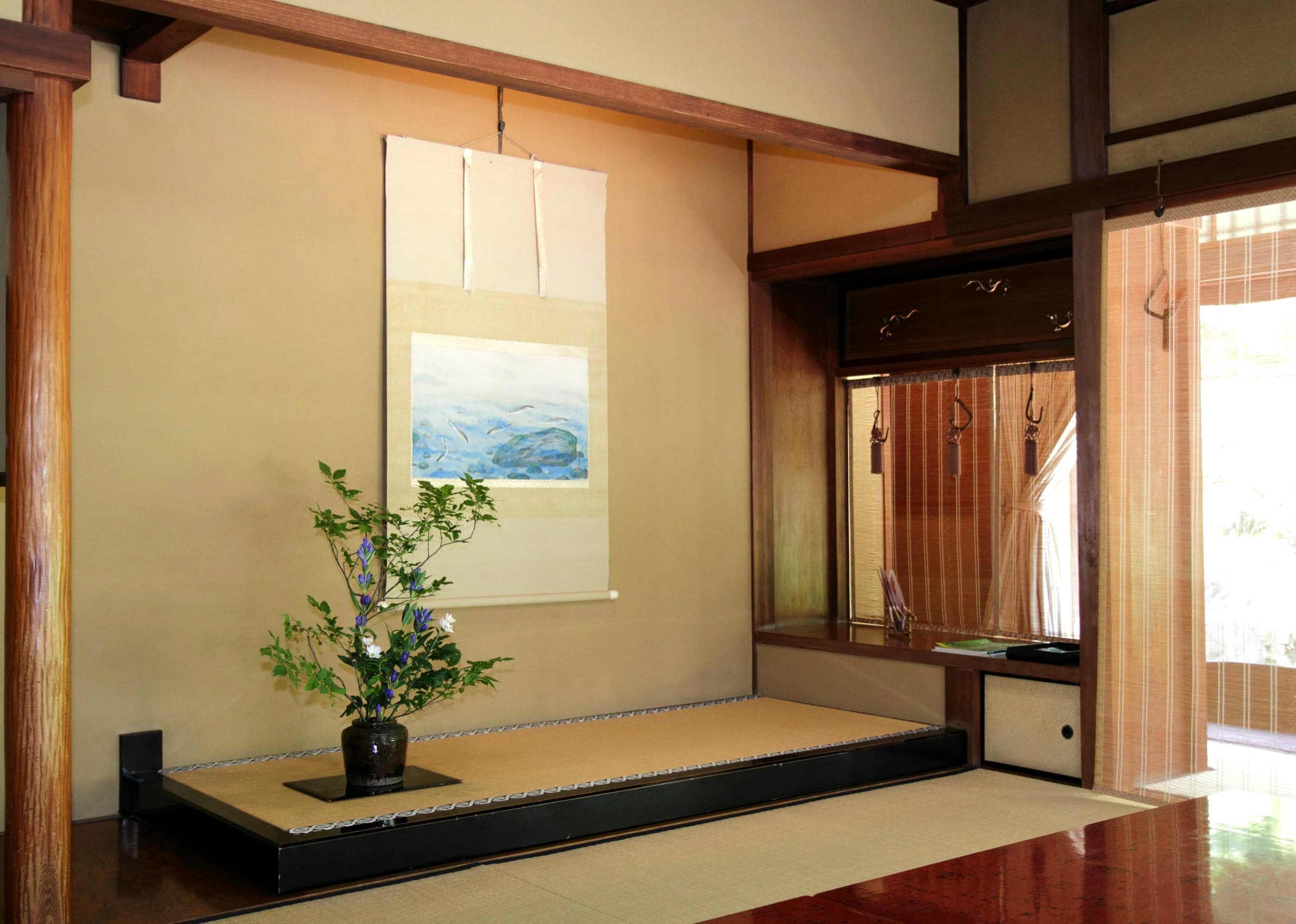
Traditional Japanese painting is defined as much by format as by subject. The kakejiku (hanging scroll, also called kakemono) is a painting mounted on silk brocade with a wooden roller, designed to be hung in a tokonoma — the recessed display alcove of a Japanese room — and rotated with the season. The byōbu is a folding screen, typically two, four, or six panels, originally a room divider and now the closest traditional equivalent to a large statement painting.
The fusuma is a sliding partition panel, painted as part of an architectural set, and the most ambitious historical format of all: the great Kanō school and Rinpa commissions were fusuma and byōbu programmes for temples and castles, not easel pictures. Ogata Kōrin’s Irises screens at the Nezu Museum in Tokyo, designated a National Treasure, remain the reference point for what the format can do.
For contemporary buyers, the practical descendant of these formats is the framed or panel-mounted painting on washi (Japanese handmade paper) or silk, often stretched over a wooden support. This is what most modern Nihonga arrives as, and it hangs like any Western painting, without the seasonal rotation a scroll implies.
Prints: Ukiyo-e, Shin-hanga, and Sōsaku-hanga
Ukiyo-e (“pictures of the floating world”) are Edo-period woodblock prints produced collaboratively by a designer, a block carver, a printer, and a publisher. Hokusai (1760–1849) and Utagawa Hiroshige (1797–1858) are the names that carry the international market, largely through Hokusai’s Thirty-six Views of Mount Fuji series of around 1830–32 and Hiroshige’s Fifty-three Stations of the Tōkaidō of about 1833–34.
Because ukiyo-e were editioned and reprinted for well over a century, the words “original Hokusai” mean very little on their own. What matters is whether the impression is an early lifetime printing from fresh blocks, a later Edo or Meiji reprinting, or a twentieth-century reproduction. The visual difference shows in the crispness of the keyblock line, the saturation of the blue, and the presence of subtle printing effects that wear away as blocks are reused.
Shin-hanga (“new prints”) is the early twentieth-century revival that kept the traditional four-person workshop but applied it to modern landscape and figure subjects, with Kawase Hasui and Hiroshi Yoshida as the dominant names for Western buyers. Sōsaku-hanga (“creative prints”) is the parallel movement in which the artist designed, carved, and printed personally — Munakata Shikō is the best-known figure. Both are considerably more accessible than fine Edo impressions and frame beautifully in series.
Ceramics, Lacquer, and Metalwork
Japanese ceramics divide broadly between high-fired unglazed stoneware traditions such as Bizen and Shigaraki, the tea-ceremony wares including Raku, Shino, Oribe, Hagi, and Karatsu, and the porcelain traditions centred on Arita, Imari, Kutani, and Nabeshima. Raku is hand-formed and removed from the kiln while still glowing, which produces the soft, irregular surface prized in tea practice; yakishime refers to unglazed stoneware where the surface effects come from ash and flame rather than applied glaze.
Since 1955 Japan has designated individual makers as holders of Important Intangible Cultural Properties — known colloquially as Living National Treasures, or Ningen Kokuhō. That designation is the clearest quality signal in the ceramics market and is reflected directly in price. Hamada Shōji (1894–1978), a central figure of the mingei (folk craft) movement based at Mashiko, is the crossover name most familiar to Western collectors.
Urushi is the sap of the lacquer tree, applied in many thin layers and cured in humidity rather than dried. Maki-e is the technique of sprinkling gold or silver powder into wet lacquer to build an image. Lacquer is exceptionally durable against water and handling but genuinely vulnerable to ultraviolet light and to dry indoor air, which matters for how it is displayed.
Postwar and Contemporary Work
The postwar market is where the largest auction figures sit. The Gutai group, founded in Ashiya in 1954 around Yoshihara Jirō, and the Mono-ha (“school of things”) tendency of the late 1960s and 1970s, associated with Lee Ufan and Sekine Nobuo, are the two movements that carry sustained international institutional interest.
Among individual artists, Yayoi Kusama and Yoshitomo Nara define the top of the market. Nara’s Knife Behind Back sold at Sotheby’s Hong Kong in October 2019 for HK$195.7 million, approximately US$24.9 million, which remains the reference result for the artist. Kusama’s strongest early Infinity Nets canvases have passed US$8 million in New York and Hong Kong evening sales since 2019.
Running alongside this is contemporary Nihonga — artists trained in the mineral-pigment tradition who work at contemporary scale and in contemporary idioms. Hiroshi Senju’s waterfall paintings, made with natural pigments on washi and including a fusuma commission for Jukō-in at the Daitoku-ji temple complex in Kyoto, are the most visible international example of that continuity.
Nihonga Explained: The Material Logic Behind the Surface
Nihonga is the term coined in the Meiji period to distinguish painting in Japanese materials and methods from yōga, oil painting in the Western manner. It is not a style, a subject range, or a period. It is a material system, and understanding that system explains why a Nihonga panel looks different from an acrylic canvas under the same downlight — and why so many interior designers end up specifying it.
The tradition runs from Meiji reformers including Yokoyama Taikan and Hishida Shunsō through Uemura Shōen and Hayami Gyoshū — whose Enbu (Dancing in the Flames) of 1925, an Important Cultural Property, is a highlight of the Yamatane Museum of Art in Tokyo — to Higashiyama Kaii and the artists working today. The Yamatane Museum is the principal institution devoted to the field; the Adachi Museum of Art in Shimane holds the major Taikan collection and has been repeatedly ranked first among Japanese gardens by the Journal of Japanese Gardening.
Iwa-enogu and the Mineral Palette
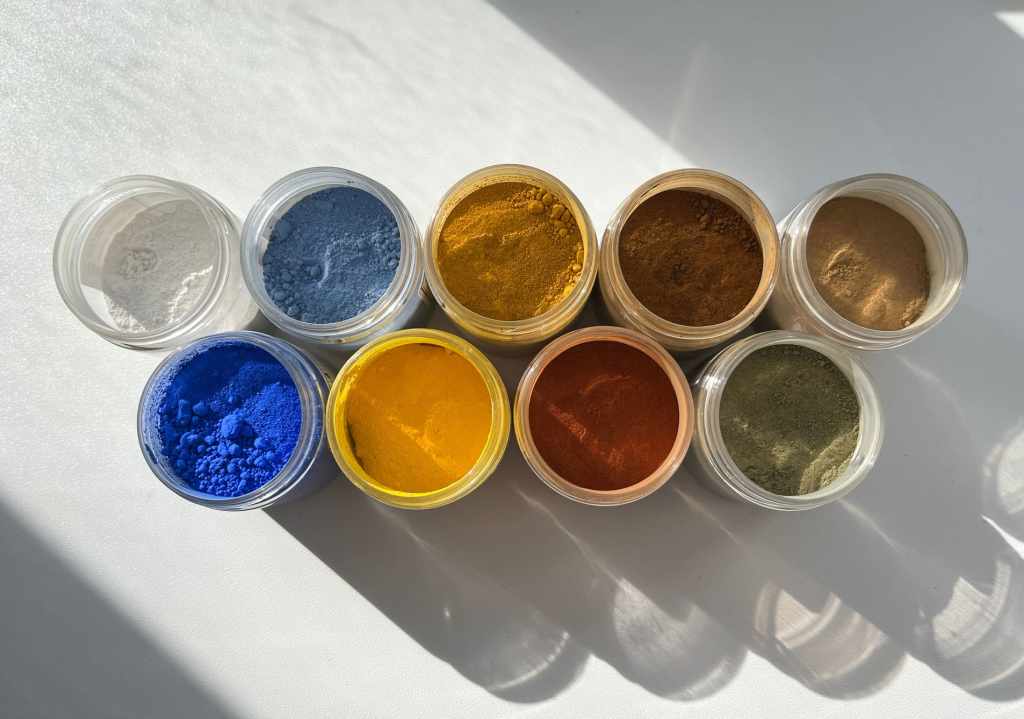
Iwa-enogu are pigments ground from minerals and semi-precious stones — azurite for blue, malachite for green, cinnabar and ochres for red and earth tones — supplemented today by synthetic mineral pigments (shin-iwa-enogu) that extend the range and stabilise supply of colours that are scarce or toxic in natural form.
The defining property is particle size. Each pigment is sold in graded coarseness, conventionally numbered, and the same mineral yields a deep saturated tone when coarse and a pale one when finely ground. Coarse particles sit proud of the surface and scatter light in a way no dye or modern film-forming paint reproduces. This is why Nihonga appears to change through the day: the surface is granular and reflective, not flat.
Gofun, Nikawa, and the Ground
Gofun is white made from calcined and aged oyster shell, used both as a pigment and as a ground layer. It gives the characteristic cool, chalky Japanese white and is the base for the moriage technique, in which built-up relief creates low physical texture — snow, blossom, textile pattern — before colour goes on.
The binder is nikawa, a gelatine glue traditionally rendered from animal hide. Pigment carries no adhesive of its own; the painter mixes it with warmed nikawa by hand for each application. Nikawa is water-soluble and remains so, which is the single most important conservation fact about Nihonga: the paint layer is permanently vulnerable to liquid water and to prolonged high humidity, though entirely stable in normal interior conditions.
Supports are washi, most often kumohada-mashi or similar heavy-weight papers, or silk. Both are sized before painting. A finished work may be mounted as a scroll, laid onto a panel, or stretched — panel mounting is now standard for works intended for Western-style rooms.
Gold, Silver, and the Handling of Light
Gold enters Nihonga in several forms: kinpaku (leaf) laid in squares with visible seams, sunago (sprinkled flakes), and powdered gold mixed as pigment. Silver (ginpaku) is used similarly but oxidises over time to grey and eventually near-black, a change many artists anticipate and some deliberately accelerate.
The visual consequence matters for buyers. A gold-ground work does not read as a bright surface under even light; it reads as a dark, warm field that ignites when raking light crosses it. In practice this means a gold-ground Nihonga in a room with a single centred downlight will look muted, while the same work on a wall with grazing light from one side will animate across the whole day. This is a lighting-design question more than a curatorial one.
What Actually Drives the Value of Japanese Art Pieces
Price in this field is determined by a small number of factors applied consistently across every genre. Learning them saves more money than learning artist names, because they explain why two apparently identical objects differ in price by a factor of fifty.
Attribution, Signature, and Seals
Japanese paintings are signed with a brushed signature and one or more red seal impressions (rakkan and inkan). Artists frequently used multiple art names across a career — Hokusai is the notorious case, working under some thirty signatures — so a signature that does not match the expected period name is not automatically a red flag, but it does require explanation.
For older works the catalogue language is precise and should be read literally. “By” asserts authorship. “Attributed to” indicates the auction house believes it probable but cannot establish it. “School of,” “circle of,” “after,” and “in the manner of” each step further away, and the price steps down accordingly. Treat these phrases as contractual, not decorative.
Condition, Mounting, and the Tomobako
Works on paper and silk are judged on foxing (brown spotting), light-staining, tears, losses, restoration, and fading. Ukiyo-e are especially exposed: the safflower-derived beni reds and several organic blues used before synthetic pigments arrived are fugitive, and a print that has spent decades on a sunlit wall may retain its line work while having lost half its palette. A faded impression can be worth a tenth of a strong one.
Mounting is a separate value component. A scroll’s silk brocade mount is itself a made object and is conventionally renewed by a specialist mounter roughly once a century; an original but degraded mount is often worth remounting rather than preserving. For ceramics and lacquer, the tomobako — the artist’s signed and sealed storage box, sometimes with an inscription identifying the piece — is close to essential documentation for modern works. A Living National Treasure’s piece without its tomobako typically trades at a substantial discount.
Provenance, Publication, and Exhibition History
Publication in a catalogue raisonné or a recognised reference is the strongest form of validation available in most of these markets. For ukiyo-e, inclusion in a standard series catalogue with a matching state and impression description does real work. For modern and contemporary Nihonga, inclusion in a museum retrospective catalogue or a dedicated artist volume is the equivalent.
Provenance also carries a compliance function. Works that left Japan before the mid-twentieth century, or that entered Western collections during the Japonisme period, generally have clean histories, but documentation should still be requested and retained. Institutional buyers and corporate collections will require it.
Where the Market Has Moved Recently
Three trends are visible in published results over the past decade. First, the very top of the ukiyo-e market has strengthened sharply while the middle has stayed flat: impressions of Hokusai’s Under the Wave off Kanagawa have set successive records at Christie’s New York, reaching US$1.59 million in March 2021 and US$2.76 million in March 2023, while competent later-edition Hiroshige landscapes remain obtainable in the low four figures.
Second, postwar Japanese material has been re-rated by Asian buyers, with Hong Kong and Seoul sales rather than London driving Gutai, Mono-ha, and contemporary results. Third, Nihonga has remained substantially a domestic Japanese market — deep, liquid, and price-stable within Japan, and correspondingly under-discovered internationally. That gap is the main reason well-made contemporary Nihonga is still accessible relative to comparable Western contemporary painting.
Indicative Price Ranges by Category
The ranges below reflect published auction results from major houses and observed specialist-dealer pricing for works in good condition. They are orientation bands, not valuations: condition, size, and attribution move any individual object well outside them.
| Category | Typical range (USD) | Notes |
|---|---|---|
| Twentieth-century ukiyo-e reprints | $50 – $400 | Modern impressions from recut blocks; decorative value |
| Shin-hanga (Hasui, Yoshida) | $400 – $6,000 | Early lifetime printings command the upper band |
| Period Hiroshige / Kunisada impressions | $800 – $8,000 | Condition and colour retention dominate |
| Fine Hokusai Fuji series impressions | $20,000 – $200,000+ | Exceptional Great Wave impressions reach seven figures |
| Antique hanging scrolls, unattributed | $500 – $5,000 | Mount condition frequently the limiting factor |
| Contemporary Nihonga, small to mid format | $2,000 – $25,000 | Emerging to mid-career, gallery and dealer pricing |
| Contemporary Nihonga, large panel or screen | $25,000 – $150,000+ | Established names and commissioned scale |
| Studio ceramics, established makers | $300 – $8,000 | Tomobako presence materially affects price |
| Living National Treasure ceramics | $5,000 – $80,000+ | Tea wares by celebrated holders sit highest |
| Blue-chip postwar and contemporary | $100,000 – $25 million | Nara, Kusama, Lee Ufan at evening-sale level |
Choosing Japanese Art Pieces for Homes and Commercial Spaces
Japanese art was developed for a specific architecture: low horizons, tatami-height sightlines, diffused light through paper screens, and a single designated display alcove rather than a gallery wall. Western rooms invert almost all of those conditions. The work still performs — often better than Western painting does in minimal interiors — but the placement decisions are different.
Matching Format to Architecture
The most common error is scale. A hanging scroll is a vertical object designed to be viewed from a seated position at close range in a shallow recess; hung alone on a broad living-room wall at standard Western picture height, it reads as small and isolated. Scrolls work best in corridors, stairwell landings, narrow wall returns between windows, and above low console furniture — anywhere the viewer comes close and the wall is itself narrow.
Screens and large panels do the opposite work. A two-panel byōbu or a large Nihonga panel is the correct answer to a wide sofa wall, a dining-room end wall, or a reception desk backdrop. Note that a folding screen is a freestanding object with depth; it can be wall-mounted flat, but doing so eliminates the shallow angling that makes a gold ground shift as you move past it.
| Format | Typical dimensions | Best-suited placement |
|---|---|---|
| Kakejiku (hanging scroll) | 30–60 cm wide, 130–200 cm overall drop | Corridors, alcoves, narrow wall returns |
| Shikishi (square board) | 24 × 27 cm | Shelves, small groupings, guest rooms |
| Framed Nihonga panel (small) | 30–60 cm | Bedrooms, studies, hotel guest rooms |
| Framed Nihonga panel (large) | 100–180 cm | Sofa walls, dining rooms, private offices |
| Two-panel byōbu | 150–180 cm wide | Room dividers, bed headboard walls |
| Six-panel byōbu | 350 cm+ wide | Lobbies, boardrooms, long gallery walls |
Palette, Light, and Wall Colour
Mineral pigment sits in a narrower, more muted register than oil or acrylic. Azurite and malachite are deep and slightly dusty rather than brilliant; gofun white is cool and chalky. Against a bright white gallery wall these colours can look recessive. Against warm off-white, plaster, limewash, oak panelling, or a mid-tone grey they gain considerable presence.
Lighting should be low-intensity and directional rather than bright and flat. Museum practice for works on paper is around 50 lux, and while domestic display need not be that strict, the principle holds: strong illumination flattens the granular surface that gives the medium its character, and accelerates fading in any organic colourants present. A dimmable, warm-temperature accent light placed off-axis does far more for the work than a powerful one placed square on.
Avoid walls that receive direct sun at any point in the day, and avoid positions directly above radiators, fireplaces, or HVAC outlets. Those are conservation rules, but they are also aesthetic ones — a work in raking daylight will look different every hour, which is desirable, while a work in direct sun will look bleached and will stay that way.
Hospitality, Office, and Lobby Commissions
Commercial specifiers ask a consistent set of questions, and the answers are generally favourable. Nihonga on panel is stable, matte enough to avoid the glare problems of varnished oil, and unaffected by the low-level continuous lighting typical of hotel public areas provided UV is controlled. Its restrained palette also tends to survive changes of upholstery and finish schedule over a refurbishment cycle, which is not true of more assertive contemporary painting.
Scale is usually the constraint. Lobbies and boardrooms need widths that a traditional single sheet of washi cannot reach, which is why multi-panel configurations and commissioned works are the norm at that size. A set of three or four aligned panels reading as one composition is both the historical solution and the practical one, since panels can be transported and installed individually.
For guest rooms, the economics favour editioned prints and smaller panel works, with shin-hanga and contemporary sōsaku-hanga particularly well suited: they are consistent across a repeated room type, genuinely original rather than reproduction, and replaceable if damaged. Specify UV-filtering glazing throughout and accept that any work on paper in a smoking-adjacent or high-humidity environment will need a maintenance plan.
Buying, Importing, and Living With the Work
Acquisition mechanics differ enough from the Western art market that they deserve separate treatment. The main practical differences are the location of supply, the cultural-property regime, and the conservation profile of the materials.
Where the Market Actually Is
Supply is concentrated in Japan. Domestic auction houses, Tokyo and Kyoto dealers, and the exchange system that supplies them handle a far larger volume of Japanese art than the international houses, particularly for Nihonga and for ceramics below the top tier. International sales at Christie’s, Sotheby’s, Bonhams, and Phillips capture the highest-value ukiyo-e, the postwar and contemporary market, and selected historical material, but not the mid-market.
For a buyer outside Japan, this means the realistic routes are a specialist dealer with Japanese sourcing, a Japanese auction house that accepts overseas bidding, or an international house’s Japanese art sale. Each has a different risk profile. A dealer takes a margin and in exchange absorbs the authentication, condition assessment, mounting, and export work; an auction purchase transfers all of that to the buyer.
Export Rules and Documentation
Under Japan’s Law for the Protection of Cultural Properties, enacted in 1950, objects designated as National Treasures or Important Cultural Properties cannot be exported. This affects a very small number of works, all of them documented and nearly all in institutional hands, so it rarely constrains a private buyer — but it is the reason certain celebrated objects will never appear on the market at any price.
Beyond designated property, ordinary export is straightforward. Practical requirements are a clear invoice with description and value, evidence of lawful acquisition, and — where a work incorporates restricted organic materials such as ivory or certain tortoiseshell in fittings or inlay, which occurs in lacquer, netsuke, and older mountings — CITES compliance. Confirm this before purchase rather than after; it is the most common cause of shipping delays in the category.
For shipping, works on paper should travel flat or rolled on a large-diameter roller, never folded, and screens should ship in purpose-built crates. Insist on a condition report with photographs before dispatch and repeat it on arrival. Japanese dealers customarily pack to a high standard, including the original tomobako where one exists, which should be retained permanently as part of the object.
Conservation in a Lived-In Room
The realistic conservation target for a private interior is stability rather than museum precision. Aim to keep relative humidity broadly between 45 and 60 percent and avoid rapid swings; lacquer in particular suffers from dry heated air and will develop fine cracking below about 40 percent sustained. Temperature matters less than its rate of change.
Because nikawa binder remains water-soluble, Nihonga should never be cleaned with any moisture, and condensation-prone walls — external walls in cold climates, bathroom-adjacent partitions — should be avoided. Surface dust is removed with a soft dry brush, gently, and nothing else. Any actual damage is a conservator’s job, not a framer’s.
Hanging scrolls should be rolled and stored between periods of display, which is the historical practice and also the best possible preservation strategy: a scroll shown for two months a year will outlast one shown permanently by generations. Rolling should be even and without force, with the cord tied firmly but not tightly, and storage should be dark, dry, and ventilated. Panel-mounted works need none of this and can simply be hung, which is why they dominate the contemporary market.
Building a Collection That Holds Up
The most durable collections in this field tend to be narrow. A focused group — one artist, one technique, one subject across several hands — reads as a considered statement in a room and is far easier to research, authenticate, and eventually resell than an assortment assembled by opportunity. Depth also builds the specific knowledge that lets you recognise a strong example when it appears.
Buy condition over rarity at every level below the very top of the market, learn to read the vocabulary of attribution literally, and insist on documentation as a condition of purchase rather than a courtesy. Above all, buy work you want to live with under the particular light of your own rooms, because Japanese art rewards exactly that kind of sustained daily looking. Mineral pigment, gold ground, and hand-made paper are materials designed to change with the hour.
If contemporary Nihonga is where that interest points — mineral pigments on washi, panel-mounted and ready for a Western wall — the practical next step is simply to look at a selection assembled with those interiors in mind.
Discover Nihonga for Contemporary Spaces
Shop carefully selected Nihonga,
curated by experienced Japanese art dealers
for homes and commercial spaces worldwide.