
Japandi Art
Famous Japanese Artists and Art Movements by Era
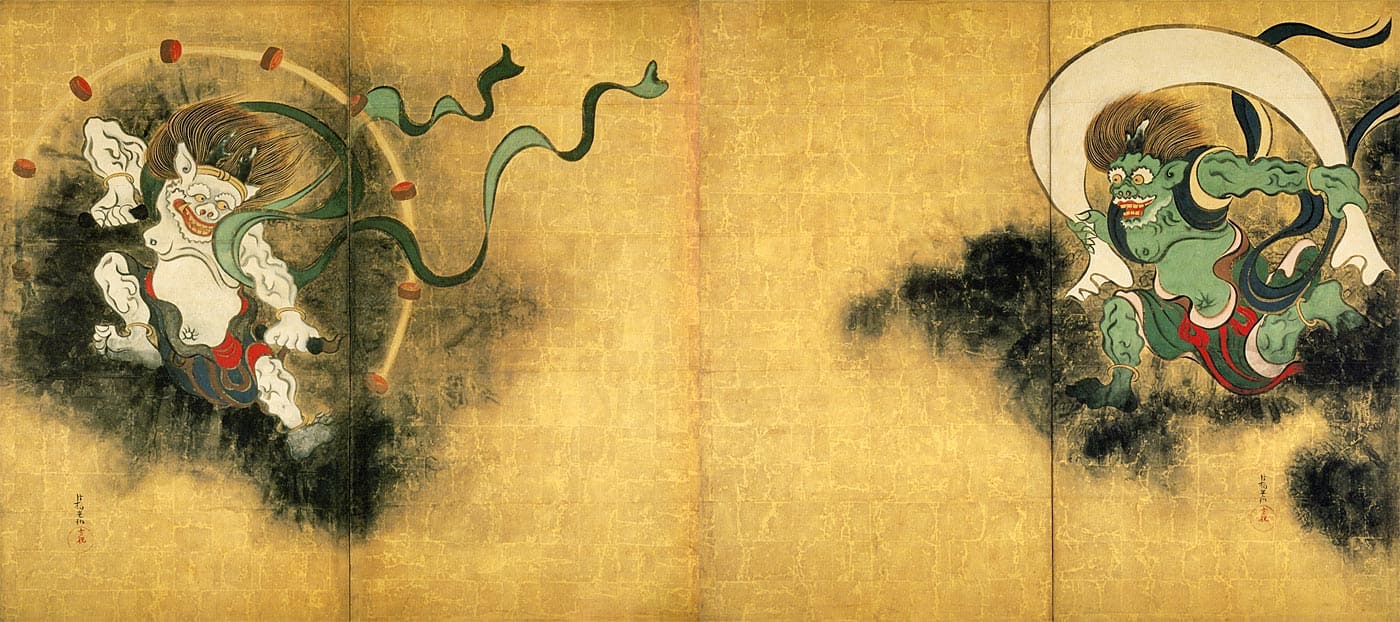
The most famous Japanese artists are Katsushika Hokusai and Utagawa Hiroshige (ukiyo-e woodblock prints), Ogata Korin and Tawaraya Sotatsu (the Rinpa school), Yokoyama Taikan (modern Nihonga), and the contemporary names Yayoi Kusama, Takashi Murakami and Yoshitomo Nara. Hokusai’s Great Wave off Kanagawa, made around 1830 and now a global symbol of Japan, is probably the single most recognized work.
The table below lists the best-known Japanese artists and painters by era, with the school or movement each belongs to. The sections after it explain the main Japanese art movements in order: the Kano and Rinpa schools, ukiyo-e, Japonisme and yoga, Nihonga, shin-hanga and sosaku-hanga, Gutai, Mono-ha and Superflat. They are followed by auction records and short advice on living with Japanese art.
Famous Japanese Artists by Era
| Era | Artist | School or movement | Best known for |
|---|---|---|---|
| Muromachi (1336-1573) | Sesshu Toyo (1420-1506) | Ink painting (suibokuga) | Zen ink landscapes; widely regarded as the greatest Japanese ink painter |
| Momoyama (1573-1615) | Kano Eitoku (1543-1590) | Kano school | Gold-ground screens and sliding-door paintings for castles |
| Momoyama (1573-1615) | Hasegawa Tohaku (1539-1610) | Hasegawa school | Monochrome ink screens such as Pine Trees |
| Edo (1603-1868) | Tawaraya Sotatsu (active early 1600s) | Rinpa | Gold-ground decorative painting, wind and thunder gods |
| Edo (1603-1868) | Ogata Korin (1658-1716) | Rinpa | Irises, red and white plum blossoms, waves |
| Edo (1603-1868) | Ito Jakuchu (1716-1800) | Independent painters of Kyoto | Meticulous, vivid paintings of birds and animals |
| Edo (1603-1868) | Kitagawa Utamaro (c. 1753-1806) | Ukiyo-e | Bijin-ga, pictures of beautiful women |
| Edo (1603-1868) | Toshusai Sharaku (active 1794-95) | Ukiyo-e | Kabuki actor portraits, produced in about ten months |
| Edo (1603-1868) | Katsushika Hokusai (1760-1849) | Ukiyo-e | Thirty-six Views of Mount Fuji, the Great Wave |
| Edo (1603-1868) | Utagawa Hiroshige (1797-1858) | Ukiyo-e | Fifty-three Stations of the Tokaido, atmospheric landscape prints |
| Meiji-Taisho (1868-1926) | Kuroda Seiki (1866-1924) | Yoga (Western-style painting) | Introduced French academic painting and plein-air work to Japan |
| Meiji-Showa | Yokoyama Taikan (1868-1958) | Nihonga | The hazy style (morotai), Mount Fuji paintings |
| Meiji-Showa | Kawai Gyokudo (1873-1957) | Nihonga | Lyrical landscapes of rural Japan |
| Meiji-Showa | Uemura Shoen (1875-1949) | Nihonga | Psychologically nuanced bijin-ga |
| Taisho-Showa | Kawase Hasui (1883-1957) | Shin-hanga | Landscape woodblock prints of rain, snow and dusk |
| Showa-Heisei | Higashiyama Kaii (1908-1999) | Postwar Nihonga | Landscapes of water, mist and forest in broad fields of muted color |
| Showa-Heisei | Kayama Matazo (1927-2004) | Postwar Nihonga | Decorative compositions of cherry blossoms, cranes and seasonal landscapes |
| Postwar | Jiro Yoshihara (1905-1972) | Gutai | Founded the Gutai Art Association in 1954 |
| Postwar | Yayoi Kusama (b. 1929) | Contemporary | Infinity Nets, pumpkins, Infinity Mirror Rooms |
| 1960s-70s | Lee Ufan (b. 1936) | Mono-ha | From Line and From Point paintings; stone-and-steel installations |
| Contemporary | Hiroshi Senju (b. 1958) | Contemporary Nihonga | Large waterfall paintings in natural mineral pigments |
| Contemporary | Yoshitomo Nara (b. 1959) | Contemporary | Paintings of solitary, defiant children |
| Contemporary | Takashi Murakami (b. 1962) | Superflat | Bright, anime-influenced paintings and sculpture |
The dates for Edo-period artists are standard reference dates; where a source gives a range for an artist’s active years it is shown as “active.”
Japanese Art Movements: A Timeline
For much of Japanese art history an artist’s identity was inseparable from a school (ryuha) or atelier, and membership meant inheriting model books and pigment recipes. After 1868 the schools gave way to movements and groups. Reading a work well often means reading the lineage or movement behind it.
Ink Painting and the Kano School
Sumi (carbon-based ink ground on stone) defines the ink painting tradition that Zen monks brought from China and that Sesshu Toyo reshaped on Japanese terms. The Kano school, founded in the fifteenth century by Kano Masanobu, served the shogunate for some four hundred years. Under Kano Eitoku and Kano Tan’yu (1602-1674) it supplied the screens and sliding-door paintings that lined castle interiors, and its gold-ground compositions of pines, hawks and dragons set against burnished leaf remain the touchstone for large-scale Japanese painting.
The Rinpa School
The Rinpa school took the decorative impulse in a different direction. Tawaraya Sotatsu and Ogata Korin produced the irises, plum blossoms and waves that are now synonymous with refined Japanese taste, and Sakai Hoitsu (1761-1828) revived and codified the idiom in Edo a century later. Gold grounds, stylized nature, strong silhouettes and rhythmic composition still inform Japanese design, Nihonga and contemporary painting.
Ukiyo-e: Pictures of the Floating World
Ukiyo-e (literally “pictures of the floating world”) is the woodblock print and painting tradition that flourished in Edo (modern Tokyo) from the seventeenth century through the nineteenth. Katsushika Hokusai is the figure most readers know by sight, even when they do not know the name. His “Thirty-six Views of Mount Fuji,” and within it the print known as the Great Wave off Kanagawa, has become a global shorthand for Japanese art itself.
Utagawa Hiroshige worked the same medium toward different ends. His “Fifty-three Stations of the Tokaido” capture mood, weather and travel with a tenderness that made him one of the most direct influences on European Post-Impressionism. Kitagawa Utamaro defined the bijin-ga genre, while Toshusai Sharaku, active for only about ten months in 1794-95, produced kabuki actor portraits whose psychological intensity still feels modern.
Japonisme and Yoga: The East-West Dialogue
The opening of Japan in the Meiji period (1868-1912) brought oil painting, perspective and academic figure drawing into Japanese art schools, producing yoga (Western-style painting), whose leading early figure was Kuroda Seiki. The same decades saw ukiyo-e prints flood European studios, where they reshaped the work of Manet, Degas, Van Gogh and Whistler in the wave now known as Japonisme.
That dual current still shapes how Japanese artists are read abroad. A contemporary painter working with mineral pigments on paper is in conversation with both Yokoyama Taikan and abstract painting in New York, and a Superflat artist is in dialogue with both ukiyo-e and Pop. Treating these layers as competing rather than coexisting almost always leads to a misreading.
Nihonga: Japanese-Style Painting
The Meiji period dismantled the old patronage system. The shogunate’s collapse cut Kano painters off from their main client, and the new government built Western-style art schools and sent students abroad. The American scholar Ernest Fenollosa, working in Tokyo with the curator Okakura Kakuzo (Tenshin), argued that Japan should defend and modernize its own painting tradition rather than abandon it for oil paint. Their advocacy led to the founding of the Tokyo School of Fine Arts in 1889 and to the emergence of Nihonga as a self-conscious modern category.

Source:Colbase(https://colbase.nich.go.jp/collection_items/tnm/A-1269)
Nihonga is defined by material discipline as much as by subject. The traditional palette is built from iwa-enogu (mineral pigments from ground stones such as azurite and malachite), suihi-enogu (water-ground pigments from earth and shell) and gofun (white made from calcined oyster shell), bound with nikawa (animal-hide glue) and applied to washi or silk, with gold and silver leaf, mica and ink completing the vocabulary. The category emerged in the late nineteenth century not to oppose the West but to define what Japanese painting would carry forward.
Yokoyama Taikan is generally treated as the central figure of modern Nihonga. A founding member of the Japan Art Institute (Nihon Bijutsuin) and a student of Okakura Tenshin, he developed morotai, the “hazy style,” in which atmospheric washes replace contour lines. Kawai Gyokudo extended the lyrical landscape tradition through carefully observed scenes of rural Japan, and Uemura Shoen brought bijin-ga into the Nihonga age with some of the most psychologically nuanced female figures in twentieth-century Japanese art. A postwar generation later, Higashiyama Kaii distilled landscape to broad fields of muted color built around water, mist and forest, and Kayama Matazo made decorative compositions of cherry blossoms, cranes and seasonal landscapes.
Nihonga is not a historical relic. Hiroshi Senju (b. 1958) is the contemporary Nihonga artist with the broadest international profile. His large waterfall paintings, executed in natural mineral pigments on Japanese mulberry paper, earned him an Honorable Mention at the 1995 Venice Biennale, and his commissioned installations, including fusuma (sliding-door) panels at Juko-in within Daitoku-ji in Kyoto, have made him a defining figure for how Nihonga reads in contemporary architecture. A newer generation including Makoto Fujimura and Hisashi Tenmyouya is extending the vocabulary into abstraction and contemporary subject matter.
Shin-hanga and Sosaku-hanga: The Modern Print
Shin-hanga (“new prints”) revived the ukiyo-e method of collaboration between designer, carver and printer for modern subjects. The movement was initiated by the publisher Watanabe Shozaburo (1885-1962) and flourished from about 1915 to 1942. Kawase Hasui (1883-1957) and Hiroshi Yoshida (1876-1950) were among its leading artists, best known for landscapes of atmosphere, weather and light. Running alongside it, sosaku-hanga (“creative prints”) took the opposite view. Under the slogan jiga-jikoku-jizuri (“self-drawn, self-carved, self-printed”), the artist did all three steps alone, as personal expression and not as a division of labor. The movement grew from the magazine Hosun, founded in 1907 by Yamamoto Kanae, Ishii Hakutei and Morita Tsunetomo, led the print world from the 1900s to the eve of the Pacific War, and formed the Japan Sosaku-hanga Association in 1919. Onchi Koshiro (1891-1955), a pioneer of abstract woodblock prints, and Munakata Shiko (1903-1975), who called his prints 板画 (“board pictures”), are two of its best-known artists.
Gutai: Postwar Action and Performance
The Gutai Art Association was formed in Ashiya, near Osaka, in 1954 under Jiro Yoshihara and operated until shortly after his death in 1972. Its members worked with performance, outdoor exhibitions and interactive works, and the group is regarded as one of the most important postwar avant-gardes in Japan. Among its best-known members are Kazuo Shiraga (1924-2008) and Atsuko Tanaka (1932-2005).
Mono-ha: The School of Things
Mono-ha (“School of Things”) was active in Tokyo from the late 1960s into the 1970s. It is usually dated from Nobuo Sekine’s 1968 work Phase – Mother Earth, in which a pit was dug and the earth formed into a cylinder. The core group included Lee Ufan (b. 1936), Nobuo Sekine (1942-2019), Kishio Suga (b. 1944) and Susumu Koshimizu (b. 1944), who worked with raw or minimally altered materials, such as stone, steel, glass, paper and soil, to investigate the relationship between objects, site and viewer. The name was coined by critics, not by the artists. Lee Ufan’s paintings in the From Line and From Point series have become a fixture of international sales.
Contemporary Japanese Artists: Kusama, Murakami and Nara
Alongside the Nihonga lineage, a parallel generation of Japanese artists is central to the international contemporary market, and these are the names that drive most press coverage of Japanese art outside Japan.
Yayoi Kusama
Yayoi Kusama (b. 1929) is the most internationally visible Japanese artist working today. Her Infinity Net paintings, pumpkin sculptures and Infinity Mirror Rooms have produced a market that keeps absorbing new supply at the top end, and major retrospectives at Tate Modern, the Hirshhorn and the M+ museum in Hong Kong have reinforced rather than saturated demand.
Takashi Murakami and Superflat
Takashi Murakami (b. 1962) coined the term Superflat to describe a visual mode rooted in ukiyo-e, anime and commercial graphics, and organized a 2000 exhibition of that name that toured the United States. His paintings, sculptures and collaborations with fashion and music brands have made him a defining figure of post-1990s Japanese art.
Yoshitomo Nara
Yoshitomo Nara (b. 1959) emerged from the same generational moment with a quite different sensibility. His paintings of solitary children, often with knives, cigarettes or ambivalent expressions, draw on punk, German Neo-Expressionism and a long Japanese tradition of figural intensity.
Japanese Art at Auction: Records for the Best-Known Artists
Records show where demand is strongest, but they are the exception, not the rule. Prints, school paintings and works by lesser-known artists sell for a small fraction of these figures, and condition, provenance and period move prices widely.
| Artist | Work | Price | Sale |
|---|---|---|---|
| Katsushika Hokusai | The Great Wave off Kanagawa (print) | About US$2.76 million | Christie’s New York, March 2023 |
| Yoshitomo Nara | Knife Behind Back (2000) | About US$24.9 million (HK$196 million) | Sotheby’s Hong Kong, October 2019 |
| Yayoi Kusama | Untitled (Nets) (1959) | About US$10.5 million | Phillips New York, May 2022 |
| Lee Ufan | From Line (1978) | About 2 million euros (a Sotheby’s New York record of about US$2.2 million was set in 2014) | Christie’s Paris, October 2025 |
Ukiyo-e prints are among the most accessible entry points for new collectors: later impressions and standard subjects can start in the low hundreds of dollars, while early, well-preserved impressions of canonical Hokusai and Hiroshige designs sell for far more. Twentieth-century Nihonga by Taikan, Gyokudo and Kayama is collected chiefly through Japanese auction houses.
Living with Japanese Art in Real Spaces
Japanese painting traditionally privileged formats other than the framed Western rectangle. The hanging scroll (kakemono) was designed to be rotated through a tokonoma alcove with the season, and the folding screen (byobu) was both image and architectural device. Large Nihonga panels and Senju’s waterfall paintings, which descend from these formats, read best when the viewer can step back at least the diagonal of the work. For residential rooms, mid-sized Nihonga on board or stretched paper, roughly 60 to 120 centimeters on the long side, tends to anchor a room without overwhelming it; hotels, restaurants and offices can carry larger panels and diptychs.
Mineral pigments are unusually stable compared with many synthetic colorants, but the paper, silk and glue that carry them are sensitive. Avoid direct sunlight and large humidity swings, and treat works on paper as you would a watercolor. Color woodblock prints are especially vulnerable to light, so use UV-filtering glazing and rotate prints between display and storage.
One of the strongest moves in an interior led by Japanese art is to pair across periods: an Edo-period screen fragment or a framed Hokusai print opposite a contemporary Nihonga abstraction, each clarifying the other. The tradition has always been a dialogue across generations, and the most considered collections continue that conversation rather than freezing it.
Discover Nihonga for Contemporary Spaces
Shop carefully selected Nihonga,
curated by experienced Japanese art dealers
for homes and commercial spaces worldwide.