
Japandi Art
Japandi Bed Frame Guide: Wood, Height, Size and Style
- What Defines a Japandi Bed Frame
- Japandi Bed Frame Materials, Joinery and Finishes
- Japandi Style Beds: Platform, Floor, Canopy and Integrated Nightstand
- Japandi Bed Size and Height: Planning the Room
- Styling the Japandi Bedroom: Bedding, Light and Palette
- Art Above a Japandi Bed: Choosing and Hanging Nihonga
- Making the Final Decision
- Discover Nihonga for Contemporary Spaces

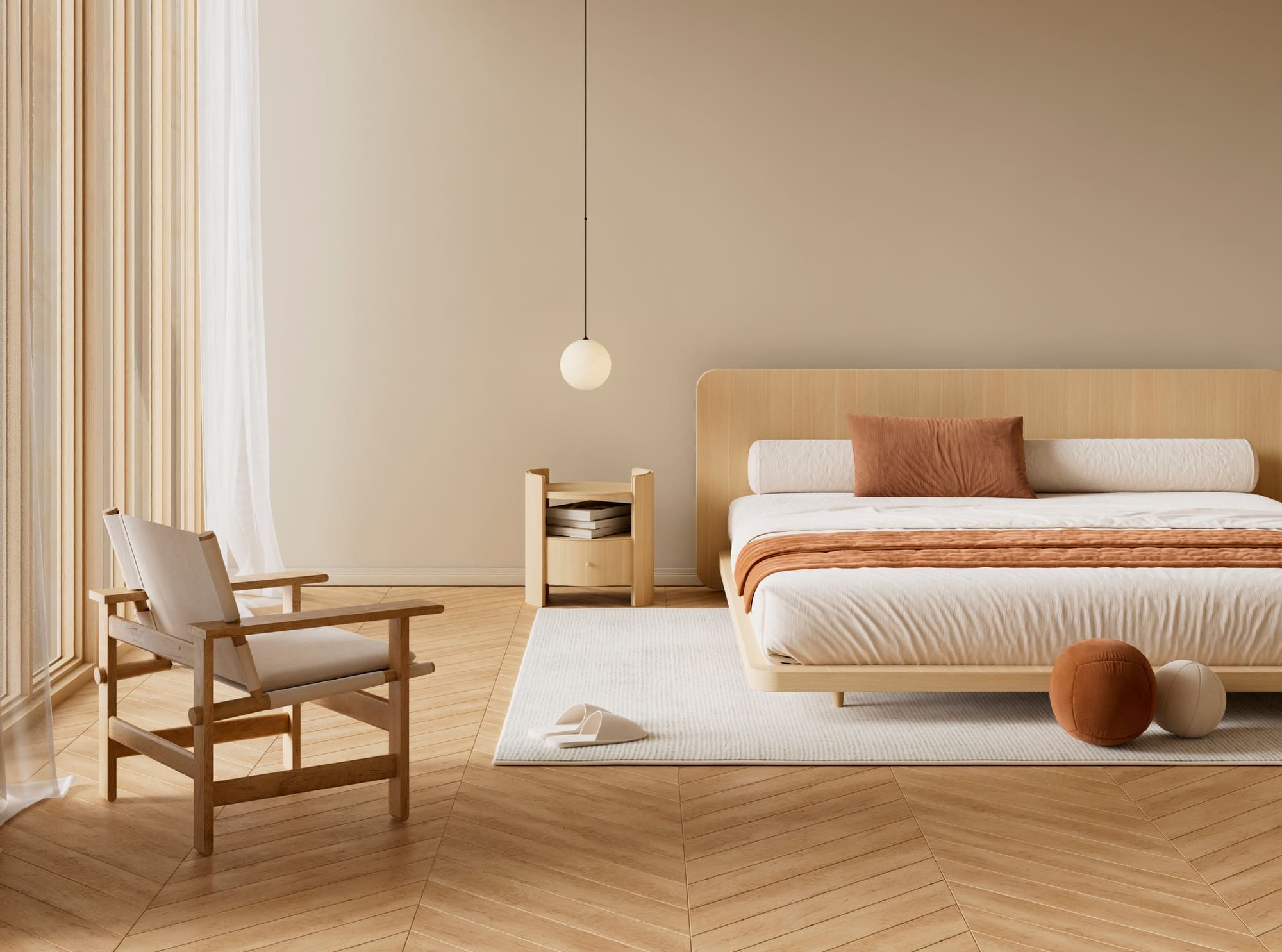
A Japandi bed frame is a low-profile bed, usually a platform frame in solid, visibly grained wood, that joins the Japanese habit of sleeping close to the floor with Scandinavian warmth and craftsmanship. “Japandi” is a blend of Japanese and Scandinavian. The frame sets the tone of the whole bedroom: clean lines, matte natural finishes, little or no headboard, and a bed that looks as if it floats just above the floor.
Most buyers are choosing among four things: the wood, the height, the size and the type of low frame. The table gives the short answer, and the sections below explain each choice and how to finish the wall above the bed, where a single work of Japanese art usually completes the room. The same advice applies if you search for a Japandi bed or Japandi bedframe: the shape is the same.
| Decision | What a Japandi frame usually looks like | What to check |
|---|---|---|
| Material | Solid white oak, ash or walnut; hinoki (Japanese cypress) in specialist frames | Solid rails, legs and slats, not veneered engineered panels; oil or hard wax oil finish |
| Height | Platform frame: roughly 20–35 cm (8–14 in) including the slatted base. Floor bed: roughly 10–20 cm | Can everyone using the bed get up from that height comfortably? |
| Size | Standard mattress sizes; the frame is a few inches larger on each side | Measure the frame’s outer footprint, not the mattress; see the size table below |
| Type | Platform, tatami-style floor bed, canopy, or integrated nightstand bed | Ceiling height, room size and how low you want to sleep |
| Bed base | Slatted wooden base that lets the mattress breathe | Slat spacing, a centre support rail on queen and king, and mattress warranty requirements |
| Headboard | None, or a low wood or woven panel | Leave clear wall above for one artwork |
What Defines a Japandi Bed Frame
The Japanese side of the Japandi bed comes from sleeping close to the floor. In a washitsu (a Japanese-style room), people slept on a shikibuton, a thin cotton-filled mattress, laid directly on tatami, the woven rush mats that have shaped Japanese interior proportions for centuries. In the morning the futon was folded into an oshiire (a built-in closet) and aired, freeing the room for daytime use. A low platform bed turns this tradition into a fixed frame that keeps the sleeper low and the sightlines open without the daily folding.
Tatami also set the scale of the Japanese room. A single mat has a 2:1 proportion, and rooms are still counted in mats, or jo: a six-mat room is a common bedroom size. Mat dimensions vary by region, with the Kyoto-size Kyoma larger than the Tokyo-area Edoma. From Scandinavia the style borrows mid-century functionalism, pale woods and the Danish idea of hygge, a coziness built from texture and warm light.
A Japandi bed frame is therefore a family of beds with shared traits. The profile is low. Lines are clean and rectilinear, sometimes with a softened edge or rounded corner that suggests handcraft. Surfaces are matte, hardware is hidden or minimal, and the wood is allowed to speak for itself. Shadow gaps, recessed legs or a slight overhang of the platform create the impression that the mattress floats.
How Japandi Differs from Generic Minimalist Beds
Many frames sold as Japandi are simply low minimalist beds with little connection to either tradition. The honest test has three parts: the wood is solid, not veneered over engineered panels; the joinery shows some evidence of craft, not just visible brackets and bolts; and the proportions look intentional from every angle. A genuine Japandi frame holds together from every approach.
Japandi Bed Frame Materials, Joinery and Finishes
The palette of materials is narrow on purpose. Solid hardwoods dominate. White oak and European ash give the pale, even-grained look associated with the Scandinavian side, while walnut gives a warmer, deeper tone for rooms with more visual weight. Beech and birch appear in Nordic-leaning designs. From the Japanese side, hinoki (Japanese cypress), sugi (Japanese cedar) and kiri (paulownia) appear in higher-end frames built in Japan or by makers using imported timber. Hinoki has a pale, slightly lemony tone and a faint resinous fragrance, and it is generally produced by a small number of specialist makers.
Solid wood matters here. Veneered MDF and engineered panels can imitate the look in photographs but show themselves in person, in the edges, the way light falls across the grain and the sound of the frame in use. Ask whether the rails, legs and headboard panel are solid timber, and whether the slatted base is solid or laminated.
Joinery as a Signal of Quality
Traditional Japanese woodworking uses interlocking joints such as mortise and tenon and dovetails, which let furniture go together with little or no metal hardware. Few contemporary Japandi beds use these joints in their pure historical form, but good ones use exposed mortise and tenon at visible junctions, knock-down hardware hidden under the rails, and dowelled or splined connections instead of visible brackets. When comparing frames, check whether the joints are real wood-to-wood connections or cosmetic.
The result is a frame that can be taken apart and reassembled without becoming unstable, which matters if you move or rearrange rooms. Visible bolt heads on the side rails, exposed L-brackets at the corners, or wobble at the joints after the first move suggest the frame was engineered to a price.
The Slatted Bed Base
Most Japandi frames use a slatted base instead of a solid platform. The slats let air move under the mattress, which carries on the practical logic of airing the futon. Check the slat spacing, whether a centre support rail is included for queen and king sizes, and whether the mattress warranty requires a particular foundation. On very low frames, or a mattress laid on tatami panels, the small gap to the floor matters in humid climates, since trapped moisture can cause mold.
Finishes
Finishes are typically natural oil, hard wax oil or a very lightly pigmented stain. Lacquer and high-gloss polyurethane are rare in serious examples, because they read as un-Japandi and seal the wood against the slow patina that defines the style. An oiled finish needs a fresh coat every year or two, and rewards it with a surface that deepens rather than degrades.
Japandi Style Beds: Platform, Floor, Canopy and Integrated Nightstand
Several silhouettes recur within the Japandi vocabulary. The choice is largely a question of how low you want to sleep and how the bed will read against the rest of the room.
The Classic Platform Frame
The classic platform frame is the most common. The mattress rests on a slatted wooden base, with the platform either flush with the rails or set back slightly to create a shadow line. Heights range from roughly 25 to 35 centimeters in total. It suits most rooms with standard ceiling heights and works in homes and in hospitality, where guests of varying ages and mobility use the bed.
The Tatami-Style or Floor Bed
The tatami-style or floor bed pushes the proportions further. Inspired by sleeping at or near floor level, these frames sit just 10 to 20 centimeters off the ground. They look dramatic in rooms with high ceilings or large windows because they emphasize horizontal space, but you must be honest about whether the occupants can rise comfortably from such a low position. They also demand a more rigorous room: clutter reads more obviously when the bed itself is humble.
The Canopy or Four-Poster Variation
The canopy or four-poster Japandi frame is the rarest of the four. Four slim posts rise from the platform, sometimes joined by a simple wooden frame at the top, creating a graphic rectangle above the mattress. Done well, it adds architectural weight without ornament; done poorly, it tips into farmhouse rusticity. It works best in larger rooms with tall ceilings.
The Integrated Nightstand Bed
In the integrated nightstand bed, low side tables or shelves extend from the headboard panel as part of the same construction. This turns the bed and bedside tables into one horizontal gesture and suits compact rooms, where it removes the clutter of mismatched bedside furniture.
Japandi Bed Size and Height: Planning the Room
Most Japandi frames put the sleeping surface well below that of a typical Western bed. A lower bed makes the ceiling feel taller and the room larger. It is less easy to get in and out of, which matters for older sleepers and hospitality settings. In rooms with a ceiling of standard height, a platform frame is the safer choice; a floor bed suits higher ceilings and people who rise easily.
The table lists standard US mattress sizes with a planning guide for the wall above. The artwork width follows the common designer rule of thumb that a piece above a bed reads best at about two-thirds to three-quarters of the bed’s width; the table uses the two-thirds figure as a minimum. It is a starting point, not a fixed rule. Sizes outside the US differ, so check the frame maker’s dimensions.
| US mattress size | Mattress dimensions | Suggested single artwork width (approx. two-thirds) | Typical room fit |
|---|---|---|---|
| Twin | 38 × 75 in (97 × 191 cm) | 25–30 in (64–76 cm) | Guest room, child’s room, compact hotel room |
| Full | 54 × 75 in (137 × 191 cm) | 34–40 in (86–102 cm) | Smaller bedrooms, studio apartments |
| Queen | 60 × 80 in (152 × 203 cm) | 38–44 in (97–112 cm) | Most primary bedrooms and standard hotel rooms |
| King | 76 × 80 in (193 × 203 cm) | 48–56 in (122–142 cm) | Large primary suites, premium hospitality |
| California King | 72 × 84 in (183 × 213 cm) | 46–52 in (117–132 cm) | Longer rooms, taller sleepers |
Platform frames often extend a few inches beyond the mattress on every side, and some have a wide ledge. Measure the frame’s outer footprint, not just the mattress, when planning the room and the wall.
Styling the Japandi Bedroom: Bedding, Light and Palette
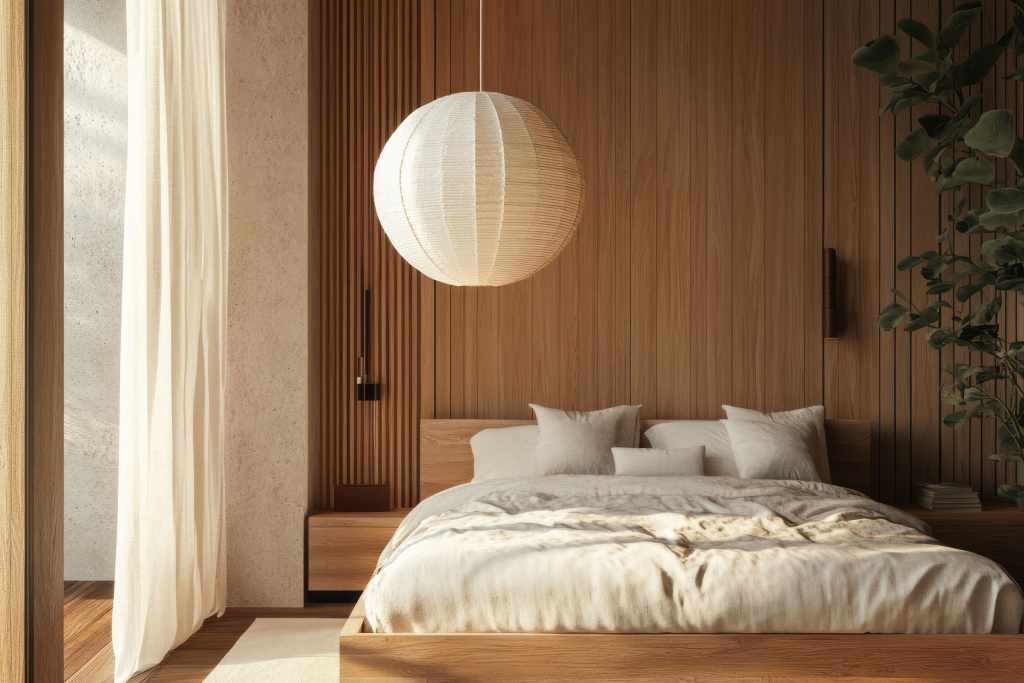
The bed frame is the foundation, but the room reads as Japandi only when the surrounding choices agree. The palette stays narrow: warm whites, oat, sand, soft greige, clay, charcoal and an occasional deep ink-black accent. Textiles run to linen, washed cotton and undyed wool. A linen duvet cover in oat or natural, layered with a heavier throw at the foot of the bed, is the canonical move. A low, wide headboard in wood or woven cane, or a simple upholstered panel, softens the frame.
Lighting is treated as architecture rather than decoration. Pendant lights of paper, rattan or matte ceramic, descended in spirit from the Akari lamps Isamu Noguchi began designing in 1951 with washi, Japanese mulberry paper, stretched over bamboo ribbing, give the soft, indirect glow the style relies on. Bedside lighting is equally understated: a small wall sconce, a paper lantern or a low ceramic lamp with a linen shade.
Art Above a Japandi Bed: Choosing and Hanging Nihonga
Wall art is where many Japandi bedrooms succeed or stall. The instinct is to leave walls bare, but a room without art often reads as unfinished rather than serene. In a traditional Japanese interior the focal point of a room belonged to the tokonoma, a slightly raised display alcove that grew out of Muromachi-period (1336–1573) shoin architecture and held a hanging scroll, a flower arrangement or a single object. Many Japandi bedrooms echo this by treating the wall above the bed as a display space. The principle is one work, well chosen, large enough to anchor the wall.
Why Nihonga Suits a Japandi Room
Nihonga (日本画, “Japanese-style painting”) is the modern lineage of Japanese painting that emerged in the Meiji era (1868–1912), in conscious dialogue with Western art, to distinguish work in traditional materials from yoga (洋画), Western-style oil painting. Okakura Kakuzo (Tenshin) and the American scholar Ernest Fenollosa sought to revive traditional Japanese painting in response to the rise of Western-style painting, and the Tokyo School of Fine Arts, now Tokyo University of the Arts, became its center. Painters such as Yokoyama Taikan, Hishida Shunso and, later, Higashiyama Kaii brought it to a wide audience.
Its materials already match the Japandi palette. Iwa-enogu are pigments made from crushed minerals, semi-precious stones and shells, graded by particle size; coarser grains give deeper colors with a slightly granular, light-catching surface. Gofun, a white pigment made from ground shell, gives soft matte whites. Nikawa, an animal-hide glue, binds the pigment to the support. Works are painted on washi or silk, sometimes with gold or silver leaf (kinpaku, ginpaku). The result is a matte, mineral surface in earth tones, soft blues and greens and chalky whites that sits comfortably beside oak, linen and plaster, without the glare of glazed prints or high-gloss canvas.
Choosing a Format: Kakejiku, Byobu and Framed Panels
The kakejiku (hanging scroll) is the most traditional choice. Its tall, narrow shape suits walls beside the bed, alcoves or a narrow space above a low headboard, and it echoes the tokonoma directly. Because scrolls roll up for storage, they also suit rotation.
The byobu (folding screen) is the most dramatic format. A two-panel screen can stand behind a low bed as a headboard or hang on the wall at full width. It suits large primary suites and hotel rooms, where a wide, horizontal composition can match a king bed.
Framed panels, often painted on board-mounted washi or silk, are the most common format for contemporary Nihonga and the easiest to hang in modern homes. Their horizontal proportions fit naturally above queen and king beds.
Scale and Placement Relative to the Bed
Scale matters as much as subject. A single work of meaningful size hung at the right height above a low platform bed completes the horizontal composition the frame establishes. Smaller framed pieces tend to drift in Japandi rooms because the surrounding restraint gives them nothing to push against.
Use the two-thirds guideline in the size table as a starting point: roughly 38–44 inches (97–112 cm) wide above a queen and 48–56 inches (122–142 cm) above a king. Design guides commonly suggest leaving a gap of roughly 6 to 12 inches (15–30 cm) between the top of the headboard and the bottom of the work, with 8 to 10 inches a frequent default; with no headboard, measure from the mattress. Do not hang the work so high that it loses its connection to the bed. A pair of vertical works on either side of the bed can frame it, as can a single tall scroll offset to one side, an asymmetry that fits the Japanese preference for balance over symmetry.
Matching Palette and Subject
For pale oak and oatmeal linen, look for soft greens, pale blues and gofun whites: landscapes, grasses or seasonal flowers. Walnut and charcoal schemes can carry deeper indigo, gunjo blue, ink-dark or gold-leaf grounds. Subjects in Nihonga often follow the seasons, such as plum and cherry blossom, summer grasses, autumn maples and snow scenes, which matches the Japanese habit of changing a room’s art with the season.
Light, Humidity and Hospitality Spaces
Nihonga is more delicate than oil or acrylic. The pigment layer is thick and granular, held by a relatively small amount of glue, and the silk or paper support expands and contracts with humidity. Sharp swings in moisture can make paint lift and flake, very dry air makes the glue brittle, and persistent damp encourages mold. Museums keep Japanese paintings in stable, moderate humidity and low light, and the exact targets vary by institution. Homes will not match those conditions, but the principles carry over: avoid swings above all. Keep works out of direct sunlight, away from radiators, vents and humidifiers, and off exterior walls prone to condensation. Warm LED lighting with low UV output is the safest way to light the wall above the bed, and UV-filtering glazing adds protection to framed works. Do not clean the surface with a damp cloth, and ask a specialist conservator about any flaking.
The same principles hold in hotels, serviced apartments, members’ clubs and private dining rooms, with the added note that mineral-pigment works age slowly and read as genuine rather than printed. In hospitality settings, fix works securely and keep them clear of headboard contact and luggage. In Japan, hanging scrolls have traditionally been changed with the seasons, then rolled and stored in paulownia (kiri) boxes. For a Japandi bedroom, rotation is both conservation and ritual: a spring blossom scroll gives way to summer grasses, then autumn leaves, and the room renews itself without new furniture.
Making the Final Decision
The simplest way to choose well is to sequence the decisions. Settle on the silhouette (platform, floor-level, canopy or integrated), then the size and height, then the wood (oak or ash at the Scandinavian end of the palette, or walnut, hinoki or kiri at the warmer end), then the joinery and finish, and only then the bedding, lighting and art. Choosing textiles or art before the frame tends to produce rooms that almost work but feel slightly off, because the bed is doing the wrong job.
A Japandi bed frame is a commitment to subtraction: the right wood, the right proportions, the right amount of nothing around it. Once the frame is in place, the remaining decision is the single work of art that will share the room with it for years. If you are furnishing a bedroom, a guest suite or a hotel room around these principles, it makes sense to see how real Nihonga, with its mineral pigments, gofun whites and hand-laid leaf, reads at bed-wall scale before you decide.
Discover Nihonga for Contemporary Spaces
Shop carefully selected Nihonga,
curated by experienced Japanese art dealers
for homes and commercial spaces worldwide.