
Japandi Art
Traditional Japanese Art: History, Forms, and Value
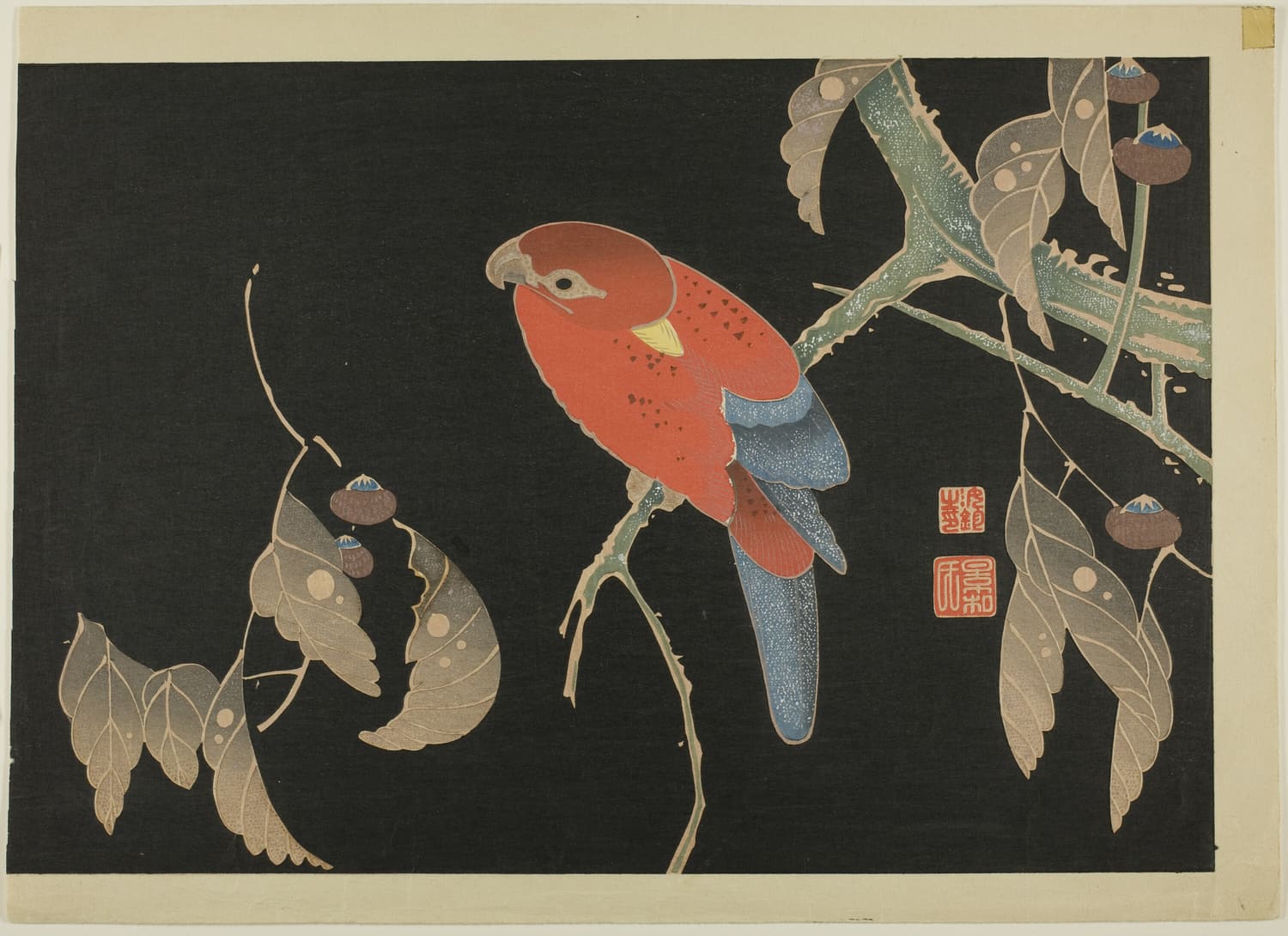
Few artistic traditions are as instantly recognizable, or as widely misunderstood, as that of Japan. A single woodblock print can evoke an entire culture, yet the term “traditional Japanese art” actually covers a vast and interconnected web of disciplines developed over more than a thousand years: ink painting, decorative gold-ground screens, refined ceramics for the tea room, calligraphy, lacquer, and the mineral-pigment painting that became known in the modern era as Nihonga.
For collectors, interior designers, and advisors approaching this field, the challenge is rarely a lack of beauty. It is knowing how the pieces relate to one another, why one work commands a few hundred dollars and another several million, and how a centuries-old object or a contemporary painting in the same lineage can live convincingly in a present-day home or hospitality space. This guide is built to answer those questions in order.
We will move from the aesthetic principles that underpin the whole tradition, through its major forms and schools, into the materials that give the work its distinctive surface, and finally to the market and to the practical realities of acquiring and living with these pieces.
What Defines Traditional Japanese Art?
Before looking at individual forms, it helps to understand the sensibility they share. Japanese art history is usually mapped onto the country’s historical periods, and a handful of period names recur constantly in catalogues and gallery labels. The Heian period (794–1185) established a refined court culture and the native painting style known as yamato-e. The Muromachi period (1336–1573) saw Zen Buddhism shape a spare ink-painting aesthetic. The Momoyama period (1573–1603) produced bold, gold-leafed screens for castles and palaces. The Edo period (1603–1868), a long era of relative peace under the Tokugawa shogunate, gave rise to the urban print culture of ukiyo-e. The Meiji period (1868–1912) opened Japan to the West and forced a creative reckoning that produced Nihonga as a self-conscious modern category.
Core Aesthetic Principles
Several ideas run through the tradition regardless of medium. The first is an embrace of empty space. The Japanese term ma describes the charged interval or negative space within a composition, the silence that gives the marks their meaning. A hanging scroll may leave most of its surface blank, trusting the viewer to complete the scene.
The second is wabi-sabi, an appreciation of imperfection, transience, and the marks of age and use. It is felt most directly in tea ceramics, where an asymmetrical bowl or an irregular glaze is prized rather than corrected. The third is a deep attentiveness to season and natural cycle: cherry blossom, maple, snow, and migrating birds are not merely decorative motifs but a shared visual calendar.
Finally, much Japanese art was made to be lived with rather than permanently displayed. Hanging scrolls were rotated in and out of storage to suit the season or the occasion, and folding screens were moved through a room as needed. This is a tradition that has always understood art as part of daily life and architecture, a point that becomes important when we consider interiors later on.
The Major Forms and Schools
What follows is a working map of the disciplines and lineages a collector will encounter most often. These categories overlap, and many artists worked across more than one, but understanding them individually is the fastest route to reading a catalogue with confidence.
Ink Painting and the Sumi-e Tradition
Sumi-e (literally “ink picture”), also called suiboku-ga, is monochrome painting in sumi, a black ink ground from soot and animal glue and dissolved in water. Arriving from China alongside Zen Buddhism, it reached its Japanese summit in the Muromachi period. The priest-painter Sesshū Tōyō (1420–1506) remains the towering figure, his landscapes built from confident, tonally graded brushwork in which the unpainted paper reads as mist, water, or sky.
Ink painting rewards economy. A few strokes describe a branch or a mountain ridge, and the discipline prizes the trained gesture that cannot be revised. For collectors, autograph ink works by major historical hands are rare and closely studied; far more accessible are accomplished works by later literati painters and by twentieth-century masters who kept the idiom alive.
Ukiyo-e: Pictures of the Floating World
Ukiyo-e, “pictures of the floating world,” is the woodblock print tradition of the Edo period and the form most international audiences meet first. The “floating world” referred to the pleasure districts and entertainment culture of Edo (present-day Tokyo). Prints fell into recognizable genres: bijin-ga (images of beautiful women), yakusha-e (kabuki actor portraits), and landscape.
The landscape masters are the household names. Katsushika Hokusai (1760–1849) produced the series Thirty-six Views of Mount Fuji, which contains the image known in English as the Great Wave. Utagawa Hiroshige (1797–1858) created the celebrated travel series The Fifty-three Stations of the Tōkaidō. In the figural genres, Kitagawa Utamaro (c. 1753–1806) defined the elegant portrait of women, while the brief, brilliant career of Tōshūsai Sharaku (active 1794–1795) produced some of the most psychologically acute actor portraits in the tradition.
A crucial point for buyers is that ukiyo-e are multiples, not unique objects, and value depends heavily on which printing a given sheet comes from. An early impression, pulled when the woodblocks were fresh and the colors unfaded, can be worth many times a later impression of the identical design. Condition, color retention, trimming of the margins, and the absence of restoration all bear directly on price.
Rinpa and the Decorative Screen
The Rinpa school is the great decorative tradition of Japanese painting, defined by bold design, lavish use of gold and silver, and stylized natural motifs. It was effectively founded in the early Edo period by the painter Tawaraya Sōtatsu and the calligrapher-designer Hon’ami Kōetsu, and revived a generation later by Ogata Kōrin (1658–1716), from whose name the school takes its label.
Rinpa produced some of the most famous objects in all of Japanese art: Sōtatsu’s screens of the Wind God and Thunder God, Kōrin’s screens of irises, and the Red and White Plum Blossoms attributed to Kōrin. These works typically take the form of the byōbu, a folding screen, which functioned both as a room partition and as a major decorative statement. The format’s portability and impact make antique and later Rinpa-style screens perennially desirable for grand interiors.
The Kanō and Tosa Schools
Where Rinpa was a tradition of independent designers, the Kanō school was the official painting academy of the military elite. Active from the late fifteenth century through the Edo period, it served the shogunate and the great lords. Under Kanō Eitoku (1543–1590) it perfected the monumental gold-ground screen, with powerful pines, hawks, and tigers set against dazzling gold leaf, a style suited to the audience halls of castles.
The older Tosa school carried the native yamato-e tradition, specializing in classical literary and courtly subjects rendered in fine line and bright mineral color. Between them, Kanō and Tosa supplied much of the formal painting of the premodern Japanese state, and works in their manner remain a substantial category in the antique market.
Nihonga: Tradition Carried Into the Modern Era
Nihonga, meaning “Japanese-style painting,” is the term coined in the Meiji period to distinguish painting in traditional materials and techniques from yōga, Western-style oil painting newly arriving in Japan. It was not simply a continuation of the old schools but a deliberate, modern reinvention of them, championed by the critic Okakura Tenshin (Kakuzō) and the American scholar Ernest Fenollosa.
The first generation of Nihonga painters included Yokoyama Taikan and Hishida Shunsō, who experimented with atmospheric, almost line-less rendering. Later masters expanded the idiom in many directions: Uemura Shōen brought refined figure painting to new heights, Hayami Gyoshū produced jewel-like, meticulously observed works, and in the postwar era Higashiyama Kaii and Kayama Matazō reached very wide audiences. The contemporary painter Hiroshi Senju, internationally known for his large waterfall paintings made with natural mineral pigments, demonstrates that Nihonga remains a living, evolving practice rather than a museum category.
For buyers furnishing contemporary spaces, Nihonga occupies a particularly useful position: it is unmistakably rooted in Japanese tradition, yet its scale, abstraction, and luminous surfaces sit comfortably alongside modern architecture and furniture. We return to this point in the interiors section below.
Ceramics, Calligraphy, and Lacquer
Painting is only part of the story. Japanese ceramics are a world unto themselves, shaped above all by the tea ceremony (chanoyu). The most revered tea wares include Raku, a hand-formed, low-fired ware closely tied to the sixteenth-century tea master Sen no Rikyū; the rustic stonewares of Bizen, Shino, Oribe, and Hagi; and, in porcelain, the refined Imari, Kakiemon, and Kutani wares that were also exported to Europe in great quantity.
Shodō, the art of calligraphy, treats the written character as a vehicle for expressive line and remains among the most esteemed of the arts, though it can be the hardest for non-Japanese readers to evaluate. Urushi, lacquer derived from the sap of the lacquer tree, produces objects of extraordinary depth and durability, often decorated with maki-e, designs built up from sprinkled gold and silver powder. Together these media round out a tradition in which surface, material, and craft are never secondary to image.
Materials and Techniques That Define the Tradition
Much of what distinguishes Japanese painting from its Western counterparts lies not in subject but in substance. The supports, pigments, and binders carry their own history and largely determine how a work ages, how it should be conserved, and how it reads under different lighting. The following table summarizes the core materials a collector should know.
| Material | Japanese term | What it is |
|---|---|---|
| Mineral pigments | iwa-enogu | Pigments ground from minerals such as azurite and malachite, bound with animal glue |
| Shell white | gofun | White pigment made from ground and aged seashell |
| Handmade paper | washi | Paper from mulberry, mitsumata, or gampi fiber, strong and long-lived |
| Ink | sumi | Solid ink stick of soot and glue, ground with water on a stone |
| Lacquer | urushi | Tree-sap lacquer cured in humidity to a hard, glossy surface |
| Gold leaf | kinpaku | Hammered gold applied as backgrounds and accents |
Iwa-enogu and Mineral Pigments
Iwa-enogu are the natural mineral pigments at the heart of Nihonga and of classical mineral-color painting. Blue traditionally comes from azurite (gunjō), green from malachite (rokushō), and other hues from a range of ground minerals and, in modern practice, manufactured equivalents. The minerals are crushed and graded by particle size, and the size matters greatly: coarse particles yield deep, saturated tones, while finer grinds of the same mineral produce paler, more delicate shades.
Because these pigments are not dissolved but suspended, they are bound to the support with nikawa, a warm animal-hide glue mixed by the painter. The result is a granular, light-catching surface quite unlike the flat film of oil or acrylic. It is also why genuine mineral-pigment works can look so different under daylight versus artificial light, a practical consideration for placement that designers learn to anticipate.
Washi, Silk, and Sumi
Japanese paintings are executed on washi, handmade paper, or on silk, both of which are absorbent and unforgiving in a way that suits the controlled brush. Washi made from the inner bark of the paper mulberry is exceptionally strong and, kept in good conditions, can survive for centuries. Silk offers a smoother, more luminous ground favored for fine figure painting.
The brush charged with sumi ink is the foundational tool. Because the ink soaks immediately into paper or silk, the painter cannot correct a stroke, and the entire aesthetic of decisiveness and economy follows from that physical fact. Understanding the support helps a collector judge condition: foxing, water staining, and old repairs to paper and silk are common and materially affect value.
Gold Leaf and Urushi
Gold leaf, or kinpaku, is the signature of the Momoyama screen and of much Rinpa work. Applied as a continuous ground, it does not merely glitter; it returns ambient light into the room, which is why gold-ground screens read so powerfully in low or candle-lit interiors and remain a favored device in contemporary lobbies and reception spaces.
Urushi lacquer is a craft of patience, built up in many thin coats that each cure slowly in humid conditions. Decorated with maki-e gold and silver powder, lacquer boxes, trays, and writing implements represent some of the finest applied art Japan produced. For collectors, condition is paramount: lacquer is durable but sensitive to dryness and direct sun, which can cause crazing and lifting over time.
The Market for Traditional Japanese Art
The market for traditional Japanese art is broad and unusually accessible at its entry levels, while its peaks rival any field in fine art. A single category such as ukiyo-e spans from affordable later impressions to multimillion-dollar early sheets, which makes it essential to understand what actually drives value before buying.
What Drives Value
Across media, a consistent set of factors determines price. Attribution and the security of an artist’s signature or seal sit at the top; a confirmed autograph work by a major name behaves very differently from a school or workshop piece. Condition is decisive everywhere, but especially for works on paper and silk, where fading, staining, and restoration are common. Rarity matters, and for prints specifically the quality and earliness of the impression can change value by an order of magnitude. Provenance, a documented history of ownership and exhibition, adds both confidence and premium. Finally, subject and period shape desirability, with iconic images and celebrated eras commanding the strongest demand.
Notable Records and Price Ranges
Hokusai’s Great Wave is the clearest illustration of how impression and condition compound. In March 2023, a fine early impression sold at Christie’s New York for $2.76 million (about ¥360 million) against an estimate of $500,000 to $700,000, setting an auction record for the artist; the previous record had been set in 2021 when another Great Wave print sold for $1.59 million. :antCitation[]{citations=”86b9c710-8c01-428a-a1c1-3177b4be9844″ injected=”space”} The following year, in March 2024, a complete set of Hokusai’s Thirty-six Views of Mount Fuji achieved $3,559,000 at Christie’s, a new record for the artist.
:antCitation[]{citations=”44269fe7-747c-4169-8bc9-500388a0e590″ injected=”space”}
Those headline figures sit atop a much larger and more approachable market. Christie’s has noted that other copies of the Great Wave sold in recent years have ranged from a few hundred thousand dollars to over $1.5 million, :antCitation[]{citations=”a5162df5-d0c7-4ffb-bf3e-638d3516be0f” injected=”space”} depending entirely on impression and condition, and the wider world of ukiyo-e by Hokusai, Hiroshige, and their contemporaries regularly offers accomplished sheets from the low thousands into the tens of thousands of dollars. The table below gives an orientation to typical ranges; actual prices vary widely with condition, attribution, and the individual work.
| Category | Indicative range (USD) | Key value drivers |
|---|---|---|
| Ukiyo-e prints, later or common impressions | Hundreds to low thousands | Impression, condition, color retention |
| Ukiyo-e prints, fine early impressions of major designs | Tens of thousands to several million | Earliness, rarity, iconic subject |
| Antique screens and scrolls (school works) | Low thousands to six figures | Attribution, condition, size, subject |
| Twentieth-century and contemporary Nihonga | Low thousands to high six figures | Artist reputation, scale, period, subject |
| Tea ceramics and lacquer | Hundreds to six figures and above | Maker, provenance, association with tea |
For Nihonga specifically, the market is anchored by established twentieth-century masters and a number of sought-after living artists. Works by major names appear regularly at the international houses and at specialist Japanese auctions, with values ranging from the low thousands for minor works to the high six figures for important paintings by the most celebrated hands. These figures reflect Christie’s, Sotheby’s, and Bonhams Asian-art sales together with the Tokyo auction market; because the field is less standardized than Western painting, expert appraisal of any specific work is well worth the cost before acquisition.
Living With Traditional Japanese Art
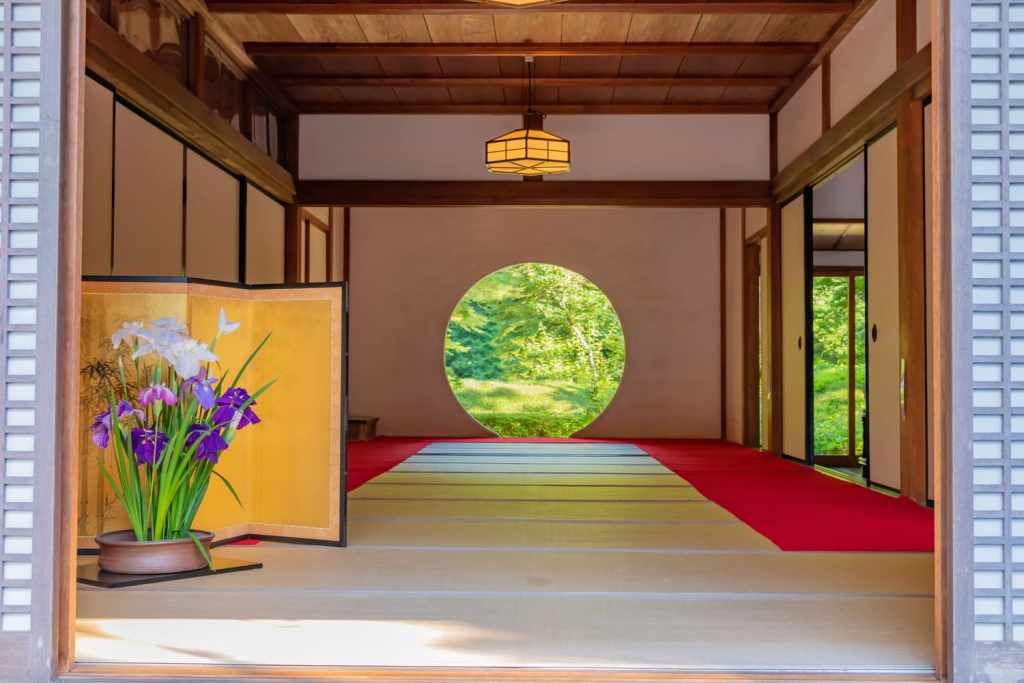
One of the quiet advantages of this tradition is that it was designed for domestic and architectural settings from the outset, which makes it remarkably adaptable to contemporary interiors. The same qualities that defined it historically, restraint, an awareness of empty space, and a palette drawn from nature, allow it to anchor a room without overwhelming it.
Scale, Format, and Light
The traditional formats map neatly onto modern spaces. The kakemono or hanging scroll was made for the tokonoma, the recessed display alcove of a Japanese room, and its vertical proportion suits a focused, intimate wall. The byōbu folding screen, by contrast, is a horizontal statement that can divide a large open-plan space or fill a long wall in a lobby or dining room. Nihonga panels and contemporary works in mineral pigment offer the flexibility of conventional framing.
Light is the single most important variable. Mineral pigments and gold leaf are alive to changing illumination, glowing under warm light and revealing their granular texture in daylight, so placement relative to windows and lamps genuinely changes how a work performs. A waterfall or landscape in mineral color can bring a sense of depth and calm to a reception area, while a gold-ground screen animates a space that might otherwise feel flat.
Conservation in Lived-In Spaces
Living with these works responsibly means respecting their materials. Works on paper and silk are sensitive to strong direct sunlight, which fades pigment over time, and to swings in humidity, which stress mounts and supports. The traditional practice of rotating scrolls in and out of display was itself a conservation measure, and it remains a sound one.
Stable temperature and humidity, protection from direct sun, and professional handling of any mounting or framing will keep a piece sound for generations. None of this makes the work fragile or impractical; it simply means treating it as the long-lived object it is. With sensible placement, traditional and contemporary Japanese pieces alike thrive in everyday residential and commercial environments.
For readers who have followed the tradition this far, the natural next step is to see how its living branch, Nihonga in natural mineral pigments, looks when chosen for a real room. Works in exactly this lineage, made for the homes and commercial spaces described above, can be explored directly.
Discover Nihonga for Contemporary Spaces
Shop carefully selected Nihonga,
curated by experienced Japanese art dealers
for homes and commercial spaces worldwide.