
Ink & Calligraphy
Zen Art Painting: A Guide to Zenga, Masters, and Collecting
Zen art painting occupies a singular position in the history of world art. Unlike virtually every other major tradition of visual art, zenga (禅画, Zen pictures) was not made primarily to be beautiful, to please a patron, or to document the visible world. It was made to transmit an experience — the direct, unmediated confrontation with reality that Zen Buddhist practice calls enlightenment — through the most economical possible means: a few strokes of black ink on white paper, executed in a state of non-deliberation, offered without preamble to whoever encountered them. That this tradition also produced some of the most visually arresting and conceptually powerful works in the history of Japanese art is, from the Zen perspective, incidental.
From the collector’s perspective, zenga represents a category of Japanese art that is simultaneously deeply traditional and radically modern — works that feel as contemporary in their gestural directness as anything produced by the Abstract Expressionists, while rooted in a philosophical tradition that is over a millennium old. This guide covers the origins and philosophy of Zen art painting, its principal subjects and techniques, the great monk-painters who defined it, and the practical considerations for collectors and interior designers who want to acquire and live with these extraordinary works.
What Is Zen Art Painting? Zenga and Its Origins
The word zenga is a compound of Zen (禅, the Japanese pronunciation of the Chinese Chan, itself derived from the Sanskrit dhyana, meaning meditation or contemplative absorption) and ga (画, picture or painting). It designates paintings and calligraphic works produced by Zen Buddhist monks primarily as tools for teaching and spiritual transmission — not as aesthetic objects for display, not as luxury goods for wealthy patrons, and emphatically not as demonstrations of technical virtuosity.
The Relationship Between Zen Buddhism and Visual Art
Zen Buddhism arrived in Japan from China in two major transmissions. The Rinzai school (臨済宗) was established in Japan by the monk Eisai (栄西, 1141–1215), who traveled to China and returned with the teaching lineage he had received there; the Soto school (曹洞宗) was brought by Dogen (道元, 1200–1253), one of the most original philosophical minds in Japanese Buddhist history. Both schools had their visual dimensions, but it is primarily the Rinzai tradition — with its emphasis on sudden enlightenment, koan practice, and the direct encounter with the teacher — that produced zenga as a distinct art form.
The relationship between Zen and art is not one of decoration or devotion in the sense familiar from Western religious art. Zen doctrine holds that elaborate ritual, doctrinal study, and even the most sophisticated intellectual engagement with Buddhist philosophy are ultimately obstacles to direct awakening. What is required is not learning but seeing — a direct, unobstructed perception of reality as it is, unfiltered by conceptual overlay. Visual art, in the Zen frame, is one of the possible vehicles for this transmission: a boldly painted Daruma staring from a scroll can cut through the viewer’s conceptual defenses in a way that a philosophical lecture cannot.
What Makes a Painting “Zen”?
Not every painting by a Zen monk is zenga, and the term is not defined by the religious identity of its maker but by the qualities of the work itself and the spirit of its making. A Zen painting is characterized by spontaneity — the sense that the marks were made without revision or deliberation, in a single committed gesture. It is characterized by economy — the maximum expressive effect achieved with the minimum of marks. It is characterized by humor — the willingness to use the absurd, the incongruous, and the deliberately crude as means of bypassing the viewer’s intellectual defenses. And it is characterized by a quality of direct presence that is difficult to define but immediately recognizable: the sense that the person who made these marks was fully inhabited in the moment of making them.
These qualities distinguish zenga from Chinese literati ink painting (which values refinement and scholarly allusion), from academic sumi-e training (which values technical mastery and adherence to established compositional conventions), and from decorative ink painting for commercial or courtly clients. Zenga works can look rough, even childlike. Hakuin Ekaku (白隠慧鶴, 1686–1769), the greatest of all zenga painters, once described his own brushwork as being like that of a child; the self-deprecation was both sincere and strategic — he knew perfectly well that the apparent clumsiness of his forms was more spiritually productive than any demonstration of technical polish could be.
The Philosophy Behind Zenga: Key Concepts
To look at Zen art painting with any comprehension requires at least a basic orientation to the philosophical concepts that generated it. These are not merely background information; they are the operative principles whose visual expression constitutes the art itself.
Mushin and the Stroke Without Deliberation
Mushin (無心, no-mind or no-thought) is the Zen Buddhist state in which action arises directly from the situation rather than from deliberate mental planning. In martial arts, it is the condition of a master swordsman who responds to an attack without the millisecond of conscious planning that would make the response too slow; in calligraphy and painting, it is the state in which the brush moves without the painter thinking about where it should go. The stroke made from mushin is not random — it carries all of the painter’s training, experience, and understanding — but it is not controlled in the ordinary sense either. It arises and completes itself with the inevitability of a natural event.
This concept is directly connected to the visual quality that distinguishes great zenga from competent zenga. A stroke made from mushin has a wholeness, a continuity from beginning to end, that a deliberated stroke lacks. The brush does not hesitate, does not correct itself, does not betray the moment at which the painter’s confidence wavered. This is why zenga practitioners speak of the entire preparation for a work — the grinding of the ink, the settling of the breath, the centering of the mind — as more important than the brushwork itself. The painting is the record of a state, not the product of a plan.
Ensō: The Circle That Contains Everything
The ensō (円相, literally “circle-form”) is the single most iconic image in all of Zen art. Executed in a single brushstroke on a large sheet of washi, the ensō represents simultaneously the void, the fullness of the universe, enlightenment, imperfection, and completeness. Some ensō are closed circles; others leave a small gap where the brushstroke began and ended without meeting. Some are thick and heavily inked; others are the thinnest trace of diluted gray. Some are perfectly round; others are uneven, asymmetric, bearing the full evidence of the speed and pressure variations of a single human stroke. Each of these variations is not a flaw but an expression: the painter’s ensō reveals something about the painter’s state of mind in the moment of making it that cannot be conveyed in words.
Ensō works are frequently accompanied by calligraphied inscriptions — a brief Zen phrase, a poem fragment, a paradoxical statement — that do not explain the circle but stand alongside it as a complementary transmission. The relationship between the image and the text in a zenga work is typically non-hierarchical: neither illustrates the other; both point toward the same inexpressible thing from different angles.
Mu, Koan, and the Vocabulary of Zen Awakening
Several other conceptual pillars of Zen appear consistently as subjects of zenga calligraphy and painting. Mu (無, nothingness or emptiness) — the answer to the first koan in the Mumonkan (無門關, “The Gateless Barrier,” a 13th-century Chinese collection of Zen koans) — is perhaps the single most common calligraphic subject in the zenga tradition. A single large 無 brushed in bold, saturated ink makes a visual and conceptual statement of extraordinary economy: the character that means “nothing” or “not” becomes, in the context of Zen practice, the pointer toward an experience that language cannot contain.
Koan (公案) practice — the use of paradoxical questions to cut through ordinary conceptual thinking — is the distinctive pedagogical method of Rinzai Zen. Hakuin standardized a curriculum of koans that remains in use in Rinzai training today, and the most famous of his contributions to this curriculum is the question 隻手の声 (sekishu no koe, “the sound of one hand”) — usually rendered in English as “what is the sound of one hand?” This question, which cannot be answered through ordinary reasoning, is frequently inscribed in zenga calligraphy works, often by Hakuin himself. Encountering it in a work is not an invitation to think but to stop thinking.
The Subjects of Zen Art Painting
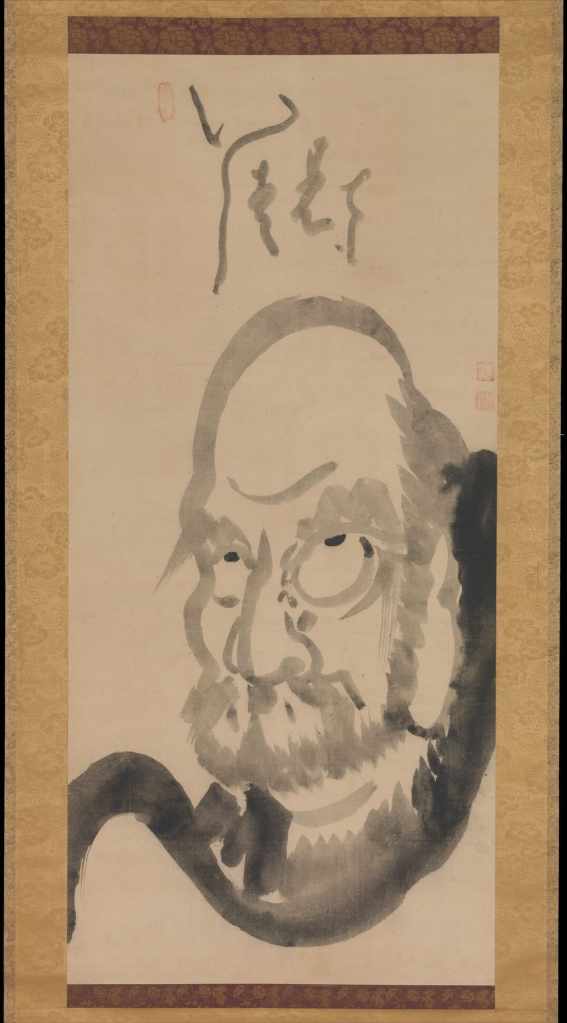
Source: The Metropolitan Museum of Art(https://www.metmuseum.org/art/collection/search/78145)
Zenga employs a relatively small repertoire of recurring subjects, each of which carries specific Zen connotations and each of which has been reimagined by successive generations of monk-painters with remarkable variation within apparent constraint. Understanding these subjects is the foundation of reading zenga works with any depth.
Daruma: The Patriarch and His Many Faces
Bodhidharma — known in Japan as Daruma (達磨) — is the legendary Indian Buddhist monk credited with bringing Chan/Zen to China in the fifth or sixth century CE. According to tradition, he spent nine years sitting in meditation facing a cave wall at Shaolin in Henan Province, achieving such depth of concentration that his arms and legs withered from disuse. His portraits in zenga — invariably frontal, occupying most of the picture surface, with enormous eyes (conveying both ferocity and the awakened gaze that sees through all appearances) and a large robe that fills the lower half of the composition with a single mass of ink — are among the most immediately recognizable images in all of Japanese art.
The Daruma is the zenga subject in which the greatest variation in approach and expression is visible. Hakuin’s Darumas are often overwhelming in their presence — massive, urgent, confrontational — executed with such muscular brushwork that the image seems to press forward from the paper. Sengai Gibon’s Darumas, by contrast, are often almost comically simplified, with an open warmth that dissolves the fierce patriarch into a round, approachable figure whose gaze invites rather than challenges. Neither approach is more orthodox than the other: the appropriateness of any Daruma is measured not by fidelity to an iconographic convention but by whether it transmits the Zen understanding of the painter who made it.
Hotei, Kanzan, and Jittoku: Figures of Enlightened Spontaneity
Hotei (布袋) — the laughing figure with an enormous belly and a large sack, widely known in the West through the mass-produced figurines placed in Chinese restaurants — is in his zenga incarnation a genuinely profound subject. He is one of the Seven Lucky Gods of Japanese popular religion, but in Zen iconography he represents the enlightened person who moves through the ordinary world without being contaminated by its concerns, carrying all his possessions in a single bag, his laughter a spontaneous response to the perfection of what is. A zenga Hotei by Hakuin or Sengai is not a decorative good-luck charm but a teaching: an image of the freedom that Zen practice aims at, rendered with the same brushwork freedom.
Kanzan and Jittoku (寒山拾得) are two eccentric Tang dynasty monk-poets from China — Hanshan (Cold Mountain) and Shide in Chinese — who appear in zenga as a pair: laughing together, their robes disheveled, their expressions of delight at once undignified and utterly liberated. They represent the companionship of enlightened friendship and the irreverence for social convention that genuine Zen practice cultivates. The paired depiction is a common zenga compositional form, and the best examples capture in two figures the quality of effortless, joyful presence that the entire tradition aims at.
Calligraphy, Koan, and Nature Subjects
Much of what is classified as zenga is primarily calligraphic rather than pictorial — single characters, short phrases, koan text, and classical poem fragments brushed in a style that has entirely shed the formal constraints of academic calligraphy training. The characters Mu (無), Ku (空, emptiness or sky), and Shin (心, heart or mind) are among the most frequently encountered calligraphic subjects. Short phrases that encapsulate specific Zen teachings — “before enlightenment, chop wood, carry water; after enlightenment, chop wood, carry water” — appear in the inscriptions of many zenga works.
Nature subjects in zenga — bamboo in wind, pine branches, mountains seen through mist, moonlight on water — carry the same philosophical freight as the figure subjects, with the difference that the communication is purely visual rather than iconographic. A zenga bamboo is not a Rinpa school bamboo in its delicate compositional elegance; it is brushed with the speed and conviction of direct encounter, its few strokes capturing the essence of bamboo — its flexibility, its uprightness, its hollow interior — rather than its botanical appearance. The Buddhist teaching embedded in bamboo — that strength lies in flexibility, that emptiness at the center is precisely the source of resilience — is transmitted in the brushwork itself, not in any accompanying text.
Great Masters of Zen Art Painting
The zenga tradition produced several figures of extraordinary creative power. Their work spans roughly three centuries and represents the full range of approaches — from ferocious intensity to comic warmth — that the tradition makes possible.
Hakuin Ekaku: The Defining Voice of Zenga
Hakuin Ekaku (白隠慧鶴, 1686–1769) is, by consensus, the most important figure in the history of zenga and one of the most significant religious figures in Japanese Buddhist history. Born in Hara, a post-station town at the foot of Mount Fuji, he entered monastic life at fifteen and underwent a prolonged spiritual crisis in his twenties that eventually resolved into the deep, sustained realization he spent the rest of his life transmitting. He revitalized the Rinzai school of Zen Buddhism, which had become institutionally established but spiritually stagnant, and his systematization of koan practice — organizing the available koans into a sequence of increasing subtlety — remains the foundation of Rinzai training today.
Hakuin began producing the paintings and calligraphy for which he is now internationally known relatively late in his life — primarily from his fifties and sixties onward — and his stated motivation was not aesthetic but pedagogical. He lived in a rural area, his followers were largely poor farmers and artisans who could not afford formal Zen training, and he produced images — Daruma figures, ensō circles, inscribed koans — that could transmit Zen teachings directly, without the mediation of monastic infrastructure. The visual power of these works, which he appears to have been fully aware of, was in the service of this transmission, not a separate concern.
The visual character of Hakuin’s work is unmistakable. His brushwork is large, muscular, and uncompromising — strokes of densely saturated ink, often covering much of a large washi sheet with a single figure, are executed with a speed and force that leave no room for revision. His ensō circles vibrate with the energy of their making. His Daruma figures are among the most visually arresting portraits in the entire tradition — imposing, even intimidating, with an intensity of gaze that carries across a room. His calligraphy is bold, idiosyncratic, and entirely liberated from academic convention. And his humor — the warmth and humanity beneath the ferocity — is consistently present, particularly in his depictions of Hotei, in his smaller-scale works for individual followers, and in the inscriptions that accompany his larger compositions.
Hakuin’s works have appeared at major international auction houses including Christie’s and Sotheby’s, and they command strong prices among collectors who recognize both their art historical importance and their visual and philosophical power. The market for his works has grown significantly among Western collectors over the past three decades, as the connection between zenga brushwork and the gestural abstraction of postwar Western painting has become more widely recognized.
Sengai Gibon: The Laughing Abbot
If Hakuin represents the fierce, urgent, demanding aspect of zenga, Sengai Gibon (仙厓義梵, 1750–1837) represents its warm, playful, and infinitely approachable counterpart. Sengai served as the abbot of Shofuku-ji (聖福寺) in Hakata — present-day Fukuoka — which Eisai had established as Japan’s first Zen temple when he returned from China in 1195. At the age of sixty-two, having served the temple for three decades, Sengai retired from official duties and spent the final quarter-century of his life in near-continuous production of paintings and calligraphy that he distributed freely to anyone who asked, refusing payment.
The resulting body of work is among the most beloved in all of Japanese art. Sengai’s style is deliberately simple — his forms are sometimes almost childlike in their reduction — and his inscriptions are often short, humorous poems that communicate the same Zen insight as a koan but through laughter rather than paradox. His famous Zen no Zu (禅の図, “Zen Diagram”) — a circle, a triangle, and a square drawn with casual mastery and accompanied by an enigmatic inscription — has become one of the iconic images of Zen visual culture internationally. His depiction of a frog perched at a pond edge, inscribed with a visual pun on Matsuo Basho’s famous haiku (古池や 蛙飛び込む 水の音, “Old pond — a frog jumps in — sound of water”), combines art-historical reference, humor, and Zen teaching in a single small composition of remarkable efficiency.
The largest collection of Sengai’s works is held by the Idemitsu Museum of Arts (出光美術館) in Tokyo, which acquired a substantial portion of the original Sengai collection and has published extensively on his life and work. His works appear less frequently at international auction than Hakuin’s — many of the finest pieces remain in institutional holdings — but examples do come to market through specialist dealers and occasionally at major Japanese auction houses.
Further Masters Worth Knowing
Beyond Hakuin and Sengai, several further figures in the zenga tradition reward the collector’s attention. Torei Enji (東嶺円慈, 1721–1792) was Hakuin’s most important Dharma heir — the student who most completely absorbed and transmitted his teacher’s spiritual realization — and his calligraphy, though less well known than his master’s paintings, is powerful and individual. Nantembo (南天棒, 1839–1925) — the Rinzai master whose name means “staff of the nanten plant,” after the walking staff he habitually carried and sometimes used to strike inattentive students — produced vigorous calligraphy and some painting during the Meiji and Taisho periods; his works bridge the classical zenga tradition and the modernizing cultural context of late nineteenth and early twentieth-century Japan.
Jiun Onko (慈雲飲光, 1718–1804) — technically a Shingon Buddhist rather than a Zen practitioner, but deeply immersed in Zen-inflected aesthetics — produced calligraphy of remarkable power, including a body of Sanskrit calligraphy (siddham script) that stands as a unique achievement within the broader tradition of Japanese ink art. His works appear at specialist auction and through dealers in Japanese Buddhist art. Fugai Ekun (風外慧薫, 1568–1654), an earlier Rinzai monk who worked in near-solitary conditions and produced vigorous Daruma paintings under circumstances of extreme ascetic practice, represents an earlier phase of the zenga tradition whose surviving works are among the rarest and most sought-after in the category.
| Artist | Dates | School | Style / Significance |
|---|---|---|---|
| Hakuin Ekaku (白隠慧鶴) | 1686–1769 | Rinzai Zen | Defining master of zenga; bold, confrontational, humorous; revived Rinzai school |
| Sengai Gibon (仙厓義梵) | 1750–1837 | Rinzai Zen | Warm, playful, accessible; abbot of Shofuku-ji, Hakata; distributed works freely |
| Torei Enji (東嶺円慈) | 1721–1792 | Rinzai Zen | Hakuin’s principal Dharma heir; powerful calligraphy; systematic transmission |
| Jiun Onko (慈雲飲光) | 1718–1804 | Shingon (Zen-influenced) | Extraordinary calligraphy including Sanskrit script; singular achievement |
| Fugai Ekun (風外慧薫) | 1568–1654 | Rinzai Zen | Early zenga master; ascetic conditions; vigorous Daruma paintings; rare |
| Nantembo (南天棒) | 1839–1925 | Rinzai Zen | Late Meiji / Taisho master; vigorous calligraphy; bridges tradition and modernity |
Zenga and the Western Art World
The reception of Zen art painting in the West is a story with significant consequences for how zenga is now understood and collected internationally. The primary conduit for Zen Buddhist thought to Western cultural audiences was the scholar and writer Daisetz Teitaro Suzuki (鈴木大拙, 1870–1966), whose writings on Zen — beginning with his “Essays in Zen Buddhism” (first series, 1927) and continuing through decades of publications and lectures — introduced Zen philosophy to a Western intellectual audience that was already receptive to Japanese cultural aesthetics following the encounter with ukiyo-e and Japonisme in the previous century.
From D.T. Suzuki to Abstract Expressionism
Suzuki’s lectures at Columbia University in New York in the early 1950s were attended by figures including the composer John Cage (1912–1992), whose subsequent development of chance-based composition and the famous silent piece 4’33” directly apply Zen principles — particularly the concept of non-intention and the elevation of environmental sound to musical status — to Western avant-garde practice. Cage in turn was a significant influence on the broader experimental art world of New York in the 1950s and 1960s, transmitting Zen-derived ideas into a cultural context that was simultaneously developing Abstract Expressionism, Fluxus, and other movements characterized by spontaneity, non-representation, and the foregrounding of process over product.
The visual parallels between zenga brushwork and Abstract Expressionist painting — particularly in the large-scale, gesture-based work of painters like Franz Kline, whose monumental black-and-white compositions bear obvious formal similarities to zenga calligraphy — are striking enough to have generated a substantial art-historical literature exploring whether these parallels reflect direct influence, parallel independent development, or a combination of the two. What is clear is that the mid-twentieth century encounter between Zen aesthetics and Western avant-garde visual culture produced a mutual recognition: Western artists saw in zenga a precedent for what they were attempting, and Western audiences encountering zenga for the first time found in it a visual language that felt simultaneously ancient and urgently contemporary.
This Western reception has had direct consequences for the zenga collector market. Works by Hakuin and Sengai, which were understood within Japan primarily as religious and cultural artifacts with limited commercial art-market engagement, began attracting serious international collector interest from the latter decades of the twentieth century onward. Major exhibitions — including important zenga shows at American institutions in the late twentieth century — introduced the tradition to broader museum-going audiences. The category is now firmly established in the programming of specialist Asian art departments at the major international auction houses, and the prices achieved for significant works reflect the depth of both Japanese and international collecting interest.
Collecting Zen Art Painting
Collecting zenga requires a somewhat different orientation than collecting Nihonga or ukiyo-e, because the works were made in a spirit of radical non-attachment to their own physical survival. Hakuin distributed his paintings without concern for whether they would be preserved; Sengai gave his works to anyone who asked. The result is that zenga survives in an unusually wide range of condition states, and the condition assessment that applies to other categories of Japanese art on paper requires some modification.
What to Look For in a Zenga Work
The primary quality criterion in zenga is not technical polish but the quality of presence — the sense that the painter was fully inhabited in the moment of making the marks, and that this inhabitation is transmitted through the work to anyone who looks at it with appropriate attention. This quality cannot be reduced to measurable technical criteria, but it is recognizable through experience: works that have it create a particular quality of stillness and charge in the viewer; works that lack it — competent imitations, works by students who have learned the forms without the understanding, or outright forgeries — produce a subtler, flatter response.
Ink quality is one objective indicator. Genuine zenga works from the classical period — Hakuin’s lifetime and the generations immediately following — were made with hand-ground ink of varying quality, producing a range of tonal values that factory-produced ink cannot replicate. The pooling, the dry-brush fraying at the edge of fast strokes, and the tonal gradation from a saturated beginning to a lighter trailing end that characterize brush behavior with hand-ground sumi are visible under close examination and are consistent evidence of period production.
Inscriptions and seals require the same careful attention as in any category of Japanese art. Hakuin’s seal impressions are documented from multiple works in institutional collections, and consistency with these documented examples is a standard authentication check for works attributed to him. The style of the calligraphied inscriptions — their character forms, the rhythm and pressure of their execution — should be consistent with documented works. For collectors approaching zenga at significant price levels, specialist advice and, where possible, access to published catalogues raisonnés or scholarly studies of the specific artist’s work, is essential.
Price Ranges and the Zenga Market
The zenga market encompasses a wide range of price points, from accessible contemporary works by living practitioners inspired by the tradition to rare historical works by major figures that command institutional-grade prices at major auction. The following table provides a general orientation.
| Category | Entry Level | Mid-Range | Major / Institutional Works |
|---|---|---|---|
| Contemporary zenga-inspired calligraphy | $300–$3,000 | $3,000–$15,000 | $15,000–$60,000+ |
| Hakuin Ekaku works | $5,000–$20,000 | $20,000–$100,000 | $100,000–$500,000+ |
| Sengai Gibon works | $3,000–$15,000 | $15,000–$60,000 | $60,000–$300,000+ |
| Other Edo-period Rinzai monk-painters | $1,000–$8,000 | $8,000–$50,000 | $50,000–$200,000+ |
| Meiji / Taisho era zenga (Nantembo, etc.) | $1,000–$5,000 | $5,000–$30,000 | $30,000–$100,000+ |
Price ranges above reflect general market observations across specialist dealers, Japanese auction houses, and major international sales at Christie’s, Sotheby’s, and Bonhams. Significant variations exist based on the specific work’s quality, size, condition, and provenance. The Hakuin market in particular has strengthened substantially over the past two decades, reflecting both growing Japanese institutional interest and the deepening of the international collector base.
Displaying Zenga in Contemporary Spaces
Zen art painting presents itself to contemporary interior contexts with a directness and visual authority that requires no cultural explanation. A large Hakuin ensō — a single ink circle occupying most of a wide sheet of washi — installs as naturally in a minimalist contemporary apartment as in a traditional Japanese reception room, because its visual language is genuinely universal: the circle, the brushstroke, the white field. No knowledge of Zen Buddhism is required to register the presence of a great ensō; the experience of the work precedes and exceeds any conceptual framework brought to it.
In a residential context, zenga works perform best in spaces designated for quiet activity: a study or library, a meditation or yoga room, a bedroom or private sitting room where the work can be encountered repeatedly at close range. The humor and humanity of Sengai’s Hotei or his frog image, and the warm accessibility of his simpler ensō works, are particularly suited to domestic environments where severity would be unwelcome. Hakuin’s more confrontational Daruma images — which can feel almost overwhelming at close range — belong in spaces with enough physical distance for the work to be seen whole, and enough visual silence in the surrounding environment for its presence not to be diffused.
Commercial and hospitality contexts benefit from zenga’s ability to communicate depth and cultural intelligence without requiring explanation. A large ensō in conservation framing behind a hotel reception desk, or a Sengai-style circle-triangle-square in a wellness or spa reception, signals an engagement with Japanese aesthetic philosophy that discerning guests will recognize and appreciate. The scale of zenga works — many are executed on large sheets of washi, often 100 centimeters or more in the longest dimension — suits commercial wall spaces well, and the bold simplicity of the compositions reads effectively at a distance.
Whether displayed in kakejiku (掛け軸, hanging scroll) format — the native presentation of most zenga works, which integrates them into the Japanese domestic tradition of seasonal rotation and contemplative display — or in conservation framing for Western-style permanent installation, zenga works benefit from display environments in which their internal silence is respected: plain walls, minimal adjacent objects, and lighting that does not compete with the work’s own luminosity. The paradox at the heart of zenga is that works made with deliberate disregard for their own aesthetic quality turn out, at their greatest, to be among the most aesthetically compelling works in the entire Japanese tradition. The collector who understands this paradox is ready to collect zenga seriously.
For those drawn to the visual simplicity and philosophical depth of Zen art painting, the broader tradition of Japanese ink art — Nihonga in mineral pigments, calligraphy in bold brushwork, sumi-e landscapes — offers a spectrum of closely related works in which the same spirit of direct material encounter animates a wider range of subjects and techniques.
Discover Nihonga for Contemporary Spaces
Shop carefully selected Nihonga,
curated by experienced Japanese art dealers
for homes and commercial spaces worldwide.