
Nihonga & Japanese Painting
Traditional Japanese Painting: Schools and Styles Explained
- Japanese Painting Styles at a Glance
- Yamato-e: The Native Japanese Painting Tradition
- The Kano School: Official Painters of the Shogunate
- The Rinpa School: Decorative Power and Natural Beauty
- Maruyama-Shijō and Nanga: Edo Painting Beyond the Official Schools
- Nihonga: Traditional Japanese Painting in the Modern Era
- Collecting and Displaying Traditional Japanese Painting
- Discover Nihonga for Contemporary Spaces
Traditional Japanese painting is not one style but a family of schools that developed over more than a thousand years. Its core is painting with ink and mineral pigments on paper or silk, in the formats of the hanging scroll, folding screen, sliding-door panel and handscroll. The main traditions are yamato-e (native court painting), the Kano school (official painters to the shoguns), Rinpa (decorative nature painting), the Maruyama-Shijō school (naturalistic observation), nanga (literati painting) and, from the Meiji era onward, Nihonga.
This guide sorts those schools by period, look and key artists, then explains the materials they share and how to collect and display traditional Japanese painting today. It covers painting only; for the wider field of traditional Japanese art, including ceramics, lacquer and prints, see our other guides.
Japanese Painting Styles at a Glance
The table below is a quick map of the major schools. Each is covered in more detail in the sections that follow.
| School | Period | Hallmarks | Key artists |
|---|---|---|---|
| Yamato-e / Tosa school | Heian period onward; Tosa school to the Edo period | Native Japanese subjects, opaque mineral pigments, flat decorative space, picture scrolls (emaki) | Tosa Mitsunobu |
| Kano school | Late 15th century to the end of the Edo period | Chinese-derived ink brushwork combined with color; monumental gold-ground screens and sliding doors | Kano Masanobu, Kano Motonobu, Kano Eitoku, Kano Tanyu |
| Rinpa | 17th–19th centuries | Bold flat color, gold and silver grounds, nature motifs, the tarashikomi wet-on-wet technique | Hon’ami Kōetsu, Tawaraya Sōtatsu, Ogata Kōrin, Sakai Hōitsu, Suzuki Kiitsu |
| Maruyama-Shijō school | 18th–19th centuries | Sketching from life (shasei), naturalistic birds, flowers and landscapes | Maruyama Ōkyo, Matsumura Goshun |
| Nanga / bunjin-ga (literati painting) | 18th–early 20th centuries | Scholar-poet ideal, Chinese literati models, personal expressive brushwork | Ike no Taiga, Yosa Buson, Tomioka Tessai |
| Nihonga | Meiji era to today | Mineral pigments and glue on washi or silk, adapted to modern subjects; defined against Western-style oil painting (yōga) | Yokoyama Taikan, Hishida Shunsō, Uemura Shōen, Hayami Gyoshū, Higashiyama Kaii |
Yamato-e: The Native Japanese Painting Tradition
The distinction between yamato-e (大和絵, “Japanese pictures”) and kara-e (唐絵, “Chinese pictures”) runs through the whole history of traditional Japanese painting. Yamato-e, developed at the Heian court, is defined by Japanese subjects such as seasonal scenes, court narratives and famous places; by dense, opaque mineral pigments; by flat decorative compositions; and by the pairing of calligraphy and image.
The Heian Court and the Tsukuri-e Technique
The Heian period (794–1185) was the crucible of Japanese painting as a distinct cultural form. The court at Heian-kyō (present-day Kyoto) produced The Tale of Genji (源氏物語, c. 1010), often called the world’s first full novel, and a painting tradition as specifically Japanese as the literature it illustrated.
In the tsukuri-e (作り絵) technique, paint is built up in dense, opaque layers of mineral pigment—gofun (胡粉, oyster-shell white), rokushō (緑青, malachite green), gunjō (群青, azurite blue) and bengara (弁柄, iron oxide red)—over an ink underdrawing, and faces are then added over the paint in minimal ink strokes. The result is simultaneously flat and spatially complex: interiors seen from a high angle, figures arranged as pattern within decorative space.
Emaki: Narrative Painting in the Scroll Format
The emaki (絵巻, “picture scroll”), unrolled from right to left to reveal narrative scenes in sequence, is the masterwork format of Heian and Kamakura-period (1185–1333) yamato-e. The Tale of Genji scroll (源氏物語絵巻), made in the early twelfth century, is the supreme example; its surviving fragments are held by the Tokugawa Art Museum in Nagoya and the Gotoh Museum in Tokyo.
Other celebrated emaki include the Ban Dainagon scrolls (伴大納言絵巻, late twelfth century, Idemitsu Museum of Arts, Tokyo), known for dynamic crowd scenes, and the Chōjū-jinbutsu-giga (鳥獣人物戯画, “Frolicking Animals,” Kōzan-ji, Kyoto), playful ink drawings of animals acting as humans that show a free ink mode alongside the polychrome one.
The Tosa School: Yamato-e into the Edo Period
The Tosa school (土佐派) preserved the yamato-e tradition from the medieval period through the Edo period (1615–1868) as painters to the imperial court in Kyoto. Tosa Mitsunobu (c. 1434–1525) established the school’s identity, and later generations kept the tsukuri-e technique and classical literary subjects from the Tale of Genji and the Tales of Ise, with fine gold and silver in place of the Kano school’s ink-dominant manner.
The Kano School: Official Painters of the Shogunate
No school shaped traditional Japanese painting more than the Kano school (狩野派), which supplied official painters to Japan’s successive military governments from the late fifteenth century to the end of the Edo period—roughly four centuries. Its central achievement was to fuse Chinese Song and Ming ink painting with yamato-e color and composition, a language that could meet official commissions (castle screens, temple sliding doors) as well as private ones.
Kano Masanobu and Kano Motonobu: The Foundation
The school was founded by Kano Masanobu (c. 1434–1530), official painter to the Ashikaga shogunate in Kyoto. His son Kano Motonobu (1476–1559) consolidated its identity: he formalized its brushwork idiom (powerful, angular strokes and precise tonal control), systematized training, and established the hereditary master-to-student transmission that organized the school for four centuries. His fusuma (sliding-door) paintings for Zen temples in Kyoto, such as Reiun-in at Myōshin-ji, show the school’s early mastery of multi-panel composition.
Kano Eitoku and the Age of Great Screens
Kano Eitoku (1543–1590) is the greatest figure of the school at its most powerful. Working for Oda Nobunaga and Toyotomi Hideyoshi in the Azuchi-Momoyama period (1573–1615), when newly unified warlords expressed their power through spectacular architecture and art, he took the monumental gold-ground screen to its fullest realization. His “Chinese Lions” (唐獅子図屏風), in the Imperial Household Collections, shows two lions on gold with saturated color and enormous energy.
The gold-ground screen (kinpeki byōbu, 金碧屏風), in which mineral-pigment figures and landscapes float against applied gold leaf, is the defining art form of the Momoyama period. Most of Eitoku’s major commissions, including those for Nobunaga’s Azuchi Castle, were destroyed in the conflicts that followed.
Kano Tanyu and the Edo-Period Academic Style
Kano Tanyu (1602–1674) secured the school’s place in the new Tokugawa order. Appointed official painter (goyō eshi, 御用絵師) to the shogunate in Edo, he supervised paintings for Nijō Castle in Kyoto and worked at the Tōshō-gū shrine at Nikkō. At Nijō Castle, most of the Ninomaru Palace paintings of the Kan’ei era (1624–1645) are now replicas; the originals have been replaced since 1972 and are kept in the castle’s painting gallery. Tanyu’s style, more restrained and elegantly composed than Eitoku’s drama, set the standard for Kano-school work for the next two centuries.
The Rinpa School: Decorative Power and Natural Beauty
The Rinpa school (琳派, named after Kōrin plus the suffix for “school”) grew up independently of the Kano and Tosa lineages, among craftsmen, designers and painters in seventeenth-century Kyoto who shared an aesthetic rather than a formal training line. Its shared approach is bold flat areas of saturated color; natural subjects such as irises, cranes, autumn grasses and waves rendered with decorative simplicity; and gold and silver grounds treated as active elements. The tarashikomi (垂らし込み) technique, in which pigments bleed into each other on a damp surface, is a characteristic device.
Kōetsu and Sōtatsu: The First Generation
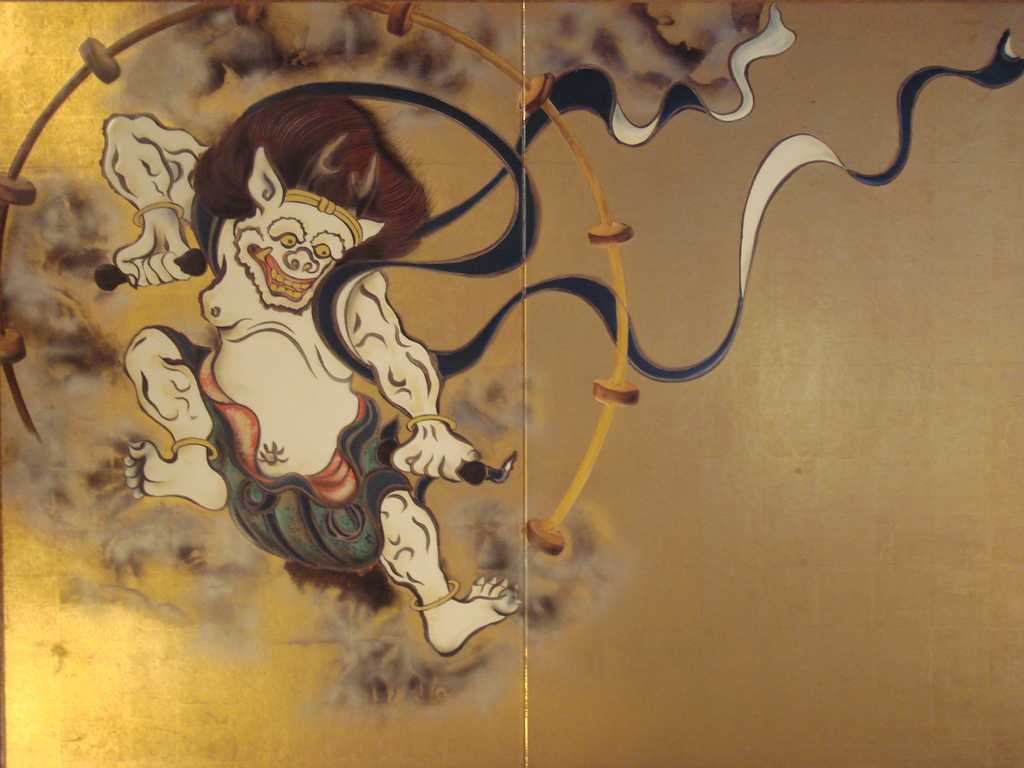
The founders of what became Rinpa were Hon’ami Kōetsu (1558–1637) and Tawaraya Sōtatsu (active c. 1600–1640). Kōetsu was a master of calligraphy, lacquer and ceramics, and his collaborations with Sōtatsu on decorated paper scrolls paired Sōtatsu’s bold brushed underimages with Kōetsu’s calligraphy. Sōtatsu’s “Waves at Matsushima” screens (Freer Gallery of Art, Washington, D.C.) and “Wind God and Thunder God” screens (風神雷神図屏風, a National Treasure associated with Kennin-ji, Kyoto) established the vocabulary later Rinpa painters would reinterpret.
Ogata Kōrin: The Definitive Rinpa Master
Ogata Kōrin (1658–1716) is the most celebrated Rinpa painter. Born in Kyoto to a family of textile merchants who supplied the imperial court, he studied Sōtatsu’s work closely and combined it with other influences into a style of striking boldness. His two supreme works are “Red and White Plum Blossoms” (紅白梅図屏風, MOA Museum of Art, Atami) and “Irises” (燕子花図屏風, Nezu Museum, Tokyo). Each reduces a natural subject to essential elements on a gold ground, so that the formal organization becomes part of the meaning. Kōrin’s original works are held almost entirely in institutions.
Hōitsu and Kiitsu: The Edo Revival
Sakai Hōitsu (1761–1828) revived the tradition in Edo more than a century after Kōrin, adapting the Kyoto vocabulary to a more intimate, lyrical Edo taste. His “Summer and Autumn Grasses” (夏秋草図屏風, Tokyo National Museum) was painted on the reverse of Kōrin’s own Wind God and Thunder God screens, a deliberate dialogue with his predecessor. Hōitsu’s student Suzuki Kiitsu (1796–1858) extended the tradition with a distinctive palette and fresh compositions.
Maruyama-Shijō and Nanga: Edo Painting Beyond the Official Schools
Alongside the official Kano and Tosa schools and the Rinpa tradition, the Edo period produced new schools for a prosperous urban merchant class and a growing network of educated amateurs. The Maruyama-Shijō school and nanga (literati painting) were the two most significant, and together they shaped the approaches that twentieth-century Nihonga painters inherited.

Source:府中市美術館(https://www.artpr.jp/fuchuartmuseum/nagasawarosetsu2026)
Maruyama Ōkyo and Naturalistic Observation
Maruyama Ōkyo (円山応挙, 1733–1795) founded the Maruyama school in Kyoto on a method of direct observation, shasei (写生, “sketching from life”). That was a departure in a tradition where most painting was based on models handed down from earlier masters. His approach was shaped partly by exposure to Western art through imported illustrated books, and it yielded birds, fish, plants and landscapes of a freshness quite unlike the stylized work of the official schools.
His “Pine Trees in Snow” (雪松図屏風, Mitsui Memorial Museum, Tokyo), a National Treasure, is the best-known example of his mature style: pine branches bending under snow, rendered in ink wash so precisely that the weight of the snow feels physical. His follower Matsumura Goshun (1752–1811) founded the Shijō branch, which was lighter and more lyrical. The Maruyama-Shijō tradition dominated Kyoto painting through the late Edo and Meiji periods and fed directly into Nihonga.
Nanga: Japan’s Literati Painting
Nanga (南画, “southern painting,” also called bunjin-ga, 文人画, “literati painting”) adapted the Chinese literati tradition, which reached Japan through imported paintings and painting manuals in the eighteenth century. Where the Kano school prized technical mastery and institutional authority, nanga valued the painter’s cultivation as a scholar and poet, with art as an expression of the self rather than a service to a patron.
The two greatest nanga painters were Ike no Taiga (池大雅, 1723–1776) and Yosa Buson (与謝蕪村, 1716–1783). In 1771 they collaborated on the album “Ten Conveniences and Ten Pleasures” (十便十宜図), a National Treasure in which Taiga painted the conveniences and Buson the pleasures, setting Taiga’s vigorous, structured landscapes against Buson’s more painterly, atmospheric style. Tomioka Tessai (富岡鉄斎, 1836–1924), the last major literati painter, carried the mode into the Taishō period with work of great energy and idiosyncrasy.
Nihonga: Traditional Japanese Painting in the Modern Era
When Meiji Japan opened to Western culture, the future of the older painting tradition was uncertain. The answer was Nihonga (日本画, “Japanese painting”), a movement that defined traditional painting as a living category worth preserving and developing, explicitly distinct from yōga (洋画, Western-style oil painting) and grounded in native materials, techniques and aesthetics.
The Meiji Revival and the Founding Generation
The central figure in the revival was Okakura Tenshin (1863–1913), who with Ernest Fenollosa helped found the Tokyo School of Fine Arts in 1887 to train painters in traditional Japanese methods. Its graduates, notably Yokoyama Taikan (1868–1958) and Hishida Shunsō (1874–1911), developed the mōrōtai (朦朧体, “vague style”): atmospheric, outline-free compositions built from graduated mineral-pigment washes that modernized painting without cutting its ties to precedent.
The next generation made Nihonga a living contemporary tradition. Uemura Shōen (1875–1949) brought psychological depth and luminous color to bijin-ga (美人画, paintings of beautiful women). Hayami Gyoshū (1894–1935) produced a small body of technically extraordinary work before his early death, including “Dance of Flames” (炎舞, Enbu, 1925, Yamatane Museum of Art, Tokyo). Higashiyama Kaii (1908–1999) created a lasting image of the Japanese landscape in serene, blue-toned paintings. Nihonga is still practiced today by artists trained at institutions such as Tokyo University of the Arts and Kyoto City University of Arts.
The Materials That Make Traditional Japanese Painting Distinct
The look of traditional Japanese painting is inseparable from its materials. Iwa-enogu (岩絵具, mineral pigments ground from azurite, malachite, cinnabar, red ochre and similar materials) have a granular texture that scatters light differently from oil or watercolor, so the surface changes with the viewer’s angle and distance. Nikawa (膠, animal glue) binds the pigment and gives a subtle dimensionality. Washi (和紙, handmade paper from kōzo, gampi or mitsumata fibers) and raw silk age very stably under proper conditions, and many surviving Heian and Kamakura paintings on silk keep their mineral color after centuries.
Collecting and Displaying Traditional Japanese Painting
Traditional Japanese paintings come in several formats. Hanging scrolls (kakejiku, 掛け軸) are vertical compositions on silk or washi, mounted in fabric borders; they are the most common collector format and very versatile for display. Folding screens (byōbu, 屏風), usually two to eight panels and often made in pairs (sōsetsu, 双隻), are the most dramatically scaled format and suit large reception rooms and lobbies, though they need more demanding storage and conservation. Album leaves (gachō, 画帖), fans and shikishi (色紙, square poem cards) are more accessible entry points.
When assessing a work, look at the stability of the pigment layer (lifting, cracking or powdering), the mounting fabric (tears, staining, foxing), the paper or silk support (yellowing, brittleness, insect damage) and the legibility of the signature and seal (rakkan, 落款). For any attribution to a major school or named master, documented provenance, such as exhibition records in published catalogues and dated gallery inventories, is essential, and a specialist’s assessment before a significant purchase is strongly advisable.
Traditional painting works in more interiors than most collectors expect. The tonal range, from the ink-dominant landscapes of the Kano and nanga traditions to the saturated color of Rinpa and Nihonga, suits most contemporary furnishings. A single hanging scroll draws the eye upward in a plain room and adds presence without lateral spread, while in hotel lobbies, private dining rooms, executive offices and gallery reception areas a folding screen of the right scale communicates cultural depth to visitors regardless of their prior knowledge of the tradition.
Discover Nihonga for Contemporary Spaces
Shop carefully selected Nihonga,
curated by experienced Japanese art dealers
for homes and commercial spaces worldwide.