
Nihonga & Japanese Painting
Japanese Folding Screens: A Complete Guide to Byōbu
.jpg)
A Japanese folding screen asks to be understood twice. It is a painting, carrying some of the most ambitious images produced in Japan over twelve centuries. It is also a piece of furniture, built to be moved, folded, stored, and set up again wherever a room needs to be divided, a draught blocked, or a guest given a background worth sitting against.
Most writing on the subject picks one of those and ignores the other. Museum catalogues treat the screen as a flat picture surface. Interior features treat it as a room divider with something painted on it. Neither account is much use to someone deciding whether to buy one, where to put it, and what it will demand in return.
This guide covers both. It sets out how screens are constructed and described, how the tradition developed from the eighth century to the present, what they are actually made of, how the format traveled far beyond Japan, and what it takes to live with one in a contemporary house or commercial interior.
Format, Structure, and the Vocabulary You Need
Byōbu is written with characters meaning wind wall, which tells you what the object was originally for. Screens arrived in Japan from the Asian mainland as functional partitions, and the painting came second. That functional origin still governs how they are built and how they behave in a room.
How a Screen Is Counted and Named
Screens are described by the number of panels and by whether they stand alone or as a pair. A panel is a kyoku, so a two-panel screen is nikyoku and a six-panel screen is rokkyoku. A single screen is isseki; a matched pair is issō. The most important configuration in the history of the form is the rokkyoku issō, a pair of six-panel screens designed to be read together, usually right screen first, as a single continuous composition across twelve panels.
This matters commercially. A pair that has been separated is worth considerably less than half of what it would have been intact, and a great many pairs were split in the twentieth century to be sold individually into Western collections. When a catalogue offers a single six-panel screen from an early period, the first question is whether it ever had a partner.
The Paper Hinge and Why It Changed the Picture
The technical development that separates Japanese screens from their Chinese and Korean predecessors is the kamichōtsugai, the paper hinge. Earlier screens joined independently framed panels with silk cords, which left visible gaps and forced each panel to be treated as a separate picture. The Japanese solution interleaves folded paper strips between the panels, producing a hinge that is nearly invisible, that lets the screen fold in either direction, and that allows a single image to run without interruption across the whole width.
The paper hinge was established practice by the Muromachi period, and it is what made the great continuous compositions possible. Everything that follows in this article, the sweeping gold-ground landscapes, the panoramic city views, the pair of wind and thunder gods separated by an expanse of empty ground, depends on it.
The panel itself is a light wooden lattice covered with multiple layers of paper. The painted surface, on paper or silk, is mounted over that lattice, and the whole is edged with a lacquered wooden frame and, often, metal fittings at the corners. The construction is remarkably light for its size, which is precisely the point.
Standard Sizes
Dimensions vary widely by period and purpose, but a few conventional formats recur often enough to plan around. The figures below are typical rather than fixed, and any specific screen should be measured before you commit floor space to it.
| Type | Panels | Approximate height | Approximate width, fully extended |
|---|---|---|---|
| Full-size screen (honma) | 6 | 150–175 cm | 350–380 cm |
| Full-size screen | 2 | 150–170 cm | 170–190 cm |
| Half-height screen | 2 or 6 | 90–120 cm | Proportional to panel count |
| Furosaki byōbu (tea ceremony) | 2 | 60–65 cm | 85–90 cm |
| Makura byōbu (bedside) | 2 | 60–90 cm | 90–120 cm |
A screen is never displayed flat. It stands zigzagged, which means a six-panel screen at full extension of 360 cm occupies perhaps 240 to 280 cm of wall and projects 40 to 60 cm into the room. That projection is the single most common planning error among first-time buyers.
Twelve Centuries of the Format
The history of the byōbu is not a straight line of refinement. It is a sequence of moments when a change in architecture, politics, or patronage handed painters a new reason to work at this scale, and they responded by reinventing what the format could do.
Nara and Heian: Arrival and Domestication
Screens came from Tang China, and the oldest surviving examples in Japan are held in the Shōsōin, the eighth-century imperial repository at Nara. The celebrated Torige ritsujo no byōbu, a set of panels showing standing women whose robes were originally covered in bird feathers, dates from this period and shows the format arriving fully formed as a luxury object of the court.
Through the Heian period, screens became fixtures of aristocratic interiors, where architecture consisted largely of open pillared spaces subdivided by movable furnishings. Painting on them shifted from Chinese subjects toward yamato-e, native themes drawn from Japanese seasons, poetry, and narrative. Poems were sometimes composed specifically to accompany screen paintings, which gives some sense of the status they held.
Momoyama: The Gold Ground
The Azuchi-Momoyama period, roughly 1573 to 1615, produced the screens that most people picture when they hear the word. Warlords building enormous castles needed interiors decorated at a matching scale, and the deep rooms of those buildings received very little natural light.
The answer was gold. Screens were faced with gold leaf across the entire ground, and pine trees, hawks, lions, and seasonal flowers were set against it in heavy mineral colour. Under candlelight and filtered daylight, the gold does not read as a flat metallic sheet; it shifts and glows as the viewer moves, functioning as a light source rather than a background. The Kanō school, under Kanō Eitoku (1543–1590), dominated this work and effectively set the visual language of power for the next century.
The counter-statement arrived from the same generation. Hasegawa Tōhaku (1539–1610) painted Shōrin-zu byōbu, the Pine Trees screens, in ink alone on unadorned paper, a pair of six-panel screens in which trees appear and dissolve in fog and most of the surface is left empty. It is a National Treasure, held at the Tokyo National Museum, and it remains the most quoted argument that a screen does not need colour to fill a room.
Edo: Rinpa, the City View, and the Merchant Patron
The Edo period, 1603 to 1868, brought two centuries of peace, a wealthy merchant class, and a broadening of who commissioned large-scale painting. The Rinpa tradition, which is less a school than a lineage of artists who admired one another across generations, produced several of the most recognizable screens ever made in Japan.
Tawaraya Sōtatsu, active in the early seventeenth century, painted the Fūjin Raijin-zu byōbu, the Wind God and Thunder God, on a pair of two-panel gold screens now at Kennin-ji in Kyōto. Ogata Kōrin (1658–1716) took up the same subject in homage, and produced two works that define the tradition: the Kakitsubata-zu byōbu, irises repeating in blue and green across a gold field, at the Nezu Museum, and Red and White Plum Blossoms at the MOA Museum of Art in Atami. All are National Treasures.
Alongside these, a documentary genre flourished. Rakuchū rakugai-zu, views in and around Kyōto, spread the entire city across a pair of screens, with gold cloud bands hiding the transitions between districts and hundreds of figures going about identifiable trades. These are among the richest sources for daily life in early modern Japan, and they demonstrate how much narrative a screen can carry without losing its decorative coherence.
What a Screen Is Made Of
Material knowledge is not optional here. It determines what a screen costs, how it ages, and what it will tolerate in your building. The same subject painted in mineral pigment on paper and in synthetic colour on board are different objects with different futures.
Iwa-enogu: Mineral Pigment
Iwa-enogu are pigments ground from minerals and shells rather than manufactured chemically. Azurite yields gunjō, a deep blue; malachite yields rokushō, a green; cinnabar and iron oxides supply the reds and earths; and gofun, a white, is made from calcined and aged oyster shell.
These pigments have no binder of their own. They are mixed on the palette with nikawa, an animal glue, immediately before use. Crucially, the particle size of the grind determines the colour: the same azurite produces a saturated dark blue when coarse and a pale, chalky blue when fine. A painter therefore works with a graded series of a single mineral rather than a single tube of blue, and the coarse grades sit on the surface as visible crystalline grains that catch light directly.
This is why photographs of Nihonga and of screen painting are so consistently disappointing. The material is semi-reflective and granular, and it changes substantially with the angle of the light. It is also why these works perform well in rooms with variable natural light, where a flat matte surface would simply go dead.
Gold, Silver, and the Ground
Gold enters the work in several forms. Kinpaku is leaf, laid in overlapping squares across the ground, and on close inspection the grid of seams is usually visible. Sunago is gold or silver dust sprinkled to produce a graded shimmer rather than a solid field. Kirikane is leaf cut into hairline strips and applied individually to describe patterns on robes and architecture, a technique demanding enough that it is now practiced by very few specialists.
Silver behaves differently from gold and this has consequences for buyers. Silver leaf tarnishes, and many screens that now read as atmospheric grey or near-black were originally bright. In most cases this is accepted as honest ageing rather than damage, and some collectors prefer it, but it should be understood as a change from the artist’s intent rather than a choice.
Supports and Ink
The painting surface is washi or silk. Washi is made from the long bast fibres of kōzo, mitsumata, or gampi, which give it a tensile strength and flexibility that wood-pulp paper cannot approach, and which is what allows a screen to be folded repeatedly for centuries without the image cracking along the joints. Silk offers a smoother, more luminous surface and is more common for finely detailed figure work.
Sumi is ink made from soot bound with animal glue and formed into sticks, ground with water on a stone at the time of use. Its tonal range, from a black that sits densely on the surface to a wash barely distinguishable from the paper, carries the entire ink-painting tradition, and the Tōhaku pines mentioned above are made of nothing else.
The Screen That Traveled
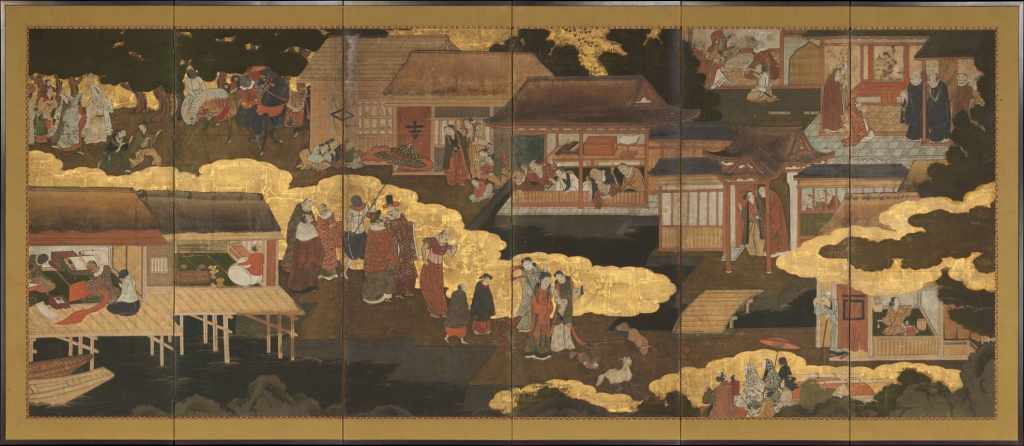
Source:The Metropolitan Museum of Art(https://www.metmuseum.org/art/collection/search/65417)
The byōbu did not stay in Japan. Its history as an export object explains why folding screens appear in European interiors, in Latin American colonial palaces, and eventually in twentieth-century Western design, and it is a useful corrective to the idea that the format is narrowly national.
Namban Screens
Portuguese ships reached Japan in the 1540s, and Japanese painters responded by turning their own screens on the visitors. Namban byōbu depict the arrival of the black ships, the unloading of cargo, and Portuguese merchants and Jesuits in baggy trousers and ruffs, observed with evident fascination. Produced largely by Kanō school painters in the Momoyama and early Edo periods, they are the earliest sustained Japanese images of Europeans, and examples are held today in Lisbon, Kōbe, and elsewhere.
Biombo: The Format Crosses the Pacific
Screens also went out as cargo and as diplomatic gifts. The Manila Galleon ran annually between Manila and Acapulco from 1565 until 1815, carrying Asian goods into the Spanish viceroyalty of New Spain, and Japanese screens were among them.
The word crossed with the object. Spanish biombo derives directly from Japanese byōbu, and Mexican workshops adopted the form with the name. By the seventeenth century, painters in Mexico City were producing monumental screens of eight or ten leaves showing hunting parties, garden gatherings, and panoramic views of the capital. The Brooklyn Museum holds a well-known example from the 1690s, painted with the conquest of Mexico on one face and a view of Mexico City on the other.
The exchange was not only commercial. Hasekura Tsunenaga’s embassy from Sendai landed at Acapulco in 1614 en route to Rome, and Japanese and Filipino artisans settled in New Spain across the galleon centuries. A format invented to divide a Japanese room became, within a hundred years, a standard luxury furnishing on the other side of the Pacific.
The Modern Screen
The format survived the Meiji period intact. When Nihonga emerged in the late nineteenth century as a conscious continuation of Japanese painting methods against imported oil painting, the screen remained one of its principal formats. Yokoyama Taikan (1868–1958), Hishida Shunsō (1874–1911), and Uemura Shōen (1875–1949) all worked on screens; so did Higashiyama Kaii (1908–1999) and Kayama Matazō (1927–2004) in the postwar decades.
Contemporary Nihonga painters continue to use mineral pigment, gold, and washi, and the screen and the related sliding-panel format still attract major commissions. Hiroshi Senju (b. 1958), best known internationally for his waterfall paintings, completed a set of sliding panels for Jukō-in at Daitoku-ji in Kyōto in 2002, working within a temple context that has received painting of this kind for four centuries.
Buying, Placing, and Keeping a Byōbu
Everything above becomes practical at the moment you consider acquiring one. Screens are among the most rewarding Japanese works to live with and among the least forgiving of careless placement, and the gap between those two outcomes is mostly a matter of information.
What Screens Cost
The market is broad. The ranges below are indicative, drawn from published results in Japanese art sales at Christie’s, Sotheby’s, and Bonhams, and at Japanese auction houses, across roughly the past decade. Condition, completeness of a pair, and the security of any attribution move individual results far outside these bands.
| Category | Indicative range (USD) | What drives the price |
|---|---|---|
| Furosaki byōbu, 20th century | $400 – $4,000 | Maker, lacquer quality, tea provenance |
| Decorative 20th-century screens | $1,500 – $10,000 | Condition, subject, whether pigments are mineral |
| Anonymous Edo-period screens | $8,000 – $60,000 | Survival as a pair, extent of restoration |
| Signed or attributed Kanō school, Edo | $30,000 – $250,000 | Strength of attribution, publication history |
| Important early or Rinpa-lineage works | Six to seven figures | Rarely on the market; often institutionally bound |
| Contemporary Nihonga screens | Wide, by artist | Exhibition record, scale, materials |
Two cautions. Restoration on screens is normal and not disqualifying, but complete remounting, replaced hinges, and retouched pigment should be disclosed and reflected in price. And the phrase “attributed to” in a catalogue for a Kanō or Rinpa work is doing a great deal of financial work; ask exactly what the attribution rests on.
Placement, Light, and Scale
Plan for the zigzag, not the flat width. A six-panel screen needs roughly 240 to 280 cm of wall and will project up to 60 cm into the room, so it wants either a wide blank wall with nothing in front of it or a genuine room-dividing position where that depth is doing useful work. Two-panel screens and half-height screens are far easier to place and are where most first purchases sensibly start.
Light is the whole argument for owning one. Gold grounds and coarse mineral pigment were made for uneven, moving light, and a screen placed where daylight crosses it during the day will change continuously in a way that a flat-varnished painting does not. Avoid direct sun, which will fade organic colorants and embrittle paper, but do not bury the work in a dim corner either. In commercial interiors, grazing light from a fixture set to one side reads far better than flat frontal spotlighting, which kills the surface.
Screens also solve problems that framed pictures cannot. They stand in front of an awkward architectural feature, close off a corner of an open-plan space, back a reception desk, or give a hotel lobby a freestanding object with real presence and no wall requirement at all. Their portability, the original reason for the format, remains genuinely useful.
Conservation in a Lived-In Space
Stable relative humidity matters more than any other single factor. Paper, animal glue, and a wooden lattice all move with moisture, and repeated swings loosen hinges and lift pigment. Keep a screen away from exterior walls, radiators, air conditioning outlets, fireplaces, and humidifiers, and aim for consistency rather than a specific ideal figure.
Handle by the wooden frame, never by the painted surface, and always with two people for anything full size. Fold and unfold slowly, panel by panel, without forcing a hinge. Do not stand a screen fully flat, which strains the joints; the zigzag is structural as well as visual. Dust with a soft brush only, never with a cloth and never with any liquid, since gold leaf and coarse mineral pigment both sit on the surface and will lift.
If a screen is stored, it should be wrapped in a breathable cloth and kept upright in a stable environment, not laid flat under weight. Serious structural work, particularly rehinging or remounting, belongs with a specialist conservator trained in Japanese mounting, and is worth the wait to arrange properly.
Where the Tradition Stands Now
The byōbu has outlasted the architecture it was invented for. The pillared aristocratic halls and the dim castle interiors are gone, and yet the format has proved unusually well suited to contemporary buildings, where open plans need dividing, where wall space is often scarce, and where large glazed openings produce exactly the moving, variable light that mineral pigment and gold leaf were developed to answer.
That continuity is not only historical. Nihonga painters today are working with the same azurite and malachite, the same shell white, the same animal glue and washi that produced the screens at Kennin-ji and the Nezu Museum, and the screen remains a living format rather than an antiquarian one. For anyone who has followed this tradition from the Shōsōin to the present and wants to see what it looks like in work available now, contemporary Nihonga is where the line continues.
Discover Nihonga for Contemporary Spaces
Shop carefully selected Nihonga,
curated by experienced Japanese art dealers
for homes and commercial spaces worldwide.