
Nihonga & Japanese Painting
Nihonga Artists: Masters of Japanese-Style Painting, Past and Present
- Nihonga Artists at a Glance: Masters by Era
- The Birth of Nihonga: Meiji Period and the Movement's Founders
- Nihonga Painters of the Taisho and Early Showa Periods
- Contemporary Nihonga Artists and the Living Tradition
- What Is Nihonga? Materials and Techniques
- Collecting Nihonga: Market, Prices and Authentication
- Discover Nihonga for Contemporary Spaces
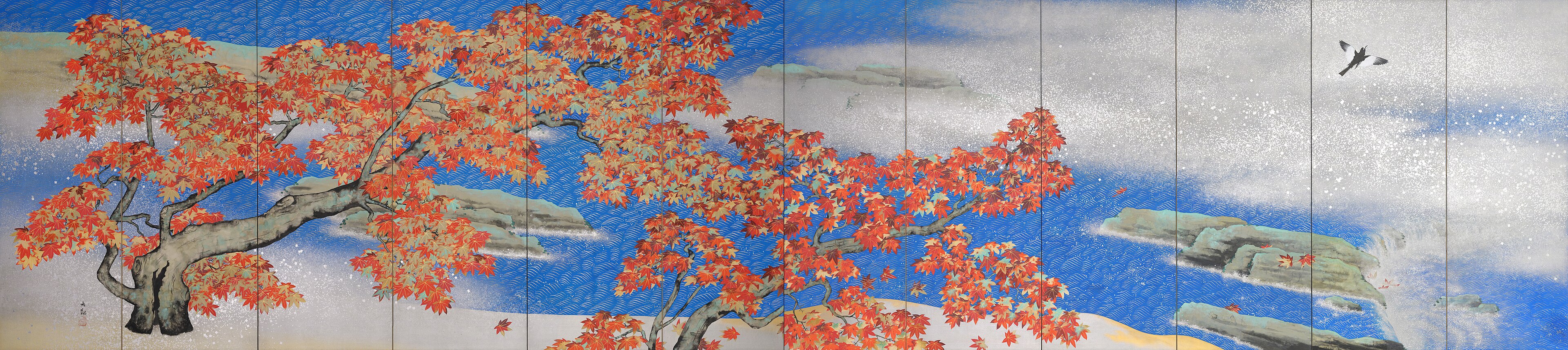
The leading nihonga artists are Yokoyama Taikan, Hishida Shunso, Uemura Shoen, Hayami Gyoshu and Higashiyama Kaii in the modern period, and Hiroshi Senju among living painters. Nihonga (日本画, literally “Japanese painting”) is the modern category of Japanese painting made with traditional materials, mainly mineral pigments (iwa-enogu) bound with animal glue on washi paper or silk. The word was coined in the Meiji period (1868–1912) to set it against yoga (洋画), Western-style oil painting.
This guide lists the major nihonga painters by era in tables with dates, representative works and style, then profiles the key figures, explains the nihonga art style and its materials, and ends with a collector’s overview of prices, authentication and display.
Nihonga Artists at a Glance: Masters by Era
The tables below give a quick reference. Each artist is discussed further in the sections that follow where marked.
Meiji Founders (born before 1890)
| Artist | Dates | Representative works | Style and significance |
|---|---|---|---|
| Kano Hogai (狩野芳崖) | 1828–1888 | Hibo Kannon (1888) | Kano-school trained; an early figure of the effort to renew Japanese painting that led to nihonga |
| Hashimoto Gaho (橋本雅邦) | 1835–1908 | Ryuko-zu byobu (Dragon and Tiger screens, 1895) | Kano-school trained; taught at the Tokyo School of Fine Arts and helped shape early nihonga |
| Takeuchi Seiho (竹内栖鳳) | 1864–1942 | Hanmyo (Spotted Cat, 1924) | Leading Kyoto painter; lifelike animals combining Japanese and Western observation |
| Yokoyama Taikan (横山大観) | 1868–1958 | Muga (1897); Seisei Ruten (1923) | Co-founder of the Nihon Bijutsuin; atmospheric landscape, mōrōtai, Mount Fuji |
| Hishida Shunso (菱田春草) | 1874–1911 | Ochiba (Fallen Leaves, 1909); Kuroki Neko (Black Cat, 1910) | Co-developer of mōrōtai; refined tone and quiet mood; died at 36 |
Taisho and Early Showa Masters
| Artist | Dates | Representative works | Style and significance |
|---|---|---|---|
| Kaburagi Kiyokata (鏑木清方) | 1878–1972 | Tsukiji Akashicho (1927) | Bijin-ga of Tokyo life; rooted in the ukiyo-e and illustration tradition |
| Uemura Shoen (上村松園) | 1875–1949 | Jo no Mai (1936) | Bijin-ga of great psychological depth; first woman to receive the Order of Culture (1948) |
| Hayami Gyoshu (速水御舟) | 1894–1935 | Enbu (Dance of Flames, 1925) | Technically daring; moved between naturalism, mōrōtai and Rinpa-influenced decoration |
| Uemura Shoko (上村松篁) | 1902–2001 | Birds and flowers | Son of Uemura Shoen; painter of birds and plants in the Kyoto tradition |
| Higashiyama Kaii (東山魁夷) | 1908–1999 | Michi (Path, 1950); Toshodai-ji fusuma (1971–1980) | Quiet, blue-toned landscapes; the best-known nihonga painter to the Japanese public |
Postwar and Contemporary Nihonga Painters
| Artist | Dates | Representative works | Style and significance |
|---|---|---|---|
| Kayama Matazo (加山又造) | 1927–2004 | Rinpa-influenced decorative works | Postwar painter who brought Rinpa design and modern composition into nihonga |
| Hirayama Ikuo (平山郁夫) | 1930–2009 | Silk Road and Buddhist subjects | Best known for Silk Road themes; a survivor of the Hiroshima bombing |
| Hiroshi Senju (千住博) | b. 1958 | Waterfall series | Large-format waterfalls on washi; the nihonga artist best known internationally |
| Takashi Murakami (村上隆) | b. 1962 | Contemporary works on nihonga foundations | Trained in nihonga at Tokyo University of the Arts; best known for contemporary pop work, not for nihonga itself |
The Birth of Nihonga: Meiji Period and the Movement’s Founders
As Japan opened to Western technology and culture with extraordinary speed, artists and intellectuals faced an urgent question: what was specifically Japanese about Japanese art, and was it worth developing on its own terms? The nihonga movement was the sustained institutional and artistic answer, and the word itself marks a philosophical distinction from yoga, not just a difference of style.
Okakura Tenshin and the Tokyo School of Fine Arts
The central figure was Okakura Tenshin (岡倉天心, 1863–1913), also known in his English-language writing as Okakura Kakuzo. A polymath who combined deep knowledge of Japanese art history with an international outlook, partly gained through work with the American art historian Ernest Fenollosa, he co-founded the Tokyo School of Fine Arts (Tokyo Bijutsu Gakko, 東京美術学校; established 1887, opened 1889) to preserve and develop traditional Japanese painting methods. The school is today the Faculty of Fine Arts at Tokyo University of the Arts and remains the main institutional center of nihonga education.
Okakura was neither conservative nor isolationist. In his English-language works The Ideals of the East (1903) and The Book of Tea (1906), he described Asian art as a living tradition with its own aesthetic logic, capable of modern development without adopting the vocabulary of European academicism. Artists trained at the school were expected to be grounded in traditional materials and methods while staying free to take up contemporary subjects.
Yokoyama Taikan: Architect of Modern Nihonga
The artist who most fully carried out Okakura’s vision was Yokoyama Taikan (横山大観, 1868–1958). Born in Mito and educated at the Tokyo School of Fine Arts under Okakura, he became the most important figure in nihonga history, as much for his role in shaping the movement as for his paintings. In 1898 he co-founded the Nihon Bijutsuin (日本美術院, Japan Art Institute) with Okakura and others, including Hishida Shunso. It became the leading independent exhibition body for nihonga, an alternative to the government-sponsored Bunten exhibitions.
Taikan’s mature work ranges from large-scale ink landscapes made with minimal means to monumental paintings of Mount Fuji across the seasons and intimate studies of plum blossom, cloud and water. Seisei Ruten (生々流転, 1923), a handscroll about forty meters long that follows a drop of water from mountain mist to the sea, is among his best-known works.
Mōrōtai: The Hazy Style
Taikan and Hishida Shunso together developed mōrōtai (朦朧体, “vague” or “hazy style”), a technique that gave up the heavy outline typical of earlier Japanese and Chinese painting. Instead, graduated washes of pigment build form through tone, producing mist, air and light. The label began as criticism: critics found the paintings blurry and questioned whether they counted as Japanese painting at all. Taikan and Shunso persisted, and the atmospheric sensibility became one of the defining marks of modern nihonga.
Hishida Shunso and the Early Nihonga Circle
Hishida Shunso (菱田春草, 1874–1911) was Taikan’s closest colleague and the co-developer of mōrōtai. He died of kidney disease at thirty-six, cutting short a career that contemporaries thought was producing some of the most refined painting of his generation. His late works Ochiba (落葉, Fallen Leaves, 1909) and Kuroki Neko (黒き猫, Black Cat, 1910) show the tonal range and quiet intimacy his technique achieved. Documented examples rarely reach the open market.
Nihonga Painters of the Taisho and Early Showa Periods
The generation that matured in the Taisho period (1912–1926) and early Showa period consolidated the Meiji advances while developing individual voices. Uemura Shoen in figure painting, Hayami Gyoshu in intimate naturalism and Higashiyama Kaii in landscape show the breadth of what nihonga can be, and their works anchor the market for historical nihonga.
Uemura Shoen: The Definitive Painter of Women
Uemura Shoen (上村松園, 1875–1949) is the most celebrated female nihonga artist and one of the great painters of the human figure in the Japanese tradition. Born in Kyoto and trained in the Kyoto painting lineage, she devoted her career almost entirely to bijin-ga (美人画, paintings of beautiful women), a genre with deep roots in ukiyo-e, and gave it a psychological depth and technical refinement far beyond its decorative origins.
Her subjects include Heian court ladies, figures from Noh theater, women preparing for performance and mothers with children. She worked in mineral pigments on silk, building luminous depth through many thin layers. In 1948 she became the first woman to receive Japan’s Order of Culture (Bunka Kunsho), the country’s highest distinction for achievement in the arts.
Hayami Gyoshu: Short Life, Lasting Legacy
Hayami Gyoshu (速水御舟, 1894–1935) died of typhoid fever at forty, leaving a small body of work that many scholars regard as the most technically accomplished of modern nihonga. His best-known painting, Enbu (炎舞, Dance of Flames, 1925), shows white moths circling an orange flame against a near-black ground, a small work of extraordinary presence. It is held at the Yamatane Museum of Art in Tokyo.
Gyoshu moved between very different approaches in a short career: detailed studies of insects and plants, broad atmospheric landscapes in the mōrōtai mode, and decorative works influenced by the Rinpa school’s gold grounds and patterned color. Documented examples rarely appear at auction, which makes them among the most sought-after works in the field.
Higashiyama Kaii: Landscapes of the Japanese Spirit
Higashiyama Kaii (東山魁夷, 1908–1999) is the nihonga painter best known to the Japanese public. His landscapes are serene and characteristically blue-toned: a road winding into misty forest, a still pond reflecting birch trees, mountains dissolving in morning mist. Born in Yokohama and educated at the Tokyo Fine Arts School, he built his postwar reputation with Michi (道, Path, 1950), now in the National Museum of Modern Art, Tokyo.
His most celebrated commission was the set of fusuma (襖, sliding partition) paintings for the Miedo hall of Toshodai-ji temple in Nara, founded in 759 and a UNESCO World Heritage site. He worked on it for nine years, from 1971 to 1980.
Contemporary Nihonga Artists and the Living Tradition
Nihonga is not a museum category. Artists work in studios across Japan and abroad, supported by Tokyo University of the Arts, Kyoto City University of Arts, the annual Nihon Bijutsuin exhibition and many regional nihonga societies, so there is real continuity between historical knowledge and new work.
Postwar Painters: Kayama Matazo and Hirayama Ikuo
Kayama Matazo (加山又造, 1927–2004) brought Rinpa design and modern composition into nihonga, and Hirayama Ikuo (平山郁夫, 1930–2009), a survivor of the Hiroshima bombing, became best known for paintings of Silk Road and Buddhist subjects. Both show how the genre widened after the war beyond the figure, bird-and-flower and landscape subjects of earlier decades.
Hiroshi Senju and the International Stage
The nihonga artist most visible in the international art market is Hiroshi Senju (千住博, born 1958 in Tokyo). He studied at Tokyo University of the Arts through to a doctorate, and made his name with the Waterfall (滝, Taki) series: large paintings of falling water on Japanese paper that fill the entire surface edge to edge, built up in layers of iwa-enogu and, in later work, fluorescent pigments. His 1995 appearance at the 46th Venice Biennale brought him wide international attention. He has also painted fusuma for Jukoin, a sub-temple of Daitoku-ji in Kyoto.
The New Generation of Nihonga Painters
Many painters active today, mostly graduates of Tokyo University of the Arts or Kyoto City University of Arts and exhibiting at the Nitten (日展, Japan Fine Arts Exhibition) and Nihon Bijutsuin shows, apply the full nihonga material vocabulary to contemporary subjects such as urban landscapes, psychological figures and abstraction. Others extend the palette with man-made pigments or mix media. Takashi Murakami, who earned a doctorate in nihonga at Tokyo University of the Arts, shows that nihonga training can lead far from classical subjects.
What Is Nihonga? Materials and Techniques
What most directly distinguishes nihonga from other painting is its materials. The pigments come mainly from natural minerals, such as malachite, azurite, cinnabar and red ochre, ground to particle sizes that set both the color strength and the surface texture of the dried paint. Many nihonga masterworks, including Hayami Gyoshu’s Enbu and Yokoyama Taikan’s Seisei Ruten, are designated by the Japanese government as Important Cultural Properties, which is one reason conservation matters.
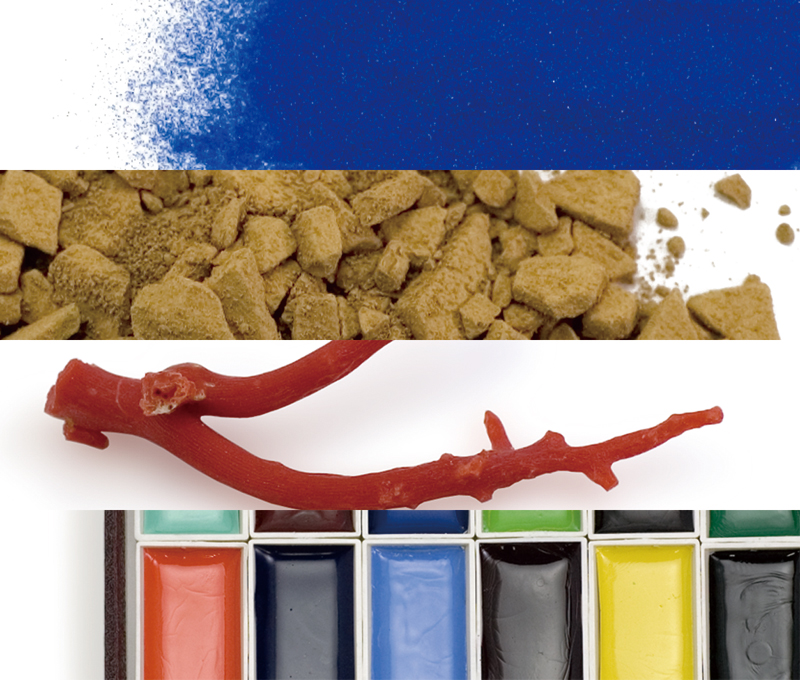
Source: Musashino Art University(https://zokeifile.musabi.ac.jp/日本画絵具/)
Iwa-enogu: Mineral Pigments from Stone
Iwa-enogu (岩絵具, “rock pigments”) are the defining material. Each is ground to a range of particle sizes designated by a numbering system called bango (番号): lower numbers are coarser, with more saturated, granular color, and higher numbers are finer, with smoother, more transparent effects. A painting may use several bango of one pigment to build depth and layered optical effects.
Key pigments include gunjo (群青, deep blue from azurite), byakugun (白群, pale blue from finely ground azurite), rokusho (緑青, malachite green), bengara (弁柄, iron-oxide red-brown), tan (丹, red lead), gofun (胡粉, a white made from calcined oyster shell, used for grounds and highlights) and gold, applied as cut-gold leaf (kirikane) or as powdered gold in glue (kindei). Contemporary artists also use man-made pigments (shin-iwa-enogu, 新岩絵具) that widen the range of colors while behaving much like the natural ones.
Nikawa, Washi and Silk
Iwa-enogu are traditionally bound with nikawa (膠), an animal glue typically made from cattle or deer hide, dissolved in warm water and mixed with the pigment just before use. The ratio of glue to water must be adjusted for each pigment and each layer: too much glue makes the surface brittle and prone to cracking, too little makes it powder or flake. Managing it is a core skill, learned mostly through years of studio practice.
The ground is usually washi (和紙, Japanese handmade paper made from kozo, gampi or mitsumata fibers) or silk. Both are prepared with an underlayer of gofun and nikawa, giving a white base that later pigment layers rest on or sink into. Silk is associated with especially luminous effects, notably in the layered bijin-ga technique of Kyoto painters, where thin layers over a white underlayer create a glow from within.
The Rinpa Influence on Nihonga
The Rinpa school (琳派), founded in the early seventeenth century by Hon’ami Koetsu (1558–1637) and Tawaraya Sotatsu (active c. 1600–1640), developed by Ogata Korin (1658–1716) and revived in the early nineteenth century by Sakai Hoitsu (1761–1828) and Suzuki Kiitsu (1796–1858), has been a continuous influence on nihonga, especially in Kyoto. Its bold flat areas of saturated color, gold and silver leaf grounds, simplified natural motifs and the tarashikomi (垂らし込み) technique, in which wet pigments bleed into one another, gave nihonga painters a ready vocabulary for works that were both traditional and bold. Kamisaka Sekka (神坂雪佳, 1866–1942), a Kyoto painter and designer working in the Rinpa tradition, bridged historical Rinpa and the modern era, and the influence remains visible in contemporary artists who use gold grounds, tarashikomi and botanical subjects.
Collecting Nihonga: Market, Prices and Authentication
The nihonga market is centered in Japan. Auction houses such as Shinwa Art Auction, SBI Art Auction and Mainichi Auction document prices across the field, while international houses including Christie’s, Sotheby’s and Bonhams increasingly include nihonga in Asian art sales and offer Western collectors the documentation central to authentication and valuation.
Price Ranges by Artist and Period
The table gives broad, indicative US dollar ranges only. They run from smaller or less-documented works to major, well-provenanced compositions, and individual works can sit well outside them; they are not auction records.
| Artist | Dates | Primary subject | Approximate market range (USD) |
|---|---|---|---|
| Yokoyama Taikan | 1868–1958 | Landscapes, figures, Mount Fuji | $30,000–$1,300,000+ |
| Uemura Shoen | 1875–1949 | Bijin-ga, court ladies, mothers | $33,000–$530,000+ |
| Hayami Gyoshu | 1894–1935 | Insects, flowers, figures | Rare; major examples $300,000+ |
| Hishida Shunso | 1874–1911 | Animals, landscapes, figures | Rare; documented examples $200,000+ |
| Higashiyama Kaii | 1908–1999 | Landscapes, nature | $20,000–$400,000+ |
| Hiroshi Senju | b. 1958 | Waterfall series, landscapes | $30,000–$300,000+ |
| Contemporary nihonga (established artists) | Active today | Various | $3,000–$50,000 |
Most transactions happen through Japanese gallery and auction channels, so significant works by mid-career artists with strong institutional credentials can cost less than comparable Western contemporary paintings.
Authentication, Provenance and Condition
Nihonga authentication rests on three things: the artist’s signature and personal seal (rakkan, 落款); provenance, such as exhibition records in published catalogues, gallery records and collection history; and consistency with the artist’s known methods and materials. Major artists have catalogues raisonnes, museum publications and university research that support attribution. Works with no publication history, relying on family attribution or visual judgment alone, carry higher risk and should be priced accordingly. For significant purchases, commission an opinion from a recognized specialist, such as a scholar from a major art university or museum, or an established Japanese art dealer.
Correctly applied iwa-enogu are very stable under controlled conditions, but humidity swings, impact or poor storage can cause powdering or flaking. Conservation needs specialists trained in this material system; standard Western picture conservation is not appropriate.
Nihonga for Contemporary Interiors
The granular mineral surface scatters light, so a nihonga work looks different across the day and under different lighting, an effect reproductions cannot copy. In a home, a single work on a well-chosen wall can set the character of a living room, dining space or entrance hall, especially among natural materials and neutral tones. In hotel lobbies, private dining rooms, wellness spaces and corporate reception areas, nihonga offers visual refinement and material authenticity that reads even to viewers who know nothing of the tradition.
For collectors and designers starting out, established contemporary nihonga artists with exhibition and gallery documentation, priced comparably to Western contemporary painting, are a well-grounded entry point into a tradition that, at its peak with Taikan, Shoen and Gyoshu, produced some of the most accomplished paintings of the twentieth century.
Discover Nihonga for Contemporary Spaces
Shop carefully selected Nihonga,
curated by experienced Japanese art dealers
for homes and commercial spaces worldwide.