
Nihonga & Japanese Painting
Traditional Japanese Art: A Guide for Collectors
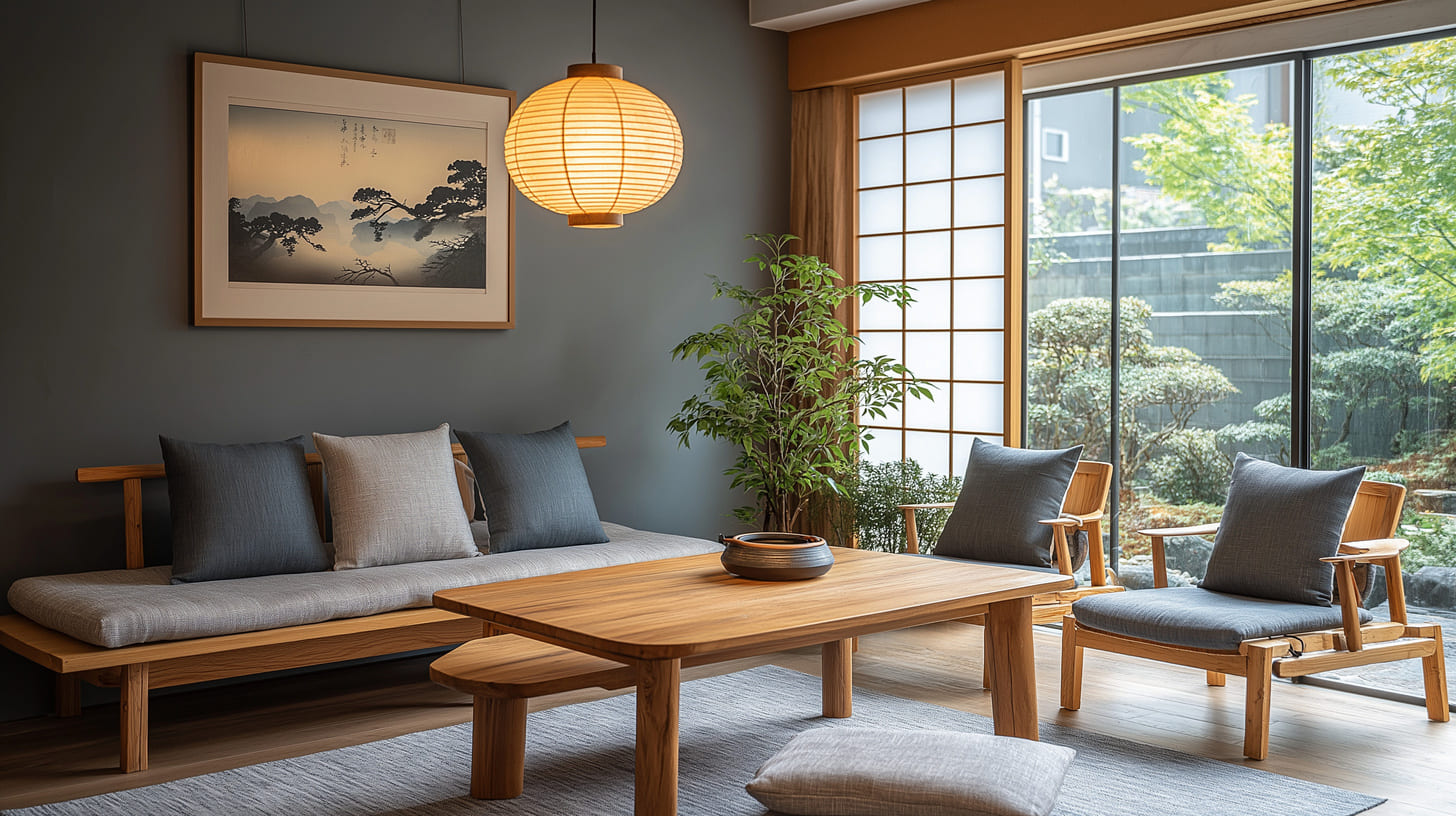
Traditional Japanese art is one of the most coherent and continuously practiced visual traditions in the world. For more than a thousand years, painters, printmakers, potters, and calligraphers in Japan refined a distinctive visual language built on line, negative space, seasonal awareness, and an unusually intimate relationship between an artwork and the room it occupies. For an international collector or designer encountering the field today, that long continuity is precisely what makes it rewarding: a single hanging scroll can carry the weight of a school that has been refined across many generations.
This guide maps the territory in practical terms. It explains what people mean by traditional Japanese art, walks through the major schools and movements, demystifies the materials and techniques that give the work its physical character, surveys how the market actually values these objects, and looks at how traditional and tradition-rooted works behave in real residential and commercial interiors. The aim is to give you the vocabulary and the judgment to look, evaluate, and acquire with confidence.
What Defines Traditional Japanese Art
“Traditional Japanese art” is a broad umbrella rather than a single style. It generally refers to the painting, printmaking, calligraphy, ceramics, and decorative arts that developed in Japan from the classical Heian period (794–1185) through the Edo period (1603–1868), together with the modern lineages that consciously continue those methods. What unites these forms is less a fixed look than a shared set of priorities: an emphasis on line and contour over modeled volume, a confident use of empty space, flattened or layered perspective, and motifs drawn from nature, literature, and the changing seasons.
Several aesthetic ideas recur often enough that they function as a working vocabulary. Knowing them changes how you read a piece on a wall.
Aesthetic Principles Worth Knowing
Ma (間) is the active use of empty space — the interval, pause, or void that gives the painted elements room to breathe. In a Japanese composition, what is left unpainted is rarely accidental; it is part of the design and often the most important part.
Wabi-sabi (侘寂) is an aesthetic of restraint, imperfection, and the beauty of age and asymmetry. It is felt most directly in tea-ceremony ceramics, where an irregular glaze or an off-center form is prized rather than corrected.
Alongside these, traditional Japanese art tends toward asymmetry rather than centered balance, toward suggestion rather than full description, and toward a deep seasonal sensibility in which a single branch of plum or a scattering of maple leaves signals an entire time of year. These are not abstract ideas; they are the reason a spare ink painting can hold a large room without crowding it.
The Main Forms at a Glance
The field divides into a handful of major forms. Suiboku-ga or sumi-e is monochrome ink painting, built from tonal washes and decisive brushwork. Yamato-e is the classical, brightly colored narrative painting tradition rooted in Japanese (rather than Chinese) subjects. Ukiyo-e, literally “pictures of the floating world,” is the woodblock print and painting tradition of the Edo period. Nihonga, meaning “Japanese-style painting,” is the modern lineage, formalized from the late nineteenth century, that uses traditional materials and techniques in a contemporary context. To these add calligraphy (shodō), ceramics, and lacquerware, which together complete the picture of what collectors mean by the tradition.
The Major Schools and Movements

Source: The Metropolitan Museum of Art(https://www.metmuseum.org/art/collection/search/765976)
Japanese art history is organized around schools — workshops and lineages, often hereditary, that transmitted style and technique across generations. Recognizing a few of the most important schools is the single most useful skill for placing a work and understanding its value. The lineages below are the ones that recur most frequently in collections, exhibitions, and the international market.
Yamato-e and the Classical Foundation
Yamato-e emerged during the Heian period as a deliberately Japanese alternative to imported Chinese painting modes. It favored native subjects — court life, seasonal landscapes, scenes from literature such as The Tale of Genji — rendered in bright mineral colors, often on handscrolls and folding screens. Yamato-e established much of the decorative grammar that later schools would inherit, including gold grounds, stylized clouds, and the bird’s-eye composition that lets a viewer look down into roofless interiors.
The Kanō School
The Kanō school dominated official painting for roughly four centuries, from the late fifteenth century through the Edo period. Patronized by the shoguns and the warrior class, Kanō artists fused Chinese ink-painting technique with Yamato-e color and decorative scale, producing the monumental screen and sliding-door paintings that defined castle and temple interiors. The school’s name is written Kanō (sometimes rendered “Kano”), and its longevity made it the closest thing Japan had to an academic establishment.
Rinpa
Rinpa (also written Rimpa) is less a hereditary workshop than a recurring decorative sensibility, named for the artist Ogata Kōrin. It is characterized by bold, flattened design, lavish gold and silver grounds, and a distinctive wet-on-wet technique called tarashikomi, in which pigment is dropped into a still-wet layer to create pooled, mottled effects. Rinpa’s graphic confidence has made it perhaps the most internationally legible of the classical traditions, and its influence is visible in everything from textiles to modern graphic design.
Ukiyo-e and the Floating World
Ukiyo-e is the art most non-specialists picture first, and for good reason. From the seventeenth century onward, it captured the pleasures of urban Edo (present-day Tokyo) — kabuki actors, courtesans, sumo wrestlers, and famous landscapes — first as paintings and then, decisively, as mass-produced woodblock prints. The genre includes bijin-ga (“pictures of beautiful women”) and the landscape print, which reached its peak with Katsushika Hokusai and Utagawa Hiroshige in the early nineteenth century. Because prints were produced in editions, ukiyo-e remains one of the most accessible entry points into collecting traditional Japanese art, with wide ranges of price and condition.
Nihonga and the Modern Revival
Nihonga is the bridge between the historical tradition and the living market. As Japan rapidly Westernized after 1868, the critic and curator Okakura Kakuzō (Tenshin), working with the American scholar Ernest Fenollosa, championed a renewal of Japanese-style painting against the rising tide of Western oil painting (yōga). Out of this came Nihonga: painting that uses traditional materials and methods — mineral pigments, ink, paper or silk — while engaging modern subjects and sensibilities.
The painter Yokoyama Taikan (1868–1958) became the movement’s defining figure, refining new techniques alongside peers such as Hishida Shunsō. Later twentieth-century artists, including Matazo Kayama (1927–2004), Kaii Higashiyama (1908–1999), Ikuo Hirayama (1930–2009), and Togyū Okumura (1889–1990), carried Nihonga forward and drew significant international attention, with works entering collections at the Metropolitan Museum of Art and the Smithsonian. :antCitation[]{citations=”b1cf7aa3-11c0-472a-8c3b-bba9e985d788″ injected=”space”} Because Nihonga is still actively produced, it is the part of the tradition most readily available for living spaces today.
Materials and Techniques
The physical character of traditional Japanese art comes directly from its materials, and understanding them is essential for evaluation and care. The same subject rendered in mineral pigment on silk versus ink on paper is, in collecting terms, two very different objects. The components below are the ones that most affect both appearance and value.
Iwa-enogu: Mineral Pigments
The luminous, slightly granular color of Nihonga and classical painting comes from iwa-enogu — pigments ground from minerals and, historically, semi-precious stones such as azurite (blue), malachite (green), and cinnabar (red). Because these are crushed rather than dissolved, the same mineral yields different hues depending on how coarsely it is ground: coarse grinds give deep, saturated tones, fine grinds give paler, chalkier ones. The pigments have no inherent adhesive, so they are bound to the surface with nikawa, a warm animal-hide glue. This is why Nihonga colors sit on the surface with a tactile, mineral presence that printed reproductions never capture.
Sumi and Washi
Sumi is the solid ink stick, made from soot and glue, that the artist grinds with water on a stone to control tone from dense black to the palest gray. Washi is traditional handmade paper, prized for its strength, long fibers, and receptiveness to ink and wash. Many works are also painted on silk, which gives a smoother, more reflective ground favored for fine detail. The choice of support is one of the first things an experienced eye checks, because it speaks to period, intended use, and conservation needs.
Kinpaku: Gold and Metal Leaf
Gold leaf (kinpaku) and silver leaf are central to the decorative tradition, especially in Rinpa and in screen painting. Beaten to extraordinary thinness, the leaf is applied as a ground that shifts with the light, so a gold screen reads as warm and solid in dim interior light and dissolves into shimmer when caught directly. This responsiveness to changing light was a deliberate design choice in rooms lit by lamps and shifting daylight rather than electric bulbs, and it remains one of the most powerful effects available to a collector furnishing a real space.
Ceramics and Urushi Lacquer
Beyond painting, the tradition includes ceramics and lacquerware. Raku ware, developed for the tea ceremony, is hand-formed and low-fired, producing irregular, deliberately humble vessels that embody wabi-sabi. Urushi is natural lacquer, harvested as sap and applied in many thin, painstakingly cured layers to produce the deep, durable surfaces of lacquer boxes, trays, and furniture, often decorated with sprinkled gold powder in the technique called maki-e. These objects sit comfortably alongside paintings in a collection and frequently anchor a room as sculpture does.
The Market for Traditional Japanese Art
The market for traditional Japanese art is wide, ranging from affordable editioned prints to seven-figure masterworks. Prices are driven by the usual fine-art factors — attribution, rarity, condition, provenance, and size — but with several field-specific wrinkles that every buyer should understand before bidding or acquiring.
What Drives Value
For paintings, secure attribution to a named artist or major school is the single largest price driver, followed closely by condition, since works on paper and silk are vulnerable to light, foxing, and water damage. For ukiyo-e prints, the key variables are the quality of the impression (early impressions from fresh blocks are sharper and more valuable), the freshness of the color, and the absence of trimming, fading, or restoration. A famous image in a poor, late, faded impression can be worth a small fraction of the same image in a crisp early one.
Notable Auction Results
A few benchmark sales illustrate the upper end of the market and how dramatically condition and rarity matter. Hokusai’s “Great Wave” is the clearest example: in March 2023 a single, exceptionally well-preserved impression of “Under the Wave off Kanagawa” sold at Christie’s New York for about $2.76 million (roughly ¥360 million), far above its $500,000–$700,000 estimate and setting a record for the artist at the time. :antCitation[]{citations=”0dbafd8a-9b65-4d08-9b1d-f5da62f60b7e” injected=”space”} A year later, in March 2024, a complete set of the “Thirty-six Views of Mount Fuji” series achieved $3,559,000 at Christie’s, setting a new auction record for Hokusai. :antCitation[]{citations=”c3c35bb3-8ef0-48df-89eb-ba0a05d39887″ injected=”space”} By contrast, more typical “Great Wave” impressions have changed hands for figures ranging from the low hundreds of thousands upward, depending heavily on condition.
| Work / category | Sale | Result (USD) |
|---|---|---|
| Hokusai, single “Great Wave” impression (fine) | Christie’s New York, 2023 | ~$2.76 million |
| Hokusai, complete “Thirty-six Views of Mount Fuji” set | Christie’s New York, 2024 | ~$3.56 million |
| Earlier “Great Wave” impression | Christie’s, 2021 | ~$1.59 million |
| Top modern Nihonga lots (e.g. Yokoyama Taikan, Matazo Kayama) | Japanese auction houses, historical | Hundreds of thousands to low millions |
The Nihonga figures deserve a note of caution: leading Nihonga works by artists such as Yokoyama Taikan have reached well into the millions of yen at major Japanese auction houses, with select top lots historically recorded above ¥100–200 million ($1 million or more). :antCitation[]{citations=”89d10ee3-1cc7-4bda-90df-2e81a28db00e” injected=”space”} However, the international market for most Nihonga sits considerably lower, and averages for the same artists at Western houses are far more modest, which points to one of the field’s defining features.
The Domestic and International Split
Traditional Japanese art has two partly separate markets. A strong domestic market in Japan supports high prices for canonical Nihonga and historical painting, where local collectors place deep cultural value on names like Taikan, Higashiyama, and Hirayama. The international market is thinner and more selective, concentrating on globally legible material — ukiyo-e, Rinpa, and a handful of internationally exhibited Nihonga masters — while many fine domestic works trade comparatively quietly. For an overseas buyer this gap is an opportunity: serious, museum-quality works in tradition-rooted styles are often available at prices that have not yet caught up with their quality, particularly through specialist dealers who bridge the two markets.
Living with Traditional Japanese Art
One of the distinguishing features of traditional Japanese art is that it was designed for architecture, not for the gallery wall. This makes it unusually rewarding to live with — but it also rewards a little knowledge about format, light, and care. For collectors, interior designers, and commercial buyers, matching the right form to the right space is where the tradition truly comes alive.
Understanding the Formats
Three formats account for most traditional and tradition-rooted painting. The kakejiku or kakemono is the hanging scroll — a vertical mounted painting, traditionally displayed for a season and then rolled and stored, which makes it ideal for a focal niche or a rotating display. The byōbu is the folding screen, a freestanding multi-panel painting that can divide a large room, anchor a lobby, or serve as a monumental work of art that needs no wall. Fusuma are the painted sliding-door panels of a traditional interior. Modern Nihonga, by contrast, is frequently produced as framed panel paintings sized for contemporary walls, which is why it adapts so readily to today’s homes and offices.
Light, Humidity, and Conservation
Because most works use light-sensitive pigments, organic dyes, ink, paper, and silk, conservation is a genuine consideration rather than an afterthought. Direct sunlight is the principal enemy: it fades the delicate vegetable dyes in ukiyo-e prints and can dull mineral pigments over time. Stable, moderate humidity protects paper and silk from both brittleness and mold, and from the expansion that stresses a scroll’s mounting. The practical implications for a buyer are straightforward: position works away from direct sun and heat sources, maintain reasonably steady indoor conditions, and treat especially fragile pieces as rotating rather than permanent displays.
Choosing for Residential and Commercial Spaces
Different spaces call for different works. In a residential setting, the restraint of the tradition is its great advantage: a single ink painting or a mineral-pigment Nihonga panel can hold a wall without competing with furniture, and its seasonal motif quietly shifts the mood of a room. The active empty space of a Japanese composition reads as calm rather than sparse, which suits modern interiors particularly well.
In commercial and hospitality settings — hotel lobbies, corporate reception areas, restaurants — scale and presence matter more. Here a folding screen or a large Nihonga panel can carry a double-height wall, with gold-ground works offering the additional advantage of changing character under different lighting throughout the day. For high-traffic environments, framed and glazed contemporary Nihonga is generally more practical than antique scrolls, combining the visual depth of mineral pigment with the durability a public space demands.
Whether you are furnishing a single room or specifying art across an entire property, the most reliable path is to start with works whose materials, scale, and condition suit the way the space is actually used — and, for tradition-rooted painting that lives gracefully in contemporary interiors, contemporary Nihonga is often the ideal place to begin.
Discover Nihonga for Contemporary Spaces
Shop carefully selected Nihonga,
curated by experienced Japanese art dealers
for homes and commercial spaces worldwide.