
Nihonga & Japanese Painting
Naoshima Art Island, Japan: Museums, Tickets and Access
- Naoshima at a Glance: Where to Go on Japan's Art Island
- How Naoshima Became Japan's Art Island
- The Museums and Installations Worth Crossing the Sea For
- Art Islands in Japan: Teshima, Inujima and the Seto Inland Sea
- The Setouchi Triennale: Japan's Island Art Festival
- Naoshima Art Island Tickets, Ferries and Planning
- What Naoshima Teaches About Living With Japanese Art and Nihonga
- Discover Nihonga for Contemporary Spaces
Naoshima is Japan’s art island. A small island in the Seto Inland Sea (Setouchi) in Kagawa Prefecture, it was turned over about 35 years from a shrinking copper-smelting community into a place where contemporary art, architecture by Tadao Ando, and the landscape cannot be separated. Together with its neighbors Teshima and Inujima, it forms the best-known group of art islands in Japan, run by the Benesse Art Site Naoshima project.
You reach Naoshima by ferry from Uno Port in Okayama (about 20 minutes) or from Takamatsu in Kagawa, and most visitors need one to two days. This guide covers how Naoshima became an art island, the museums and installations worth the trip, the other art islands in Japan’s Seto Inland Sea, the Setouchi Triennale, and a practical plan for tickets, ferries and timing. It ends with what the island teaches about showing Japanese art, including Nihonga, at home.
Naoshima at a Glance: Where to Go on Japan’s Art Island
Naoshima is roughly 8 square kilometers, and its art sits in three areas. Planning by area saves hours of walking.
| Area | Main sites | Character |
|---|---|---|
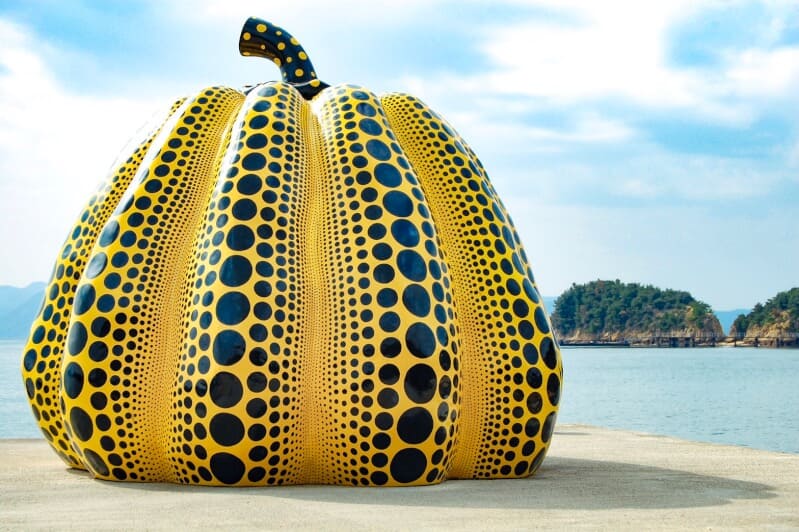
| South coast (Benesse area) | Benesse House Museum, Chichu Art Museum, Lee Ufan Museum, Valley Gallery, yellow Pumpkin | Large museums set in the hillside; the most timed-entry tickets; hilly |
| Honmura (east) | Art House Project, Ando Museum, Naoshima New Museum of Art | Old village and port; art in empty houses; easy on foot |
| Miyanoura (west, main port) | Red Pumpkin, ferry terminal, Naoshima Bath “I♥湯” | Arrival point; a short stop before or after the museums |
How Naoshima Became Japan’s Art Island
Naoshima’s reputation is the result of a sustained patronage project that paired one family’s vision with one architect’s discipline for more than three decades. Knowing the backstory makes the island much easier to read.
From Copper Smelter to Benesse Art Site
For much of the twentieth century the islands of the Seto Inland Sea bore the costs of Japan’s industrialization. Naoshima’s economy relied on a Mitsubishi Materials copper smelter at its northern end; nearby Inujima held a copper refinery that operated only briefly before closing; and Teshima later became notorious for illegal industrial waste dumping. As young people left for the cities, these islands aged and emptied.
The change began in the mid-1980s. Tetsuhiko Fukutake, founder of the Okayama-based educational publisher Fukutake Publishing (now Benesse), and Naoshima’s mayor, Chikatsugu Miyake, agreed to develop the island’s southern coast as a cultural and educational site. Tetsuhiko died in 1986, and his son Soichiro Fukutake took up the project and turned it into a long-term philosophy. The company later took the name Benesse, from the Latin bene (well) and esse (being), and the art programme became known as Benesse Art Site Naoshima, which now spans Naoshima, Teshima and Inujima.
Rather than importing a finished collection into a conventional gallery, the project commissioned site-specific works and buildings tuned to the landscape. The aim was never tourism alone; it was the slow regeneration of island communities through culture.
The 1989 Campsite and the First Sculpture
The first built step was modest: the Naoshima International Camp, which opened in 1989 with a master plan by Tadao Ando. A sculpture by the Dutch CoBrA painter Karel Appel, Frog and Cat, was installed at the campsite and is generally cited as the island’s first public artwork. It set the pattern: art placed outdoors, met on foot, facing the sea.
Tadao Ando and the Architecture of Light
If Fukutake supplied the vision, the architect Tadao Ando gave it form. Ando, a self-taught Osaka native and one of the most decorated architects alive, has designed ten structures on Naoshima. His signature material is board-formed exposed concrete, and his true medium is natural light. He repeatedly buries buildings in the hillside so that they barely disturb the skyline, then carves openings that let sun move across the galleries through the day and the seasons. The architecture is not a neutral container; it is part of the work, and the experience changes with the hour you arrive.
Timeline of Naoshima’s Art Sites
| Year | Milestone | Architect / Artist |
|---|---|---|
| 1985–86 | Tetsuhiko Fukutake and Mayor Chikatsugu Miyake agree to develop southern Naoshima; Tetsuhiko dies in 1986 | Fukutake family |
| 1989 | Naoshima International Camp opens; Karel Appel’s Frog and Cat installed | Tadao Ando (master plan), Karel Appel |
| 1992 | Benesse House (museum and hotel) opens | Tadao Ando |
| 1994 | “Out of Bounds” exhibition; Yayoi Kusama’s yellow Pumpkin installed | Yayoi Kusama and others |
| 1995 | Benesse House Oval opens | Tadao Ando |
| 1998 | Art House Project begins with Kadoya | Tatsuo Miyajima |
| 2004 | Chichu Art Museum opens | Tadao Ando; Monet, Turrell, De Maria |
| 2006 | Benesse House Beach opens; Miyanoura ferry terminal and Red Pumpkin | Tadao Ando; SANAA; Yayoi Kusama |
| 2008 | Inujima Seirensho Art Museum opens | Hiroshi Sambuichi, Yukinori Yanagi |
| 2009 | Naoshima Bath “I♥湯” opens | Shinro Ohtake |
| 2010 | Lee Ufan Museum; Teshima Art Museum; first Setouchi Triennale | Tadao Ando, Lee Ufan; Ryue Nishizawa, Rei Naito |
| 2013 | Ando Museum opens | Tadao Ando |
| 2021–22 | Yellow Pumpkin destroyed by typhoon (August 2021), remade and reinstalled (2022) | Yayoi Kusama |
| 2022 | Valley Gallery and Hiroshi Sugimoto Gallery: Time Corridors open | Tadao Ando; Yayoi Kusama, Shinro Ohtake; Hiroshi Sugimoto |
| 2025 | Naoshima New Museum of Art opens (31 May) | Tadao Ando |
The Museums and Installations Worth Crossing the Sea For
The islands reward slow looking. Several sites require timed-entry reservations, so confirm details before you travel.
Chichu Art Museum

Source:benesse artsite naoshima(https://benesse-artsite.jp/art/chichu.html)
The Chichu Art Museum (chichu meaning “in the earth”), opened in 2004, is the spiritual center of Naoshima and, for many, the reason to come. Ando built it almost entirely underground, around the specific works of just three artists: Claude Monet, Walter De Maria and James Turrell. Much of it is nonetheless lit by daylight coming through openings and courtyards cut into the concrete.
The Monet room holds five paintings from the Water Lilies series painted in the artist’s late years at Giverny. There is no artificial light, so the paintings change with the weather and time of day, looking cool and silvery on overcast mornings and warm in late afternoon. Visitors remove their shoes to enter a room whose floor is made of small white marble cubes that reflect soft light up onto the canvases. Seeing Monet in variable natural light is a revelation, and a pointed lesson for interiors.
James Turrell is represented by three works: Afrum, Pale Blue (1968), a projected light piece; Open Field (2000), an immersive room of colored light that you enter by climbing a set of stairs; and Open Sky (2004), a room with a square opening in the ceiling that frames the sky. Walter De Maria’s Time/Timeless/No Time (2004) is a grand stepped hall with a polished granite sphere more than two meters in diameter and 27 gilded wooden sculptures, lit by an overhead skylight so that the room changes through the day. The Chichu Garden near the ticket center is planted with species that Monet grew at Giverny.
Benesse House Museum
Opened in 1992, Benesse House was the first major Ando building on the island and combines a contemporary art museum with guest rooms, so that overnight guests can wander the galleries after day visitors have left. An oval-shaped annex reached by a private monorail, the Oval, followed in 1995, and the Beach wing opened in 2006. The museum’s pivotal 1994 exhibition “Out of Bounds” invited artists to make work for sites around the building and shoreline, and it established the idea that works would be made for Naoshima rather than simply brought to it.
The collection runs from the late twentieth century onward, with artists including Bruce Nauman, Jannis Kounellis, Richard Long, Cy Twombly, Jasper Johns, Andy Warhol, Hiroshi Sugimoto and Yayoi Kusama. Sugimoto’s Seascapes photographs are installed outdoors on the terrace facing the real sea, and the Hiroshi Sugimoto Gallery: Time Corridors, which opened in 2022, is an extension devoted to his work. Displays rotate, so check the current selection before you go.
Lee Ufan Museum and Valley Gallery
The Lee Ufan Museum (2010) is a joint project between Ando and the Korean-born artist Lee Ufan, a central figure of Mono-ha (the “School of Things”, a late-1960s movement that worked with raw materials such as stone, steel and wood in their unaltered state). The building is set low into a valley between the hills and the sea, and its rooms hold a small number of paintings and sculptures with large areas of empty wall and floor. Few places show more clearly how much empty space a work needs to be seen properly. Valley Gallery, a small Ando structure near Benesse House, opened in 2022.
Naoshima New Museum of Art
The newest anchor, the Naoshima New Museum of Art, opened on 31 May 2025 in Honmura. It is Ando’s tenth structure on the island: a three-story building, with two floors below ground and one above, holding four galleries and a café with views across the Seto Inland Sea. Unlike the island’s older institutions, which lean toward Western and Japanese modern masters, it is devoted to contemporary art from across Asia, including Japan. Under director Akiko Miki, its opening program featured works by artists such as Takashi Murakami, Cai Guo-Qiang, Do Ho Suh, N. S. Harsha and Aida Makoto. Its exhibitions rotate, so it is the one major venue likely to change between visits.
The Art House Project in Honmura
Since 1998, the Art House Project in the old village of Honmura has turned empty houses, a shrine and a temple site into permanent installations, so that the village itself becomes a gallery you walk through. Kadoya (1998) holds Tatsuo Miyajima’s Sea of Time ’98, a pool of water with blinking LED counters set by local residents. Minamidera, in a building by Ando, has James Turrell’s Backside of the Moon, a work in near-total darkness that visitors enter in timed groups. Kinza has an installation by Rei Naito, visited alone and by reservation. Go’o Shrine was restored by Hiroshi Sugimoto, with a glass staircase linking an underground stone chamber to the shrine above. Haisha, a former dentist’s house, is a collage building by Shinro Ohtake, and Gokaisho holds Yoshihiro Suda’s carved wooden camellias.
For readers interested in traditional Japanese painting, Ishibashi is the key stop. This former merchant’s house holds works by Hiroshi Senju, one of the best-known Nihonga painters working today, whose waterfalls are a central theme of his career. Senju works with iwa-enogu (mineral pigments ground from stone and shell) bound with nikawa (animal-hide glue). Seeing Nihonga in a traditional house with tatami, sliding doors and low, indirect light is the closest the island comes to showing how such work lives in an actual dwelling.
Kusama’s Pumpkins and the Naoshima Bath
Yayoi Kusama‘s two pumpkins are the most photographed objects in the Seto Inland Sea. The yellow Pumpkin (1994) sits on a pier near Benesse House. On 9 August 2021 Typhoon Lupit swept it into the sea and broke it apart; Kusama’s studio produced a replacement, reinstalled on the same pier in 2022. The Red Pumpkin (2006) at Miyanoura Port is hollow, so visitors can step inside through holes in its red, dotted shell.
Naoshima Bath “I♥湯” (pronounced “ai-rabu-yu”, a pun on the Japanese word for hot water), opened in 2009 near Miyanoura, is a working public bathhouse designed by Shinro Ohtake, with mosaics, collage and a small elephant statue around ordinary bathing. Bathing etiquette follows Japanese sentō (public bath) norms, so check the current tattoo policy if relevant. It is art you use rather than look at.
Art Islands in Japan: Teshima, Inujima and the Seto Inland Sea
People who search for “art islands in Japan” in the plural usually mean this archipelago. Naoshima is the flagship and the easiest to reach, but many serious visitors think the most profound single work is on Teshima. Ferries link Naoshima’s Miyanoura and Honmura ports with Teshima’s Ieura and Karato ports, and Inujima is reachable by boat via Teshima or from Okayama’s Hōden port. Schedules are thin, so plan these connections carefully. A common rhythm is two or three days based on Naoshima or near Takamatsu, with day trips to Teshima and Inujima. Other islands, among them Shōdoshima, Megijima and Ogijima, host works during the Setouchi Triennale.
Teshima Art Museum
The Teshima Art Museum, opened on 17 October 2010, is a collaboration between the architect Ryue Nishizawa (co-founder of SANAA) and the artist Rei Naito. It is a single white concrete shell shaped like a water droplet, with no columns and two large oval openings to the sky, set among restored terraced rice fields above the sea. Inside is Naito’s Matrix, in which water beads up from tiny holes in the floor and gathers into slowly moving pools. Visitors sit or walk barefoot, in silence. Admission is ¥1,800 online or ¥2,000 on site, and an advance date and time reservation is required; if online tickets sell out there is no sale on the day. The museum closes on Tuesdays from March to November and on Tuesdays through Thursdays from December to February. Nearby, Christian Boltanski’s Les Archives du Coeur records visitors’ heartbeats, and the Teshima Yokoo House, a collaboration between Tadanori Yokoo and the architect Yuko Nagayama, rounds out a full day.
Inujima Seirensho Art Museum
The Inujima Seirensho Art Museum (2008) restores the ruins of a Meiji-era copper refinery. The architect Hiroshi Sambuichi designed it to use natural energy (sun, geothermal heat and the chimney effect) for passive cooling and heating, and it houses work by Yukinori Yanagi that draws on the writer Yukio Mishima. The Inujima Home Project, a group of galleries in the village directed by Kazuyo Sejima, shares the ticket. It is the islands’ most powerful statement on industry, memory and regeneration.
The Setouchi Triennale: Japan’s Island Art Festival
Every three years the islands swell into a single sprawling exhibition. The Setouchi Triennale (Setouchi International Art Festival) is among the world’s most ambitious site-specific art festivals.
How the Triennale Works
First held in 2010 and staged every three years, with Fram Kitagawa as general director and Soichiro Fukutake as general producer, the Triennale spreads commissioned works across the islands and port towns of the Seto Inland Sea. The 2025 edition was the sixth and covered 17 locations, including coastal areas of Kagawa Prefecture. The festival runs in three seasonal sessions rather than continuously, for a combined total of 107 days. A multi-site passport covers many of the festival artworks (the adult all-season passport for 2025 was listed at around ¥5,500, less when bought in advance), though several flagship museums charge separate admission.
| 2025 Session | Dates |
|---|---|
| Spring | 18 April – 25 May 2025 |
| Summer | 1 – 31 August 2025 |
| Autumn | 3 October – 9 November 2025 |
Visiting During or Outside the Festival
A Triennale year offers the widest range of work and a communal atmosphere, but it also brings crowds, full ferries and booked-out lodging, so book ferries, Chichu slots and accommodation much further ahead. Many popular installations from past festivals become permanent, so the off-years are far from empty, and traveling between festival years is often the connoisseur’s choice for a calmer visit. The next edition is expected in 2028, following the three-year cycle, but dates are announced by the organizers, so treat that year as a projection until confirmed.
Naoshima Art Island Tickets, Ferries and Planning
Naoshima is more accessible than its reputation suggests, but it needs a plan. Most museums close one day a week, capacity at the key venues is limited, and the ferry timetable controls your day. Prices on the island have been raised several times since 2023, so check the official Benesse Art Site Naoshima website shortly before you travel.
Admission, Reservations and Closing Days
| Venue | Area | Adult admission (approx.) | Reservation | Usual closing day |
|---|---|---|---|---|
| Chichu Art Museum | South | ¥2,500 online on weekdays, ¥2,700 on weekends and holidays; more on site | Date and time reservation required; if online tickets sell out there is no on-site sale that day | Monday |
| Benesse House Museum | South | ¥1,300 online, ¥1,500 on the day | Tickets can be bought on the day | Generally open daily; short annual maintenance closures |
| Lee Ufan Museum | South | ¥1,200 online, ¥1,400 on site | Online purchase is cheaper; last admission 4:30 p.m. | Monday |
| Valley Gallery | South | about ¥1,300 (free for Benesse House guests) | Check official site | Check the open days calendar |
| Naoshima New Museum of Art | Honmura | ¥1,500 online, ¥1,700 on site | Online booking recommended | Monday |
| Art House Project | Honmura | Five-house multi-site ticket ¥1,200 online, ¥1,400 on site; one house ¥600 online, ¥700 on site; Minamidera and Kinza ¥600 / ¥700 each, sold separately | Minamidera and Kinza require a date and time reservation (Kinza admits one person at a time) | Monday (Kinza has further closed days) |
| Ando Museum | Honmura | ¥600 online, ¥700 on site | No | Monday |
| Naoshima Bath “I♥湯” | Miyanoura | ¥660 | No | Monday |
Children aged 15 and under are free at the Benesse museums. When a Monday is a national holiday, most venues open that day and close on the Tuesday instead. The island also has irregular maintenance closures, so the official calendar is the only reliable source. Prices are online / on-site adult fares as listed by Benesse Art Site Naoshima at the time of writing and are a planning guide only.
Getting to Naoshima from Tōkyō, Ōsaka and Okayama
Most visitors reach Naoshima through Uno Port in Okayama Prefecture. From Tōkyō, take the Tōkaidō and San’yō Shinkansen to Okayama (about three and a quarter hours on the fastest Nozomi trains); from Shin-Ōsaka it takes roughly 35 to 45 minutes depending on the train. From Okayama, the JR Uno Line takes about 50 minutes to Uno Station, a three-minute walk from Uno Port. Ferries from Uno to Miyanoura take about 20 minutes and cost ¥370 for an adult; some smaller boats go to Honmura.
From Takamatsu in Kagawa (reached by the Marine Liner train from Okayama, or by air), the crossing to Miyanoura takes about 60 minutes by the regular ferry (¥680 for an adult), and a higher-priced high-speed passenger boat (¥1,590) is also available. The ferry and the high-speed boat use different piers at both ends. On the island, a town bus connects Miyanoura, Honmura and the south coast, and a Benesse shuttle serves the museum area. Rental bicycles, including e-bikes, are the most flexible option, and the hills near Chichu are steep enough that an e-bike is worth the extra cost.
How Many Days, When to Go, and Where to Stay
A day trip is possible, but two nights let you see Chichu without rushing, cover Honmura on foot and spend a day on Teshima. Book Chichu first and build the rest of the day around its time slot. Spring (April–May) and autumn (October–November) give the best walking weather and the clearest light over the Inland Sea; summer is hot and humid, and winter is quiet, with some reduced hours and thinner ferry schedules.
Benesse House offers four accommodation types (Museum, Oval, Park and Beach), and staying there gives you after-hours access to the museum. It books up months ahead and is priced at the high end. Honmura and Miyanoura have guesthouses, minshuku (family-run inns) and small hotels. Many travelers stay in Okayama or Takamatsu, where rooms are easier to find, and take early ferries.
What Naoshima Teaches About Living With Japanese Art and Nihonga
Naoshima is not a showroom, and its lessons are not decorating tips. But it is the most sustained demonstration anywhere of a principle that Japanese interiors have long understood: a work of art is completed by the space, light and path that lead to it. For collectors and designers placing Japanese art, and Nihonga in particular, in homes, hotels and offices, three ideas carry over.
Light: The Lesson and Its Limits
Chichu shows Monet and De Maria in changing daylight, and the works become more alive for it. The traditional Japanese house worked on the same principle: paintings and hanging scrolls in the tokonoma (the raised display alcove of a formal room) were seen in indirect light filtered through shōji (paper sliding screens) and deep eaves. Jun’ichirō Tanizaki’s essay In Praise of Shadows (In’ei Raisan, 1933) remains the classic account of that aesthetic.
The limit is conservation. Chichu’s Monets are oil on canvas under strict institutional control, not works on paper or silk in a sunny living room. Nihonga is built from iwa-enogu, gofun (a white pigment made from ground seashell) and sometimes metallic leaf, bound with nikawa, on washi (Japanese paper) or silk. Some organic pigments and dyes fade under ultraviolet light, and the substrate can yellow. Translate the Naoshima lesson as soft, indirect, controlled light: filtered north or east light, UV-filtering glazing or acrylic, and LED lighting with good color rendering and no UV output. Direct sun should never touch the work. Museum guidance for light-sensitive works on paper and silk is commonly set at around 50 lux, far below daylight.
Humidity and Stability
Nikawa weakens with sharp swings in humidity, and mineral pigment can crack or flake when the paper or silk moves. Naoshima’s buried and semi-buried buildings are partly a response to climate, since masses of concrete and earth even out temperature and humidity. At home or in a hotel, keep Nihonga off exterior walls exposed to weather and away from heating vents, air-conditioning outlets, bathrooms and kitchens, in rooms held at a steady moderate relative humidity (conservators often cite roughly 45–60 percent; stability matters more than the exact number).
Scale, Placement and Empty Space
The Lee Ufan Museum and Chichu each show a few works in large rooms; their confidence comes from placement, not quantity. For Nihonga that suggests one strong painting on a wall with generous space around it. A kakejiku (hanging scroll) needs vertical space and suits entry halls and alcove-like niches, a byōbu (folding screen) works as a room divider or backdrop in a lounge or restaurant, and a framed panel painting (gakumen) hangs most naturally in contemporary settings. Hospitality designers can take a cue from Benesse House itself, where guest rooms, corridors and dining spaces all hold collection works: one well-lit Nihonga painting in a lobby or private dining room often does more than a gallery wall of prints, because, as at Naoshima, the work becomes a destination within the building. Choosing a work with the room’s light, sightlines and palette in mind is the most practical Naoshima-inspired rule for acquisition.
Discover Nihonga for Contemporary Spaces
Shop carefully selected Nihonga,
curated by experienced Japanese art dealers
for homes and commercial spaces worldwide.