
Ukiyo-e & Scrolls
Kakejiku: A Complete Guide to Japanese Hanging Scrolls
- Kakejiku Meaning: The Word, the Characters, and the Reading
- Where the Kakejiku Came From
- How a Kakejiku Is Made
- Types of Japanese Hanging Scroll by Subject
- Ukiyo-e and the Hanging Scroll
- How to Hang a Kakejiku: Height, Hooks, and Tools
- Kakekae: Changing Kakejiku with the Seasons
- Collecting Japanese Hanging Scrolls
- Storage and Care: How to Roll and Store a Kakejiku
- Discover Nihonga for Contemporary Spaces
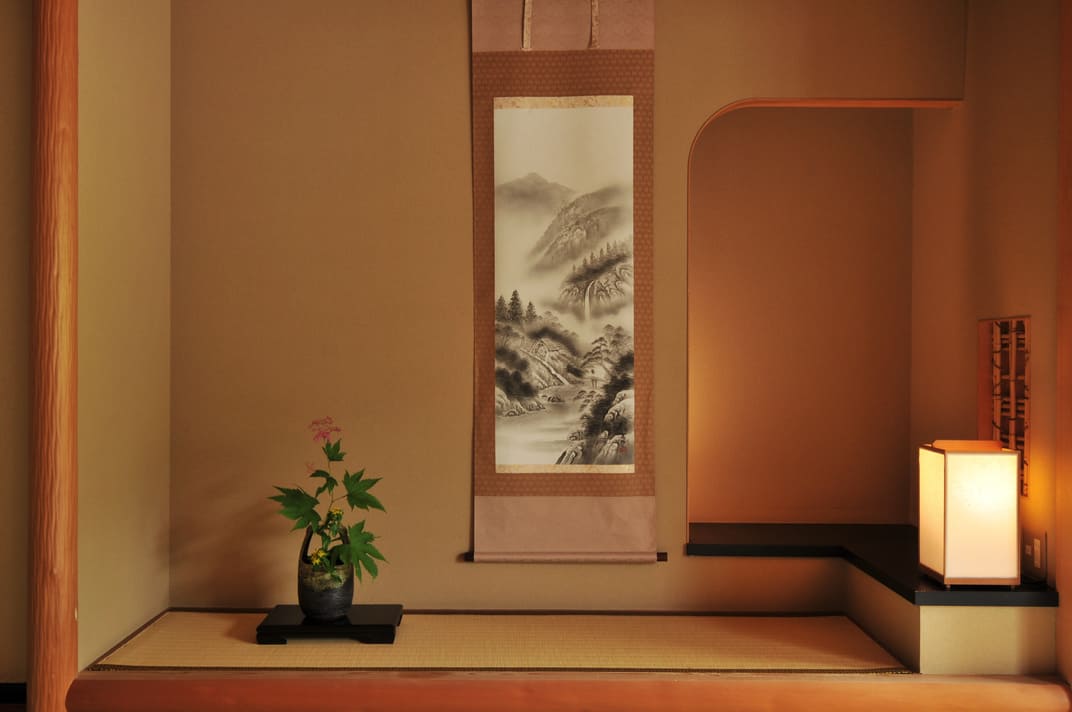
A kakejiku (掛け軸) is a Japanese hanging scroll: a painting or a piece of calligraphy mounted on a flexible backing of silk and paper, fitted with a wooden rod at the top and a weighted roller at the bottom, and hung from a single hook. The word is read kah-keh-jee-koo, and it is built from kake (掛け, to hang) and jiku (軸, axis or roller). So “kakejiku” and “Japanese hanging scroll” are not two different objects. They are the Japanese and the English name for the same thing.
What makes a kakejiku different from a framed picture is that it is designed to be taken down. It rolls around its bottom rod, goes into a paulownia-wood box, and is replaced by a different scroll when the season turns — a cycle called kakekae (掛け替え). A household might own a dozen scrolls and display one at a time. This guide covers what the word means and how a kakejiku differs from other Japanese scrolls, how one is built and what the parts are called, the standard mounting formats and sizes, how to hang one at the right height in a tokonoma or an ordinary room, which subject to hang in which month, how to collect and authenticate scrolls, and how to roll and store one without damaging it.
Kakejiku Meaning: The Word, the Characters, and the Reading

The two characters do the defining work. 掛け (kake) is the verb “to hang” or “to suspend”; 軸 (jiku) means an axis, a shaft, or a roller, and here it points to the wooden rod at the bottom around which the whole scroll is wound. A kakejiku is therefore, quite literally, “a hanging roller” — an object named for the mechanism that lets it be put away.
Japanese counts kakejiku with an unusual counter: not 本 (hon) as for other rod-shaped things, but 幅 (fuku), the counter for widths of cloth, a reminder that the scroll is understood as an assembly of fabric. One scroll is ippuku (一幅).
Kakejiku, Kakemono, Makimono, and Emaki: Japanese Scroll Types Compared
“Japanese scroll” covers several distinct formats, and the distinction matters when reading a dealer’s listing or an auction catalogue.
| Term | Japanese | What it is |
|---|---|---|
| Kakejiku | 掛け軸 | A vertical hanging scroll, displayed on a wall and viewed all at once. The subject of this guide. |
| Kakemono | 掛け物 | Literally “hanging thing” — an older and slightly broader word for the same object. Common in antique catalogues and in tea-ceremony usage. Treat it as a synonym for kakejiku. |
| Makimono | 巻物 | A horizontal handscroll, unrolled on a table from right to left and read or viewed in sections. Never hung. |
| Emaki / emakimono | 絵巻 / 絵巻物 | A narrative handscroll — a makimono carrying a story told in alternating text and illustration. |
| Gakuso | 額装 | Not a scroll at all: a work mounted in a fixed frame. Mentioned here because the same painting can be mounted either way, and a scroll that has been reframed has lost its kakejiku character. |
If a listing says kakejiku or kakemono, expect something to hang vertically. If it says makimono or emaki, expect something to unroll horizontally across a surface.
Is a Kakejiku the Same as a Japanese Hanging Scroll?
Yes, with one caveat about how the words are used in practice. In English, “Japanese hanging scroll” is a descriptive phrase and gets applied to anything vertical and rollable, including machine-printed decorative scrolls sold as souvenirs. “Kakejiku,” when used by a Japanese dealer or mounter, usually carries the implication that the object was properly mounted — that a professional chose the silks, applied the backing layers, and fitted the rods. The distinction is not linguistic but one of quality, and it is worth asking about: a printed image glued to a fabric panel and a scroll mounted by a hyogushi (表具師, professional mounter) are both “Japanese hanging scrolls” in English and only the second is a kakejiku in the sense a specialist means.
Where the Kakejiku Came From
The hanging-scroll format is Chinese in origin and arrived in Japan with Buddhism and the visual culture of Chinese Zen monasteries during the Heian (794–1185) and Kamakura (1185–1333) periods. Early Japanese scrolls were overwhelmingly Buddhist in content — deities, patriarchs, mandalas — intended for veneration rather than aesthetic appreciation, and mounted to suit the ritual requirements of temple interiors.
The shift from devotional object to vehicle for secular art — landscape, calligraphy, flower-and-bird studies, literary illustration — followed the development of Japanese civil culture through the Muromachi period (1336–1573) and accelerated through the Edo period (1603–1868), when the merchant class became the primary patron of visual culture and the tokonoma became a standard feature of the domestic interior. By the Edo period the kakejiku held the position it still holds in traditional Japanese homes: the single most important object in a formal reception room, changed with the seasons, chosen to honour a guest, and read as the clearest statement of the household’s taste.
The Tokonoma
The tokonoma (床の間) is the shallow recessed alcove built into the formal reception room of a traditional Japanese house, and it is the natural home of the kakejiku. It typically measures between 90 centimetres and 1.8 metres wide — a half-ken or full ken of traditional module — and sits on the principal interior wall. The scroll hangs on the back wall of the alcove; a ceramic vessel or a flower arrangement stands on the alcove floor in front of it, and occasionally an incense burner joins them. The three elements together make one composed statement, assembled by the household rather than a curator, and reassembled whenever the season or the occasion changes.
How a Kakejiku Is Made
Mounting a kakejiku is a specialised craft, practised by a hyogushi and known collectively as hyogu (表具); the finished mounting itself is the hyoso (表装). A fully realised scroll is a composite object of real complexity, and knowing the parts makes it possible to judge quality, assess condition, and understand what a mounter’s quotation is actually for.
The Honshi: the Work Itself
At the centre of every kakejiku is the honshi (本紙, main sheet) — the painting or calligraphy that is the reason the scroll exists. A honshi on paper is called shihon (紙本); on silk, kenpon (絹本). The paper is washi (和紙), made from kozo, gampi or mitsumata fibre; paper is the norm for calligraphy and ink painting, silk for more formal paintings intended for significant display. The honshi’s dimensions set the proportions of the finished scroll, and the mounting silks are chosen against its scale, tonality and subject.
Before mounting, the reverse of the honshi receives one or more layers of thin washi applied with wheat-starch paste (nori, 糊), a process called urauchi (裏打ち, backing). This stabilises the sheet, prevents tearing during mounting, and gives it enough body to hold its position in the assembly. Further backing layers are applied to the whole scroll during mounting, building a flexible, stable structure that can be rolled and unrolled for centuries.
The Parts of a Kakejiku and What They Are Called
| Part | Japanese | Function |
|---|---|---|
| Honshi | 本紙 | The painting or calligraphy itself. |
| Ichimonji | 一文字 | Narrow horizontal strips of fine silk immediately above and below the honshi — kami-ichimonji above, shimo-ichimonji below. Usually the most expensive fabric in the scroll, used in the smallest quantity. |
| Chumawashi | 中廻し | The middle border, the main silk field surrounding the honshi. Its colour and pattern dominate the scroll’s appearance and demand the most careful selection. |
| Tenchi | 天地 | The outermost upper and lower panels — ten (天, heaven) at the top, chi (地, earth) at the bottom. The ten is conventionally longer than the chi. |
| Hashira | 柱 | The vertical side strips, in formats where the sides are treated as separate elements. |
| Suji | 筋 | Very thin strips of silk, roughly 1.5 to 3 millimetres wide, used as a fine dividing line between fabric fields. |
| Futai | 風帯 | Two narrow bands hanging free from the top rod, cut from the same silk as the ichimonji. They add visual rhythm and, traditionally, discourage insects from settling on the scroll. |
| Tsuyu | 露 | The small decorative thread tufts at the lower end of each futai. |
| Hasso | 八双 | The half-round wooden rod at the very top, also called hyomoku (表木). The scroll’s structural head. |
| Kakeo | 掛緒 | The silk hanging cord, fixed at the hasso and looped over the hook. Its length sets the height of the scroll on the wall. |
| Makio | 巻緒 | A second, longer cord used to tie the scroll once rolled. |
| Makigami | 巻紙 | A strip of paper laid under the makio before tying, so the cord cannot leave an impression that telegraphs through to the honshi. |
| Jikubo | 軸棒 | The round rod at the bottom. It supplies the weight that keeps the scroll hanging straight and is the core around which the scroll is wound. |
| Jikusaki | 軸先 | The finials at each end of the jikubo. These are the only parts you should hold while rolling. Materials run from plain turned wood through lacquer and ceramic; ivory, once standard, is now replaced by bone, resin or substitute under international trade rules. |
| Futomaki | 太巻 | An optional pair of hinged wooden half-cylinders fitted over the jikubo to increase the diameter of the roll. Used for fragile or heavily pigmented works, where a tight roll would stress the paint layer. |
Mounting Formats: Maru, Nidan, Sandan, Butsu, Chagake
Mounting formats are graded by formality, and the grades borrow the calligraphic vocabulary of shin (真, formal), gyo (行, semi-formal) and so (草, informal). The system is known as yamato hyoso (大和表装), and it tells you at a glance how a scroll was meant to be used.
| Format | Japanese | Description | Typical use |
|---|---|---|---|
| Maru-hyoso | 丸表装 | A single silk surrounds the honshi on all four sides. No ichimonji, no separate tenchi. The simplest and least costly mounting. | Informal paintings, modern work, decorative scrolls. |
| Sujiwari-hyoso | 筋割表装 | A maru-hyoso with thin suji lines added around the honshi. | A step up from maru at modest extra cost. |
| Nidan-hyoso | 二段表装 | Two fabric zones — chumawashi and tenchi — with the ichimonji omitted. | Restrained mountings; literati and ink work. |
| Sandan-hyoso | 三段表装 | Three zones: ichimonji, chumawashi and tenchi, usually with futai. The most widely used format and the one most buyers encounter. | The default for paintings and calligraphy intended for the tokonoma. |
| Butsu-hyoso | 仏表装 | The most formal grade, built with kinran and donsu (金襴緞子) — gold-brocaded and damask silks. | Buddhist images, memorial scrolls, the most significant works. |
| Chagake | 茶掛け | Deliberately narrow and plain, proportioned for the small scale and low sightlines of a tea room. Most often carries a single line of Zen calligraphy. | Tea ceremony. |
Regional practice also varies. The clearest distinction is between Kyoto mounting (Kyo-hyogu, 京表具) and Edo mounting (Edo-hyogu, 江戸表具): Kyoto work tends toward quieter, more harmonious silk combinations, Edo work historically toward bolder fabric choices and slightly different proportional conventions. Both traditions are still practised, and collectors develop preferences as they handle more scrolls.
A well-chosen mounting enhances the honshi while staying subordinate to it. Poor choices — fabric that competes with the painting in colour or pattern, proportions that unbalance the composition — measurably reduce the impact of even a fine work, which is why remounting is a legitimate improvement rather than an admission of damage.
Standard Kakejiku Sizes
Finished scrolls are sold in a small set of conventional sizes, named after the width of the honshi and quoted as the overall dimensions of the mounted scroll including the jikusaki. The figures below are the common commercial standards; individual mounters vary by a centimetre or two.
| Size name | Japanese | Approximate width × length | Notes |
|---|---|---|---|
| Shakusan | 尺三立 | roughly 45 × 180 cm | The small standard. Suits the compact tokonoma of an apartment, or a narrow wall. |
| Shakuhaba | 尺巾立 | roughly 47 × 181 cm | Marginally wider than shakusan. |
| Hansetsu | 半切立 | roughly 51 × 181 cm | Derived from the standard sheet of gasenshi calligraphy paper cut in half lengthwise, so it is the usual size for calligraphy. |
| Shakugo | 尺五立 | roughly 61 × 190 cm | The most common size overall, and the safe default for a full-size tokonoma. |
| Shakuhachi | 尺八立 | roughly 71 × 194 cm | Large. Needs a wide alcove or a generous wall. |
The sizing rule of thumb for a tokonoma is that the scroll should be about one third of the alcove’s width. A 1.8-metre alcove therefore takes a shakugo or shakuhachi comfortably; a 90-centimetre alcove wants a shakusan. If the alcove has a shelf or a window below the display wall, choose a shorter scroll so the proportions still read.
Types of Japanese Hanging Scroll by Subject
Kakejiku carry nearly the entire range of traditional Japanese painting and calligraphy. Knowing the principal subject categories — their conventions, their cultural associations and their availability — is what turns browsing into focused collecting.
Landscape and Nature
Sansui-ga (山水画, mountain-water painting) is the largest single subject category. Rooted in Chinese literati painting and transformed by the Japanese ink masters of the Muromachi period, the sansui scroll depicts mountains, water, mist, trees and the occasional small human figure in an idiom that has stayed recognisable across six centuries. The ink-wash landscape — black and grey on white washi, with selective light colour washes — is the classical form; elaborate coloured landscapes on silk in mineral pigment, in the Nihonga tradition, run parallel with a different tonal character and different seasonal associations.
Kacho-ga (花鳥画, flower-and-bird painting) is the second great category, covering flowers, birds, insects and natural subjects in every medium and period. A flowering plant paired with a bird — crane and pine, kingfisher and lotus, bush warbler and plum — is the standard compositional formula, and examples run from ink-wash treatments of extreme economy to highly coloured mineral-pigment paintings of vivid detail. Kacho scrolls are among the most immediately accessible to collectors outside Japan, because the subjects read without specialist knowledge.
Figures, Buddhist Works, and Poem-Paintings
Jinbutsu-ga (人物画, figure painting) covers classical poetic figures from the Hyakunin Isshu (百人一首, the anthology of one hundred poets), Zen patriarchs and monks, historical warriors, and the elegant figures of the bijin (美人) tradition associated with the ukiyo-e school. Buddhist scrolls (butsuga, 仏画) — deities, mandalas, devotional subjects — form a distinct and specialised category whose significance is primarily religious, though the finest examples are of real art-historical importance and sit in major museum collections.
Haiku-ga (俳句画) combines a poem with a painting in the poet-painter tradition associated with figures including Yosa Buson (与謝蕪村, 1716–1784). In these works the calligraphed poem and the brushed image are compositionally unified: neither illustrates the other, and both arise from the same moment of apprehension. Works by the great poet-painters of the Edo literati tradition are among the most sought-after kakejiku in both Japanese and international markets.
Calligraphy Scrolls
Calligraphy scrolls — single characters, short phrases, classical poems, Zen koan text — are the largest category by quantity, running from mass-produced decorative scrolls to works by historically significant calligraphers that command serious prices at auction. The gap between a fine calligraphy scroll and a mediocre one is visible immediately to any experienced viewer: the energy, rhythm, ink management and compositional intelligence of the brushwork is either present or absent, with very little middle ground.
For interior use, calligraphy has a specific advantage. A single large character in bold sumi ink on white washi — mu (無, emptiness), wa (和, harmony), shin (心, heart) — makes a graphic statement that works whether or not the viewer can read it. These single-character works, ichiji-sho (一字書), are among the most popular kakejiku subjects internationally.
Ukiyo-e and the Hanging Scroll
International audiences know ukiyo-e through its printed works — the woodblock prints (mokuhanga, 木版画) of Katsushika Hokusai, Utagawa Hiroshige, Kitagawa Utamaro and their contemporaries that swept through European studios in the nineteenth century and set off Japonisme. But the prints are only one half of the school’s output. Alongside them, often at far greater expense and prestige, the same artists produced original hand-painted works that were mounted as kakejiku for their wealthiest patrons.
Nikuhitsu ukiyo-e (肉筆浮世絵, “brush-painted floating-world pictures”) are those originals: ink, mineral pigment and sometimes gold on silk or paper, typically mounted as hanging scrolls. Unlike the printed hanga (版画), produced in editions and sold to a broad public at modest prices, nikuhitsu works were one-off commissions for specific merchants, daimyo and occasionally samurai patrons who wanted what the print market could not supply.
They also look different. Woodblock printing flattens colour into clean separated fields defined by an outline cut by a specialist carver; nikuhitsu work carries the brush directly — gradations of pigment concentration, the slight relief of thickly applied mineral pigment, the calligraphic character of the ink line, and the warm luminosity of silk that no paper print reproduces. Artists who produced significant bodies of nikuhitsu work include Kitagawa Utamaro (c. 1753–1806), whose bijin on silk carry a material sensuality his prints cannot match; Katsushika Hokusai (1760–1849), whose painted works demonstrate a range beyond the compositional ingenuity of the prints; and Utagawa Kuniyoshi (1797–1861), whose warrior and supernatural subjects in painted form draw strong collector interest. Authenticated examples appear at Christie’s, Sotheby’s and Bonhams, and with specialist dealers in Japanese art.
Bijin-ga (美人画) is the most frequently encountered nikuhitsu subject and, in fine condition on silk by a major hand, the most expensive. Quality gradations within the category are severe: a documented work by the artist’s own hand occupies a completely different market position from one attributable to a student, a follower, or workshop production. For a collector whose interest is ukiyo-e but who wants paintings rather than prints, nikuhitsu kakejiku is the natural focus — entry costs are higher, and so is the depth of engagement.
How to Hang a Kakejiku: Height, Hooks, and Tools
A kakejiku hangs from a single point, which makes installation simple and makes getting the height right the only real decision.
Height
Two different sightlines govern the two settings. In a traditional tokonoma, the scroll is viewed by someone seated on the tatami, so it hangs lower than Western instinct suggests. In an ordinary room the viewer stands, and the centre of the image should sit at roughly standing eye level. As working baselines: place the centre of the image around 120 centimetres from the floor, and keep the top of the scroll roughly 20 to 30 centimetres below the ceiling or the alcove’s head beam. If the two rules conflict in a low-ceilinged room, favour the sightline of whoever will actually be looking at it.
The lower jikubo should clear the floor, the tatami, or the alcove’s raised floor by a few centimetres — never resting on it, which would deform the roller and crease the silk.
Hooks and Tools
- The hook. In a traditional room a small hook is driven into the otoshigake (落掛), the decorative beam across the head of the alcove. On a plain wall, any picture hook rated for the scroll’s weight will do; a kakejiku is light, and the load is concentrated at one point.
- Jizaikake (自在掛け). An adjustable hanger that lets you raise and lower the scroll without moving the hook. Useful when you rotate between scrolls of different lengths, which is exactly what seasonal changing involves.
- Yahazu (矢筈). A long pole with a forked metal tip that catches the kakeo. It lets you reach a high hook, and in a tokonoma it lets you hang and unhang the scroll without stepping onto the alcove floor.
- Fuchin (風鎮). Paired weights of stone, ceramic or metal hung from the two jikusaki. They steady the scroll in a draught and draw it gently flat, which helps a scroll that has taken a set from long storage. Use them with restraint: they load the scroll continuously, and mounters warn against hanging them specifically to pull out existing creases, which stresses the silk rather than repairing it.
Kakejiku Outside the Tokonoma
The tokonoma remains the ideal setting, but its logic is portable. What the alcove supplies is a shallow, visually bounded field dedicated to one composed arrangement, kept uncluttered and changed regularly. You can reproduce that on a plain wall by designating a section as the scroll’s place, leaving it otherwise empty, and putting a low shelf or a single ceramic beneath it.
The format also happens to suit contemporary interiors unusually well. Its tall narrow proportions, its natural materials — silk, washi, wood — and its compositional restraint sit comfortably in minimalist and Japandi rooms, and the verticality is genuinely useful under a high ceiling, bridging floor and ceiling without the visual weight of a large framed horizontal work. In an open-plan space, the wall behind a low storage unit or a single chair makes a serviceable improvised alcove.
Kakekae: Changing Kakejiku with the Seasons
Kakekae (掛け替え) is the practice of swapping the displayed scroll, and it is not decorative fussiness — it is the point of the format. Two rules govern it.
Anticipate the season by about a month. A plum scroll goes up while the trees are still bare, not when the blossom is out; the scroll announces the season rather than matching it. Hanging an autumn maple in late November, when the leaves are already turning outside, reads as late.
Do not leave one scroll up indefinitely. Three to four weeks at a stretch is the conventional display period, after which the scroll goes back in its box and another takes its place. Even for a scroll you intend to keep up longer, change it at least every two to three months. This is a conservation measure as much as an aesthetic one: continuous display means continuous light exposure, and a scroll left hanging for a year will fade and take a permanent set.
| Period | Conventional subjects |
|---|---|
| New Year | Pine, bamboo and plum (shochikubai, 松竹梅); crane and tortoise; sunrise; Mount Fuji; auspicious phrases on longevity and good fortune. |
| February – March | Plum blossom; camellia; peach and Hinamatsuri subjects; early bush warbler. |
| April | Cherry blossom; willow; spring landscape. |
| May | Carp and Shoki for Boys’ Day; wisteria; peony; iris. |
| June | Hydrangea; firefly; rain subjects. |
| July – August | Morning glory; waterfall; sweetfish; lotus; anything that reads as cool. |
| September | Autumn moon; bush clover; susuki grass. |
| October – November | Chrysanthemum; maple; persimmon; harvest subjects. |
| December | Snow landscape; narcissus; winter peony. |
| Year round | Sansui landscape; single-character calligraphy; Kannon and devotional subjects; family memorial scrolls as the occasion requires. |
A household that rotates seriously will own somewhere between four and twelve scrolls, which is a more useful way to think about building a collection than acquiring one centrepiece. Four scrolls — one per season — is a complete working set.
Collecting Japanese Hanging Scrolls
The kakejiku market is one of the deepest in Japanese art, spanning an enormous range of periods, subjects, quality levels and prices. Navigating it takes visual education, specialist relationships, and a grasp of what actually determines value.
Authentication and Condition
Attribution rests on several pillars assessed together. The rakkan (落款, signature) and the seal impression on the honshi are the primary surface indicators; their calligraphic style and the design of the seal should be consistent with documented examples. A hakogaki (箱書き) — the artist’s inscription on the lid or side of the wooden box — adds documentary support that, when consistent in ink and hand with the work inside, is among the strongest authentication indicators in the Japanese market. For works without an inscribed box, exhibition records, auction provenance and references in scholarly catalogues do the same job.
Assess the honshi and the mounting separately. Damage to the honshi — tears, losses, tide marks from water, foxing, pigment fading — bears directly on value. Deterioration of the mounting silk — fraying, discolouration, old repairs, or the loss of an original mounting to replacement — affects presentation and the object’s documented history without necessarily compromising the painting.
Remounting (hyoso) is routine maintenance and does not inherently reduce value; a skilled remounting restores a scroll to optimal condition and can significantly improve how it presents. The questions that matter are whether the work was done by a professional hyogushi with appropriate traditional materials, and whether original elements of historical significance — period silk, the original box — were preserved or at least documented.
Where to Buy
Specialist dealers in Japanese art — in Japan, the United States, Europe and Australia — offer the deepest expertise, the most thorough provenance documentation, and the ability to source to a brief. The better ones also provide conservation referrals, installation guidance and help with resale. The premium over auction for an equivalent work is the price of that expertise, and for a collector without deep specialist knowledge it is usually money well spent.
Auction gives the broadest access and the most transparent price discovery. Internationally that means Christie’s, Sotheby’s and Bonhams; in the Japanese domestic market, Shinwa Art Auction, SBI Art Auction, Mainichi Auction and Est-Ouest Auctions. Pre-sale catalogues from these houses carry specialist scholarship, and published results build the price record that makes market orientation possible. The offsetting risks are a compressed viewing window, no recourse if a problem emerges after the sale, and a buyer’s premium that adds roughly 20 to 30 percent to the hammer price.
Price Ranges by Category
| Category | Entry Level | Mid-Range | Museum / Major Works |
|---|---|---|---|
| Contemporary calligraphy kakejiku (living artists) | $300–$2,000 | $2,000–$15,000 | $15,000–$80,000+ |
| Edo-period ink painting (sansui, kacho) | $1,000–$5,000 | $5,000–$40,000 | $40,000–$300,000+ |
| Nihonga in kakejiku (20th-century masters) | $2,000–$10,000 | $10,000–$80,000 | $80,000–$500,000+ |
| Nikuhitsu ukiyo-e (original paintings) | $3,000–$15,000 | $15,000–$100,000 | $100,000–$2,000,000+ |
| Buddhist painting scrolls (butsuga) | $1,000–$8,000 | $8,000–$60,000 | $60,000–$500,000+ |
| Zenga / Zen monk-painter scrolls | $2,000–$10,000 | $10,000–$60,000 | $60,000–$500,000+ |
These ranges reflect general market observation across specialist dealers and major auction houses. Individual works vary substantially within them according to attribution quality, condition, provenance documentation, subject, and the state of specific collecting markets. Nikuhitsu ukiyo-e in particular spans extraordinary variation: an authenticated major work by Kitagawa Utamaro or Katsushika Hokusai on silk in fine condition sits in a different market altogether from an unsigned or workshop-attributed work in the same genre.
Storage and Care: How to Roll and Store a Kakejiku
Almost all damage to kakejiku happens during handling, not during display. The procedure below is the standard one, and the order matters.
Rolling a Kakejiku
- Fold the futai first. With the scroll still on the wall, lay each of the two futai flat against the hasso, folding at the base and bringing them across horizontally. If a futai is long enough to overhang the edge of the scroll, turn the excess back inwards. Rolling a scroll with the futai unfolded is one of the commonest causes of permanent creases.
- Start rolling while it still hangs. Take the two jikusaki, one in each hand, and roll upward from the bottom — the painted face turns inwards as you go, so the lining ends up on the outside of the finished roll and protects what is inside it. Roll until you reach the lower ichimonji, then lift the kakeo off the hook. Rolling before unhooking keeps the scroll under even tension and stops it slumping.
- Hold only the jikusaki. Never grip the middle of the roll. Hand pressure on a partly rolled scroll puts a lengthwise crease straight through the honshi.
- Roll loosely. A tightly wound scroll presses the paint layer and creates exactly the creases you are trying to avoid. For a fragile or heavily pigmented work, fit futomaki to widen the core.
- Tie over the makigami. Lay the makigami paper around the roll, wind the makio over it about three turns, then tuck the free end back under itself. Keep the cord slack. A tight cord leaves an impression that eventually shows on the face of the scroll.
Storage and the Box
Store the rolled scroll lying flat in its wooden box. Boxes are made from paulownia (kiri, 桐), which is light, buffers humidity swings, and contains compounds that deter insects — the standard material for storing valuables in Japan for centuries. Keep the box away from strong heating and cooling, direct sun, and damp. Replace any insect-repellent sachet periodically.
Air the scrolls twice a year. Mushiboshi (虫干し) means taking them out on a clear, dry day in spring and again in autumn and hanging them for a few hours so that moisture accumulated inside the closed box can escape. This single habit prevents most mould and foxing problems.
Display Environment
Relative humidity between 45 and 55 percent is the band in which washi and silk stay stable and the mounting paste does not deteriorate. Above roughly 70 percent, mould grows and paste softens; below roughly 35 percent, the structure becomes brittle and the mounting layers can delaminate. Direct sunlight accelerates the breakdown of silk and the fading of pigments, so use indirect daylight or controlled artificial light, and keep the display period short — which is another argument for kakekae.
When Something Is Wrong
A scroll that has spent years in a damp basement or a very dry room, or that was rolled too tightly, should be unrolled slowly in a stable environment before anyone tries to hang it. If it shows cockling, tide marks, silk delamination or loss in the honshi, stop and consult a professional hyogushi. Forcing a stiff or damaged scroll open is the single most common cause of irreversible damage.
Professional conservation and remounting are available through the Kyoto and Tokyo hyogu workshops, and a growing number of conservators outside Japan have trained in the relevant techniques. For scrolls of real value, inspection every five to ten years under normal conditions — more often for one displayed continuously — is a sound investment. A well-kept kakejiku outlasts any alternative format: scrolls mounted five hundred years ago survive in excellent condition in museum collections today.
That is the quiet argument the format makes. A kakejiku rewards the visual pleasure of the work it carries, the material beauty of its silk and wood, the intelligence of its seasonal use, and the particular depth of an object built from the start to be present for a while and then to be gone.
Discover Nihonga for Contemporary Spaces
Shop carefully selected Nihonga,
curated by experienced Japanese art dealers
for homes and commercial spaces worldwide.