
Ukiyo-e & Scrolls
Japanese Woodblock Printing: History, Technique, and Market

Japanese woodblock printing is one of the most influential image-making traditions in art history. From the elegant courtesan portraits of the Edo period to the contemporary works coming out of small studios in Kyōto, Tōkyō, and increasingly abroad, the medium has carried Japanese aesthetics into living rooms, museums, and design schemes around the world.
For collectors, interior designers, and serious enthusiasts, understanding woodblock printing means understanding far more than a single technique. It means recognizing the difference between an early impression and a late one, knowing why two prints of the same image can be separated by a factor of a hundred in price, and appreciating how the medium evolved through three distinct movements — ukiyo-e (pictures of the floating world), shin-hanga (new prints), and sōsaku-hanga (creative prints) — before flowering once again as contemporary mokuhanga.
This guide walks through the history, the workshop process, the major artists and movements, and the market as it stands today. It also addresses a practical question that comes up constantly with buyers furnishing residential and commercial spaces: how does a Japanese woodblock print actually live on a wall, and how does it relate to the wider tradition of Nihonga (Japanese-style painting) that shares so many of its materials?
The Origins of Japanese Woodblock Printing
The art of printing from carved wooden blocks reached Japan from continental East Asia, where the technique had been in use for centuries to reproduce Buddhist scripture. What Japan did with it — over roughly twelve hundred years — was to transform a religious reproduction technology into one of the most expressive pictorial mediums the world has produced.
From Buddhist Sutras to Popular Imagery
The earliest known Japanese printed objects are the Hyakumantō Darani, one million miniature dharani scrolls commissioned by Empress Shōtoku in the 760s and placed inside small wooden pagodas. They are among the oldest extant printed materials anywhere. For centuries afterward, printing in Japan remained largely a tool of the Buddhist clergy, used for reproducing sutras and devotional images.
By the late seventeenth century, that began to change. Edo (modern Tōkyō), now a vast commercial city of around a million residents, had developed a wealthy merchant class with money to spend on entertainment, fashion, and printed pictures of the theater and pleasure districts. The technical infrastructure for book printing had matured, and publishers began to commission single-sheet pictorial prints. These were initially monochrome, then hand-colored, and finally, from the 1760s onward, fully polychromatic in the form known as nishiki-e — literally “brocade pictures” — pioneered by Suzuki Harunobu.
The Rise of Ukiyo-e in the Edo Period
Ukiyo-e, which translates loosely as “pictures of the floating world,” refers to the entire genre of prints and paintings made for this urban audience between roughly the 1670s and the end of the Edo period in 1868. The term ukiyo originally carried a Buddhist sense of the world’s impermanence, but in popular Edo usage it came to mean something closer to “the world of fleeting pleasures” — the kabuki theaters, the licensed pleasure quarters of Yoshiwara, the famous beauties of the day, and the seasonal landscapes of the road and the city.
Within ukiyo-e, certain subject categories dominated. Bijin-ga depicted celebrated beauties; yakusha-e captured kabuki actors in role; meisho-e showed famous places; and from the early nineteenth century, fūkei-ga (landscape prints) rose to prominence in the hands of Hokusai and Hiroshige. The medium was deeply commercial — prints were sold in bookshops and stationers for the price of a bowl of noodles — and that commercial pressure is part of what drove its formal sophistication.
How a Japanese Woodblock Print Is Made
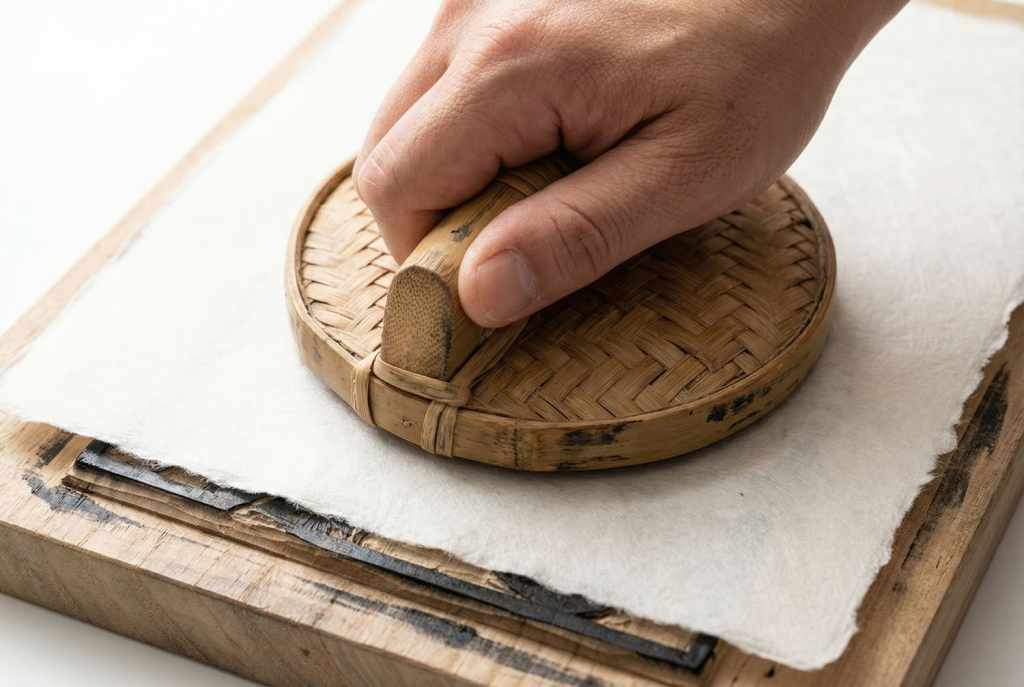
A Japanese woodblock print, mokuhanga (literally “wood plate picture”), is the product of four hands and a great deal of patience. Unlike Western intaglio prints, where the artist often does everything, traditional mokuhanga was — and to a large extent still is — a collaborative process involving a designer, a block carver, and a printer, all working under the coordination of a publisher.
Materials: Cherry Wood, Washi, and Sumi
The blocks themselves are traditionally cut from yamazakura, mountain cherry wood, prized for its fine grain, even density, and ability to hold a clean carved line. A single print of any complexity requires multiple blocks — one for the key outline, called the keyblock or omohan, and a separate block for each color.
The paper is washi, the traditional handmade paper of Japan, most often produced from the inner bark of the kōzo (paper mulberry) plant. Washi for printing is dampened before pressing, allowing the fibers to absorb pigment deeply rather than letting it sit on the surface. This is one reason a fine mokuhanga print has such a soft, breathing quality of color.
The inks are sumi (Japanese black ink, made from soot and animal-hide glue) for the outline, and water-based pigments mixed with rice paste for the colors. Many of the traditional pigments overlap with those used in Nihonga: indigo derived from the ai plant, bengara iron oxide for red-browns, gofun (a white ground made from crushed oyster shell), and on the most luxurious editions, ground mineral pigments related to iwa-enogu — the powdered mineral colors that define Nihonga painting.
The Collaborative Workshop
In the classic Edo workshop, the painter or designer (eshi) supplied a finished line drawing on thin paper. The carver (horishi) pasted this drawing face-down on the keyblock, made it transparent with oil, and cut away everything that was not a line, leaving the design standing in relief. Proofs printed from the keyblock were then sent back to the designer, who indicated the color separations. From those marked proofs, the carver produced additional blocks — sometimes a dozen or more — for each color and gradation.
The printer (surishi) inked each block with a stiff brush, registered the paper against kentō marks (small notches cut into the block to align the paper precisely), and pressed the sheet down by hand. This division of labor allowed extraordinary specialization. A printer who had spent thirty years pulling impressions could control the moisture of the paper, the viscosity of the pigment, and the pressure of the burnisher with a precision impossible for a generalist.
Hand-Burnishing with the Baren
The press, in mokuhanga, is the human body. The printer transfers pigment from block to paper using a baren, a circular hand pad traditionally made from a coil of twisted bamboo cord sheathed in a fresh leaf of takenokawa (bamboo sheath). Pressed and rubbed in tight circles, the baren picks up subtle variations of pressure that a mechanical press cannot replicate.
This is why early impressions — those pulled when the blocks are sharp and the printer is still rested — are prized so heavily by collectors. A first-edition print from the early Edo years can show crisp keylines, deeply saturated color, and visible bokashi (graded color, applied by selectively dampening the block before printing). Later impressions from worn blocks or different printers can lose much of this character even when the design is identical.
Masters and Movements
Three movements define the arc of Japanese woodblock printing from the eighteenth century to the present. Each responded to the conditions of its time, and each is now collected by a distinct international audience.
Edo Masters: Hokusai, Hiroshige, and Utamaro
Katsushika Hokusai (1760–1849) is, by global recognition, the single most famous Japanese artist of any period. His Thirty-six Views of Mount Fuji series, designed around 1830–1832, includes Under the Wave off Kanagawa — universally known as the Great Wave — which has become a worldwide visual icon. A fine, early impression of the Great Wave set an auction record at Christie’s New York in March 2023, selling for approximately 2.76 million US dollars. Strong impressions of other prints from the series regularly trade in the tens to hundreds of thousands of dollars depending on condition and edition.
Utagawa Hiroshige (1797–1858) was Hokusai’s great rival in landscape, particularly through his Fifty-three Stations of the Tōkaidō series, which captured the way stations on the highway between Edo and Kyōto. His work is celebrated for atmospheric weather effects — rain in slanting black lines, snow held in white reserve, mist suggested in pale bokashi. These effects translate especially well to interior settings, where a Hiroshige snow scene can carry an entire wall with quiet authority.
Kitagawa Utamaro (c. 1753–1806) defined bijin-ga, prints of women, with an intimacy and psychological focus that was unprecedented in Japanese figure work. His half-length and bust-format portraits, including the series Ten Studies in Female Physiognomy, are foundational to the global appreciation of ukiyo-e and remain consistently strong at auction.
Shin-Hanga: The New Print Movement
By the late nineteenth century, ukiyo-e was in decline. Photography had taken over many of its journalistic functions, mass-produced lithographs were cheaper, and the old Edo publishing structures had collapsed. The shin-hanga movement, launched around 1915 by the publisher Watanabe Shōzaburō, set out to revive traditional woodblock printing for a new market — including, importantly, Western collectors and tourists who admired Japanese prints but wanted images grounded in the sensibility of their own era.
Shin-hanga retained the classical four-role workshop but updated the visual language. The movement’s leading designers — Kawase Hasui (1883–1957), Hiroshi Yoshida (1876–1950), Itō Shinsui (1898–1972), and Hashiguchi Goyō (1880–1921) — produced landscapes, beauties, and travel scenes that absorbed lessons of Western perspective and light without sacrificing the linear discipline of Japanese print design. Hasui’s snowscapes and Yoshida’s mountain views are among the most reproduced and most collected images of twentieth-century Japan, and they remain a popular point of entry for designers building Japanese-art interiors.
Sōsaku-Hanga: The Creative Print Movement
In parallel, a quite different movement emerged. Sōsaku-hanga rejected the workshop division of labor entirely. Following the principle of jiga, jikoku, jizuri — “self-drawn, self-carved, self-printed” — the artist did everything, treating the woodblock as a personal medium on a level with painting.
Onchi Kōshirō (1891–1955), the movement’s intellectual leader, made abstract and semi-abstract prints that connect to international modernism while remaining unmistakably Japanese. Munakata Shikō (1903–1975), the most internationally celebrated sōsaku-hanga artist, won the International Grand Prize for prints at the 1956 Venice Biennale for his powerfully drawn black-and-white prints rooted in Buddhist subject matter and Japanese folk tradition. Sōsaku-hanga prints now command strong prices and are increasingly recognized as central to twentieth-century Japanese art rather than a sub-genre of printmaking.
Contemporary Mokuhanga and Its Crossover with Nihonga
The story did not end in the twentieth century. A vital contemporary mokuhanga scene exists today, sustained by working studios in Japan and by an international community of artists who have learned the technique through programs such as the Mokuhanga Innovation Laboratory (MI-LAB) at Lake Kawaguchi and the International Mokuhanga Conference, first held in Japan in 2011.
Today’s Practitioners
Contemporary mokuhanga ranges widely in idiom. Some practitioners work in a direct continuation of shin-hanga — atmospheric urban and landscape scenes, often editioned in the hundreds. Others use the medium for abstract, conceptual, or experimental work, taking advantage of mokuhanga’s water-based pigments to produce effects unavailable in oil-based Western relief printing. A growing market segment treats contemporary mokuhanga as collectible art objects in their own right, with prices for established living artists generally ranging from the low hundreds to the low five figures in US dollars, depending on edition size, scale, and reputation.
Shared Materials with Nihonga
What is sometimes missed by collectors approaching Japanese prints from a Western perspective is how closely woodblock printing sits to Nihonga, the broader tradition of Japanese-style painting. Both work on washi or on silk, both use water-based pigments bound with animal-hide glue (nikawa), both employ sumi ink for line, and both draw on the same family of mineral and shell-derived colors. A number of major figures — Itō Shinsui among them — moved fluidly between print design and Nihonga painting.
For collectors and designers building a coherent Japanese-art interior, this material kinship matters. A shin-hanga print and a contemporary Nihonga panel will read as members of the same family on a wall — the same paper, the same depth of color, the same restraint — in a way that an oil painting and a print typically do not.
Collecting Japanese Woodblock Prints
Collecting Japanese woodblock prints rewards study. The same image can exist in dramatically different physical forms — early impression, late impression, posthumous re-cut, twentieth-century reproduction — and the difference between them, both visually and financially, is enormous.
Authentication: What to Look For
For Edo-period prints, the key markers of an early, original impression include the sharpness of the keyline (look for thin, precise lines, not thickened or broken ones), the presence of well-executed bokashi gradations, the survival of the original publisher’s seal and date seal in the margin, and the freshness of color — particularly of fugitive pigments like beni (safflower pink) and ai (indigo blue), which fade under light exposure.
For shin-hanga, original-edition prints from Watanabe Shōzaburō’s workshop typically carry the publisher’s seal, and prewar editions can be dated by specific cartouches. Posthumous editions from the same blocks exist for many designs and trade at substantially lower prices. Reputable auction houses — Christie’s, Sotheby’s, and Bonhams all hold dedicated Japanese-prints sales — provide detailed condition reports that note edition state, foxing, fading, and trimming.
For contemporary mokuhanga, documentation is paramount: signed and numbered editions obtained from the artist or an established gallery, with clear provenance, are the standard.
Price Ranges and Auction Benchmarks
The market spans an extraordinary range. The following figures reflect documented price bands at major international auction houses in recent years and are intended as orientation only, not as guarantees of specific value.
| Category | Approximate Range (USD) |
|---|---|
| Late Edo and Meiji prints by lesser-known designers | $150 – $1,500 |
| Hiroshige, later or worn impressions | $800 – $5,000 |
| Hiroshige, fine early impressions of major series | $5,000 – $50,000+ |
| Hokusai, fine impressions from Thirty-six Views of Mount Fuji | $20,000 – $500,000+ |
| Hokusai, Great Wave (record sale, Christie’s NY, March 2023) | approx. $2.76 million |
| Utamaro, fine impressions of major bijin-ga | $10,000 – $200,000+ |
| Shin-hanga, Kawase Hasui (prewar editions, fine condition) | $1,500 – $25,000+ |
| Sōsaku-hanga, Munakata Shikō | $2,000 – $50,000+ |
| Contemporary mokuhanga (established living artists) | $200 – $10,000+ |
At the high end, the 2.76 million US dollar Great Wave at Christie’s is the public benchmark, but it represents a fine early impression in exceptional condition; most surviving impressions of the same image trade for considerably less. At the accessible end, very competent late-Edo and Meiji prints by lesser-known designers can still be acquired for a few hundred dollars, making woodblock prints one of the most welcoming entry points into serious Japanese art collecting.
Living With Prints: Light, Framing, and Scale
Japanese prints are, with a few exceptions, intimate objects. The standard ōban format — roughly 25 by 38 centimeters (about 10 by 15 inches) — sits comfortably on a residential wall but reads at close range rather than across a room. For larger commercial spaces, hotel lobbies, or open-plan interiors, designers often group prints in series — a triptych or a run from a known set, framed identically — or pair prints with a larger Nihonga work that anchors the composition.
Conservation is straightforward but non-negotiable. The water-based pigments in mokuhanga are sensitive to ultraviolet light; direct sunlight or strong gallery lighting will fade beni, ai, and certain organic yellows within years rather than decades. UV-filtering glass or acrylic is standard for any print intended for daily display, and serious collectors typically rotate prints in and out of frame, keeping them in archival storage when not on view. Humidity above sixty percent encourages foxing — the brown spots caused by fungal activity — so climate-controlled spaces are strongly preferable to humid coastal environments without conditioning.
For interiors designed around Japanese art, woodblock prints offer something few other mediums can: a deep, art-historical pedigree at a price point that allows real selection rather than a single trophy acquisition. They also pair naturally with Nihonga, sharing the same materials and the same visual logic of line, void, and clear color.
A Living Tradition
Japanese woodblock printing is not a closed chapter. It is a living tradition that runs from the eighth-century dharani scrolls of Empress Shōtoku through Hokusai’s Great Wave, the shin-hanga revival, the experimental work of the sōsaku-hanga modernists, and the contemporary studios producing new editions in cherry wood and washi today.
For collectors and design professionals drawn to this lineage, the deepest reward is often the discovery that prints, Nihonga paintings, and the wider universe of Japanese visual art share a common grammar — line, washi, mineral color, and restraint. Building a room or a collection around that grammar is one of the most enduring directions in contemporary art collecting. For readers wanting to continue along that path with original works on hand-prepared washi and silk, a curated selection of Nihonga is the natural next step.
Discover Nihonga for Contemporary Spaces
Shop carefully selected Nihonga,
curated by experienced Japanese art dealers
for homes and commercial spaces worldwide.