
Ukiyo-e & Scrolls
Japanese Woodblock Prints: A Complete Guide to Ukiyo-e
- What Is Ukiyo-e? The Art of the Floating World
- The History of Japanese Woodblock Prints
- How Ukiyo-e Woodblock Prints Are Made
- The Major Genres of Ukiyo-e
- Great Masters of Ukiyo-e: Artists Every Enthusiast Should Know
- Ukiyo-e and the West: Japonisme and Its Legacy
- Collecting and Displaying Ukiyo-e Prints
- Discover Nihonga for Contemporary Spaces
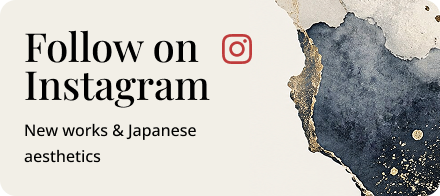
Ukiyo-e (浮世絵, “pictures of the floating world”) is a style of Japanese woodblock printing and painting that flourished in the Edo period (1603–1868), made for city dwellers and focused on beautiful women, kabuki actors, famous places and everyday life. The best-known examples, such as Katsushika Hokusai’s “The Great Wave” and Utagawa Hiroshige’s Tōkaidō series, were produced as affordable multi-block colour prints, and they went on to reshape Western painting.
This guide covers what ukiyo-e is and what its style looks like, how a print was made by a team of specialists, the history from Hishikawa Moronobu to the shin-hanga revival, the main genres and artists, the influence on Monet and Van Gogh, and a short summary of collecting and display.
What Is Ukiyo-e? The Art of the Floating World
The term ukiyo-e combines ukiyo (浮世, “floating world”) and e (絵, “picture”). It designates a tradition of painting and printmaking centered on Edo (present-day Tōkyō) that took its subjects from urban merchant culture: the pleasure districts, the theaters, the landscapes travelers knew from the highways, and the celebrities — courtesans, kabuki actors, sumō wrestlers — who filled the imagination of the townspeople who bought these works.
Ukiyo-e, Ukiyo e, Ukiyoe: Spelling and Pronunciation
The same word appears in English as ukiyo-e, ukiyo e and ukiyoe. All three refer to the same art, pronounced roughly “oo-kee-yoh-eh”. The hyphenated form is the most common in museum and scholarly writing, and ukiyo-e prints, ukiyo-e woodblock prints and Japanese woodblock prints are used almost interchangeably, although strictly speaking “ukiyo-e” also covers hand-painted works.
The Meaning of “Floating World”
The word ukiyo had a long prior history before the Edo period adopted it. In Buddhist usage it referred to the sorrowful, impermanent world of ordinary existence, written with the character 憂き (sorrowful). Edo culture performed a deliberate inversion: the same sound, now written with 浮 (floating), became the name for the pleasurable, fashionable, transient world of entertainment and beauty. The floating world was the world you could enjoy precisely because it did not last — the beautiful courtesan, the celebrated actor, the cherry blossoms in their one week of bloom — and ukiyo-e were its pictures.
This context explains why ukiyo-e was popular art in the strict sense. It was made for and sold to the urban merchant and artisan class (chōnin, 町人), not to aristocratic or samurai patrons. It depicted subjects the ruling samurai class officially disdained, with a frankness and visual delight that has no parallel in the officially sanctioned art of the same period.
What Defines the Ukiyo-e Style
Several features make an ukiyo-e print recognisable at a glance. Outlines are bold and calligraphic, drawn from the brush line of the original design. Colour is laid in flat, unmodulated areas rather than modelled with shading, with gradations (bokashi) used mainly for skies and water. Compositions are often asymmetrical and cropped, with figures cut off at the edge of the sheet or a close foreground object framing a distant view. Perspective is shallow or deliberately unconventional, and the subjects are contemporary rather than religious or classical. These are the qualities that struck European painters in the nineteenth century.
Woodblock Prints and Paintings
The primary medium of ukiyo-e is mokuhanga (木版画, woodblock printing), a relief process in which images are cut into blocks of cherry wood, inked, and transferred to sheets of washi (Japanese plant-fiber paper). Woodblock printing had been used in Japan for centuries to reproduce Buddhist texts and images; ukiyo-e’s achievement was to apply it to secular, commercial image production and refine it into the full polychrome system of the eighteenth and nineteenth centuries. The tradition also includes hand-painted hanging scrolls and screens (nikuhitsu-ga, 肉筆画, “brush-drawn pictures”), made as unique works for wealthier patrons.
The commercial consequences were profound. A successful design, once carved, could be printed in editions of hundreds or even thousands of impressions. A new print from a leading master in the late Edo period cost roughly the price of a bowl of noodles, within reach of any working resident of Edo. Ukiyo-e was the first genuinely mass-market art form in Japan, and it changed the relationship between artist, artwork and audience.
Print Formats, Series and Sets
Most ukiyo-e prints were made as single sheets in the ōban format, about 25 by 38 cm, but publishers used many shapes. Smaller sheets, narrow vertical formats made for hanging on pillars (hashira-e), and diptychs and triptychs spread across two or three sheets were all common, with triptychs especially popular for panoramic landscapes, kabuki scenes and battles. Many of the best-known works were published as numbered series, such as the “Thirty-six Views of Mount Fuji” or the “Fifty-three Stations of the Tōkaidō”. Buyers collected them sheet by sheet, which is why single prints from a series are so common today and complete sets are not.
The History of Japanese Woodblock Prints
The ukiyo-e tradition developed over roughly two centuries, from its origins in the mid-seventeenth century through the technical revolution of the 1760s to the late nineteenth-century decline in the face of photography and Western printing technology.
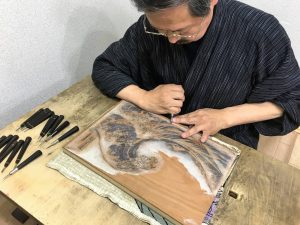
Source: Tokyo Weekender(https://www.tokyoweekender.com/japan-life/carve-your-own-art-where-to-learn-traditional-japanese-woodblock-printing/)
From Monochrome to the Nishiki-e Revolution
The founder of the ukiyo-e print tradition is generally identified as Hishikawa Moronobu (菱川師宣, c. 1618–1694), a textile designer who turned to woodblock illustration and transformed monochrome book illustration into a freestanding art of single-sheet prints. His bold black outlines on white paper, depicting the Yoshiwara pleasure district and scenes of daily life in Edo, established the compositional vocabulary and commercial framework of the tradition.
Through the first half of the eighteenth century, artists experimented with adding colour. Tan-e (丹絵) were hand-coloured with an orange-red lead pigment; urushi-e (漆絵, “lacquer pictures”) used a black ink and glue mixture with a lustrous surface; and benizuri-e (紅摺絵, “pink-printed pictures”) introduced limited colour printing from two or three blocks in pink, pale green and black.
The decisive revolution came around 1765 with full polychrome printing, nishiki-e (錦絵, “brocade pictures”), typically attributed to Suzuki Harunobu (鈴木春信, c. 1725–1770) and his collaborators. Nishiki-e used a separate block for each colour, with registration marks (kentō, 見当) cut into each block to keep the colour layers aligned. A finished print might need five, eight or more blocks, and the result was prints that carried the chromatic range of paintings at a fraction of the cost.
The Golden Age: Ukiyo-e from the 1760s to the 1860s
The century following Harunobu’s innovation is the golden age. It produced Kitagawa Utamaro’s close-up portraits of beautiful women; the intense actor portraits of Tōshūsai Sharaku; and the landscape masterworks of Katsushika Hokusai and Utagawa Hiroshige, which brought natural beauty and atmospheric observation to an enormous public and eventually to Western artists.
A key technical development was the arrival of Prussian blue, known in Japan as bero-ai (ベロ藍), around the 1820s to 1830s. Printers had relied on indigo, which makes a beautiful blue but fades under light. Prussian blue, first synthesized in Berlin in the early eighteenth century and reaching Japan through trade, was more light-fast and could be printed in a range of strengths from deep navy to the palest sky tone. It is the pigment behind the blue of Hokusai’s “The Great Wave”, and the atmospheric gradations in Hiroshige’s landscapes depend on it.
Censorship and Reform
Ukiyo-e was made under official supervision. From the 1790s, prints had to carry a censor’s approval mark, and publishers learned to work within rules that changed with the political climate. The Tenpō reforms of the early 1840s were especially severe: they restricted luxury and prints of kabuki actors and courtesans, the genres that had sold best. Artists and publishers responded by shifting toward landscape, warriors, flowers and birds, and by disguising banned subjects in parody, which is one reason the 1830s to 1850s are so rich in landscape and warrior prints.
Decline, the Shin-Hanga Revival and Sōsaku-Hanga
The Meiji era (1868–1912) brought Western printing technology to Japan and rapidly displaced the commercial woodblock tradition. Photography, lithography and newspaper illustration took over the roles ukiyo-e had filled. Tsukioka Yoshitoshi (月岡芳年, 1839–1892), often called the last major figure of the classical tradition, produced works of striking originality in the 1880s and early 1890s, notably “One Hundred Aspects of the Moon” (月百姿), even as the commercial basis of his medium was collapsing.
The response took two directions in the early twentieth century. The sōsaku-hanga (創作版画, “creative print”) movement rejected the collaborative commercial model and insisted that the artist design, carve and print their own work. The shin-hanga (新版画, “new prints”) movement, championed by the publisher Watanabe Shōzaburō, kept the traditional collaborative system while updating subjects and absorbing Western compositional and atmospheric influences. Artists such as Kawase Hasui (川瀬巴水, 1883–1957), Hiroshi Yoshida (吉田博, 1876–1950) and Ohara Koson (小原古邨, 1877–1945) produced landscape, figure and bird-and-flower prints that are now actively collected internationally.
How Ukiyo-e Woodblock Prints Are Made
A nishiki-e print was a collaborative product of three specialists, coordinated by a publisher who initiated the project, carried the commercial risk and controlled distribution. A common misconception is that a print is the work of one artist.
The Publisher, Designer, Carver and Printer
The publisher (hanmoto, 版元) was the commercial engine. Publishers selected subjects, commissioned artists, paid carvers and printers, handled censorship approvals and sold the finished prints through their shops. Major publishers such as Tsutaya Jūzaburō, who published Sharaku, were as influential as the artists they backed.
The designer (eshi, 絵師) produced the hanshita-e (版下絵), a finished brush drawing in black ink on thin paper. The carver (horishi, 彫師) pasted it face-down onto a block of mountain cherry wood (yamazakura) and cut away everything that was not line, destroying the drawing in the process. Separate blocks were then cut for each colour, guided by proofs of the key block marked to show each colour area.
The printer (surishi, 摺師) completed the work, applying each colour in sequence with a baren (馬連), a flat disc of coiled cord in a bamboo sheath, pressed over the back of the washi. The kentō marks kept every colour in register. Skilled printers could add bokashi (暈し, gradation), a smooth fade from saturated colour to bare paper achieved by managing the ink on the block, and the sky gradations in Hiroshige’s landscapes are its most celebrated expression.
Paper, Pigments and Special Effects
The washi was typically hōsho paper (奉書紙) or another absorbent, flexible washi, generally made from the inner bark of the kōzo (paper mulberry) plant. Its long, interlocking fibers absorb water-based inks deeply and remain stable through repeated impressions, which is why fine prints stay crisp centuries later.
Pigments were water-based and applied in thin layers that let the paper texture show through. Important colours included beni (紅, a pink-red from safflower), yellow from gamboge or gardenia, indigo and later Prussian blue, and verdigris green. Beni and certain yellows are the least light-fast, which is why a surviving print with strong pinks and yellows usually signals limited light exposure. Further effects include kira-zuri (雲母摺), in which mica is applied to backgrounds for a soft metallic shimmer, famously in Utamaro’s bijin-ga, and karazuri (空摺, “blind printing”), in which an uninked block embosses pattern into the paper.
The Major Genres of Ukiyo-e
Ukiyo-e developed distinct subject categories, each with its own conventions and star artists. Knowing them helps in reading any individual print.
Bijin-ga: Beautiful Women
Bijin-ga (美人画, “pictures of beautiful people”) is quantitatively the largest genre. Its subjects were primarily the courtesans and geisha of the Yoshiwara licensed district, along with teahouse waitresses and fashionable townswomen. They were the celebrities of Edo popular culture, and ukiyo-e rendered them in images of extraordinary elegance.
Kitagawa Utamaro (喜多川歌麿, c. 1753–1806) is the master of the genre. His okubi-e (大首絵, “large head picture”) format, showing the subject from the shoulders up, brought the viewer into new intimacy with the figure, often against a shimmering mica ground. Series such as “Ten Physiognomies of Women” (婦人相学十躰) represent bijin-ga at its highest refinement.
Yakusha-e: The Kabuki Actor Portrait
Yakusha-e (役者絵, “actor pictures”) depicts the stars of kabuki, the dominant popular entertainment of Edo, in their celebrated roles. The characteristic subject is the mie (見得), the frozen pose of maximum intensity that an actor holds for the audience.
The most compelling artist in the genre is Tōshūsai Sharaku (東洲斎写楽), who produced about 140 prints, almost all actor portraits, between 1794 and early 1795 and then vanished from the record. His large-headed, almost caricatured figures abandon the idealizing conventions of bijin-ga. His identity remains debated; the most widely cited hypothesis identifies him with Saitō Jūrōbei, a Noh actor, but the identification is not definitive.
Meisho-e and Fūkei-ga: Landscape and Famous Places
Meisho-e (名所絵, “famous place pictures”) are landscape prints of well-known locations, the genre most familiar in the West through Katsushika Hokusai (葛飾北斎, 1760–1849) and Utagawa Hiroshige (歌川広重, 1797–1858). The landscape boom of the early nineteenth century was driven by growing domestic travel and by Prussian blue.
Hokusai’s “Thirty-six Views of Mount Fuji” (富嶽三十六景), published from about 1830 to 1832, includes “Under the Wave off Kanagawa” (神奈川沖浪裏), “The Great Wave”, whose breaking crest and the stillness of Mount Fuji in the distance have given it a recognition exceeded by almost no other artwork. He followed it with “One Hundred Views of Mount Fuji” (富嶽百景).
Hiroshige’s “Fifty-three Stations of the Tōkaidō” (東海道五十三次), first published in 1833–1834 by Hoeidō, depicts the post-stations of the highway between Edo and Kyōto with an observation of rain, snow, mist and seasonal light that had no precedent in Japanese art. His last great cycle, “One Hundred Famous Views of Edo” (名所江戸百景, 1856–1858), uses extreme foreground elements, such as a hawk’s wing or a persimmon branch, with Edo opening beyond them.
Kachō-e, Musha-e and Yūrei-zu
Kachō-e (花鳥絵, “flower-and-bird pictures”) depict birds, flowering branches, insects and fish with accurate observation and compositional elegance. Hokusai and Hiroshige both produced major series, and in the twentieth century Ohara Koson made the genre a specialty of shin-hanga.
Musha-e (武者絵, “warrior pictures”) show historical and legendary samurai in dramatic scenes. Utagawa Kuniyoshi (歌川国芳, 1797–1861) is its greatest practitioner, with muscular figures, elaborate tattoo designs and supernatural creatures in energetic compositions, as in his “One Hundred and Eight Heroes of the Suikoden”. He also produced celebrated images of cats and parodies in which animals replace human figures. Related are yūrei-zu (幽霊図), pictures of ghosts and supernatural beings, a subject Yoshitoshi also took up.
Surimono and Shunga
Surimono (摺物, “printed things”) were privately commissioned prints, made not for commercial sale but as gifts for poetry and literary clubs. They combine an image with a poem for the occasion, such as New Year greetings, and show exceptional printing, with embossing (karazuri) and metallic inks, in small editions. They are typically small, around the shikishiban size of about 21 x 18 cm.
Shunga (春画, “spring pictures”) formed an explicit erotic genre that circulated alongside the mainstream output. Nearly every major ukiyo-e artist produced it, and it was technically among the most virtuosic printing of the period.
Great Masters of Ukiyo-e: Artists Every Enthusiast Should Know
The table below is a concise orientation to the most significant artists, when they were active and what they are best known for.
| Artist | Dates | Primary Genre(s) | Key Works / Series |
|---|---|---|---|
| Hishikawa Moronobu (菱川師宣) | c. 1618–1694 | Founder; bijin-ga, genre scenes | Yoshiwara scenes; established ukiyo-e print conventions |
| Suzuki Harunobu (鈴木春信) | c. 1725–1770 | Bijin-ga; introduced nishiki-e | Elegant small-format bijin; seasonal and poetic subjects |
| Kitagawa Utamaro (喜多川歌麿) | c. 1753–1806 | Bijin-ga; okubi-e portraits | Ten Physiognomies of Women; mica-ground bijin series |
| Toshusai Sharaku (東洲斎写楽) | Active 1794–1795 | Yakusha-e; actor portraits | c. 140 actor prints; intense psychological portraiture |
| Katsushika Hokusai (葛飾北斎) | 1760–1849 | Landscape; kachō; musha; surimono | Thirty-six Views of Mount Fuji (incl. Great Wave); One Hundred Views of Mount Fuji |
| Utagawa Hiroshige (歌川広重) | 1797–1858 | Landscape (meisho-e); kachō-e | Fifty-three Stations of the Tōkaidō; One Hundred Famous Views of Edo |
| Utagawa Kuniyoshi (歌川国芳) | 1797–1861 | Musha-e; supernatural; kachō | One Hundred and Eight Heroes of the Suikoden; cat and parody subjects |
| Tsukioka Yoshitoshi (月岡芳年) | 1839–1892 | Musha-e; bijin-ga; moonscapes | One Hundred Aspects of the Moon |
| Kawase Hasui (川瀬巴水) | 1883–1957 | Shin-hanga landscape | Tabi Miyage (Travel Souvenirs) series |
| Ohara Koson (小原古邨) | 1877–1945 | Shin-hanga kachō-e | Bird-and-flower series; exceptional print quality |
Katsushika Hokusai: Structure and Drama
Hokusai is the artist most non-specialists picture when they hear “ukiyo-e”. He worked for roughly seven decades under more than thirty names, moving between book illustration, the sketch compendium “Hokusai Manga”, and landscape design, and his late landscape series, produced in his seventies, are the high-water mark of the genre.
His “Great Wave” shows fishing boats caught beneath a breaking wave, with Mount Fuji small and still in the distance, and its power comes from the contrast between the two. The same series includes “Fine Wind, Clear Morning” (凱風快晴), popularly called “Red Fuji”, in which the mountain is reduced to a few bold areas of colour. Both designs show Hokusai’s habit of treating a landscape as a geometric composition rather than a view copied from nature.
Utagawa Hiroshige: Atmosphere and Travel
Where Hokusai is dramatic and structural, Hiroshige is atmospheric. His Tōkaidō series popularized travel imagery and influenced Western painters more directly than any other ukiyo-e designer, and his snow, rain and evening scenes remain the standard for weather in printmaking. “One Hundred Famous Views of Edo”, his final great cycle, is a meditation on the city he would not live to see transformed, and its cropped foreground objects and unusual viewpoints are the designs that reached Van Gogh.
Utamaro, Sharaku, Kuniyoshi and Yoshitoshi
Utamaro defined bijin-ga through mica grounds, refined facial drawing and a sense of interior life. Sharaku’s actor portraits were apparently too confrontational for contemporary buyers but are now among the most highly prized sheets in the field. Kuniyoshi brought baroque energy to warriors and the supernatural, and Yoshitoshi carried the classical tradition into the Meiji era with psychologically charged moonscapes and historical scenes.
Ukiyo-e vs Shin-Hanga
Searchers often ask how ukiyo-e differs from the prints that followed. Ukiyo-e in the strict sense belongs to the Edo period and into the Meiji decades, and was made for a mass urban market. Shin-hanga, from about the 1910s to the 1950s, kept the same publisher, designer, carver and printer system but turned to quieter, more atmospheric subjects, with Western-influenced treatment of light, and found a large audience abroad. Prints by Kawase Hasui, Hiroshi Yoshida and Ohara Koson are therefore often collected beside classical ukiyo-e, even though they are not Edo-period works.
Ukiyo-e and the West: Japonisme and Its Legacy
Ukiyo-e prints arrived in Europe in significant quantities from the mid-nineteenth century, and the resulting artistic enthusiasm was named Japonisme by the French critic Philippe Burty in 1872. It was not mere imitation but a structural response to a visual language that offered European artists solutions to problems they had not known how to formulate.
A traditional account credits the printmaker Félix Bracquemond with an early role: he is said to have found a volume of Hokusai’s Manga in Paris around 1856 and shared it with friends. Whatever the details, the evidence of influence is specific. Claude Monet collected more than 200 ukiyo-e prints, which still hang at his house in Giverny, and his garden there, with its Japanese bridge and lily pond, was partly inspired by them. Edgar Degas adopted the cropped, asymmetric compositions of ukiyo-e, and Henri de Toulouse-Lautrec brought flat colour areas, bold outlines and diagonal space into his posters. Mary Cassatt and James McNeill Whistler also drew on Japanese prints.
The most direct act of reception is Vincent van Gogh’s oil copies of two Hiroshige prints, “Plum Park in Kameido” and “Sudden Shower over Shin-Ōhashi Bridge and Atake”, painted in Paris in 1887 and now held by the Van Gogh Museum in Amsterdam. Van Gogh collected hundreds of Japanese prints. The visual language of flat colour, bold outline and strong silhouette also passed into twentieth-century graphic design, and ukiyo-e is often cited as a forerunner of manga.
Collecting and Displaying Ukiyo-e Prints
Collecting: The Short Version
Ukiyo-e is among the most accessible categories of Japanese art for new collectors, with a developed international market and extensive scholarship. Five factors do most of the work in pricing a print: the artist, the impression (early, sharp impressions printed while the blocks were fresh are worth far more than later ones), condition (colour freshness, margins, absence of foxing, trimming or repair), rarity and provenance.
Many designs exist as original Edo-period impressions, later reprints from the original blocks, twentieth-century reissues from newly cut blocks (for example by Watanabe and the Adachi Institute) and modern reproductions, so distinguishing them is a core skill; verification by a specialist dealer or an established auction department is the standard safeguard. At the top of the market, a very early impression of Hokusai’s “Great Wave” sold for about USD 2.76 million at Christie’s New York in March 2023, but fine prints by Kuniyoshi, Yoshitoshi and shin-hanga artists such as Kawase Hasui and Hiroshi Yoshida remain far more accessible. For prices by artist, authentication and condition in depth, see our dedicated guide, Ukiyo-e Woodblock Prints: A Guide to Value and Collecting.
Where to See Ukiyo-e
Major reference collections are held by the British Museum, the Museum of Fine Arts, Boston, the Honolulu Museum of Art, the Tokyo National Museum and the Ōta Memorial Museum of Art in Tokyo. Seeing original impressions in person is the quickest way to understand the colour, paper and printing effects described above, which reproductions flatten. Because the pigments are light-sensitive, museums usually show prints in rotation and for limited periods, so check what is currently on display before a visit.
Displaying Ukiyo-e
The pigments that give ukiyo-e its beauty, particularly the safflower pinks, yellows and some historical blues, are among the most light-sensitive in any art tradition. A print shown without UV protection in a well-lit room can show visible fading within a decade, and in direct sunlight within months. Conservation framing with UV-filtering glazing and acid-free mats is essential for any print of value, together with a position away from direct sun, humidity and heating or air-conditioning airflow.
Within those limits, ukiyo-e suits contemporary interiors well. Its flat graphic quality integrates naturally with clean, modern rooms, and the modest size of a standard ōban print (about 25 by 38 cm) makes it a good fit for a study, hallway or bedroom. Groups of related prints from one series create thematic coherence on a wall while letting each print be read at its own scale.
For those drawn to the clarity of line, controlled palette and attention to season in ukiyo-e, contemporary Nihonga, which shares many of its materials and subjects, is a natural next step for a wall at home or at work.
Discover Nihonga for Contemporary Spaces
Shop carefully selected Nihonga,
curated by experienced Japanese art dealers
for homes and commercial spaces worldwide.