
Ukiyo-e & Scrolls
Wood for Japanese Woodblock Printing: Types, Choice, Care
- What Is Woodblock Printing in Japan? A Short Definition
- Woods Used in Japanese Woodblock Printing
- How to Choose a Woodblock for Printing
- Where to Buy Woodblocks
- How to Care for Woodblocks
- From Block to Print: Carving, Registration and Wear
- What the Wood Means for Prints and Collectors
- Woodblock Prints in the Contemporary Interior
- Discover Nihonga for Contemporary Spaces

A Japanese woodblock print is an image printed from carved wooden blocks onto paper using water-based pigments. The Japanese name is mokuhanga (木版画), and the wood is its working heart: traditionally mountain cherry (yamazakura), today often shina plywood. The species, the direction of the grain and the condition of the board decide how fine a line can be cut, how long a block lasts and how a print changes over a long run.
This guide explains the woods used in Japanese woodblock printing and what each is good for, then shows how to choose a block, where blocks come from, how to look after them, and how the block’s wear shows up in a finished print. It is written for printmakers and students choosing their first block, and for collectors and designers who want to understand the craft beneath an ukiyo-e print.
What Is Woodblock Printing in Japan? A Short Definition
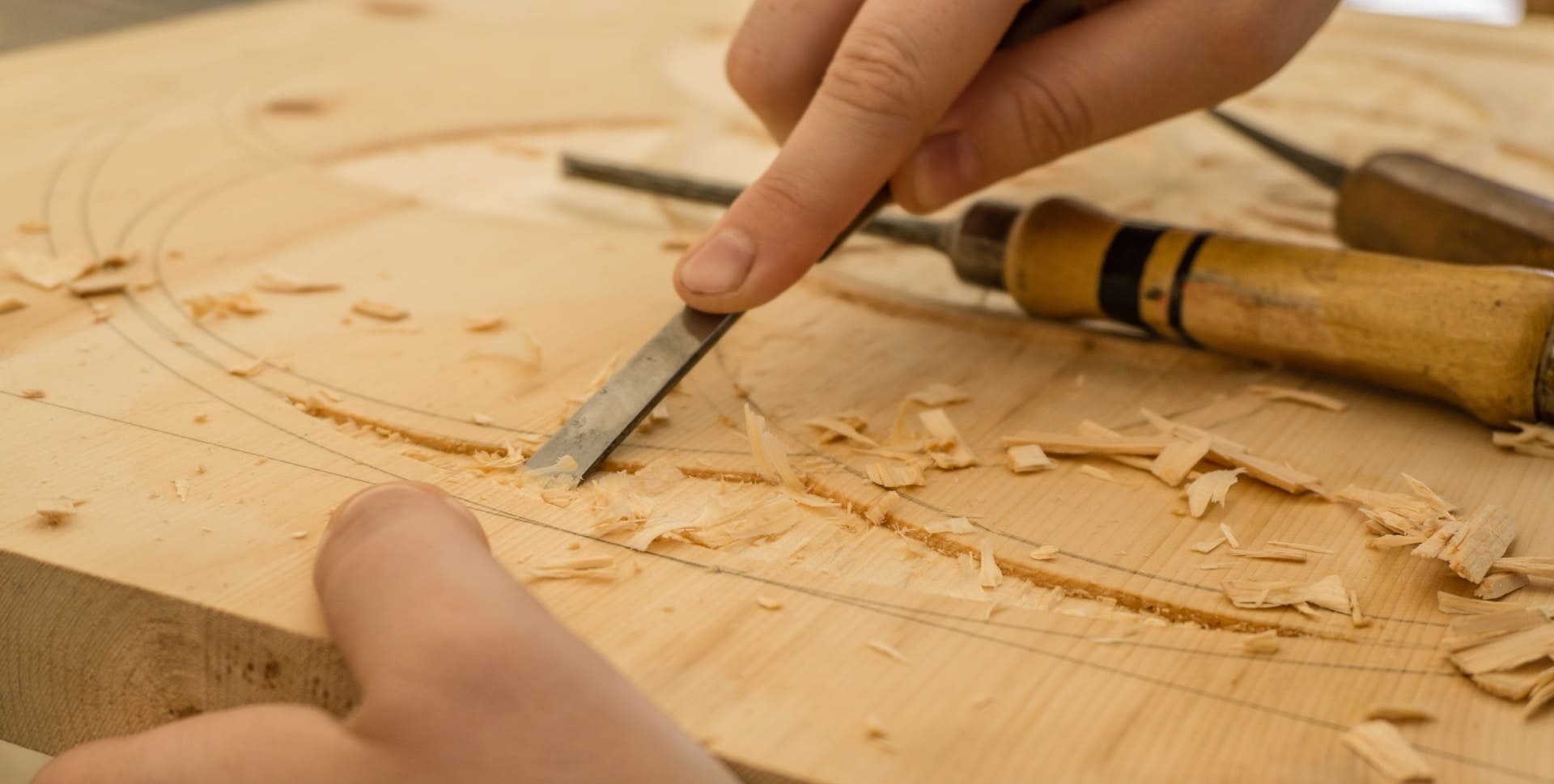
Woodblock printing in Japan means cutting a design into the surface of a wooden board so that the lines or areas to be inked stand in relief, brushing water-based ink or pigment onto the block, laying a sheet of washi paper over it and rubbing the back with a pad called a baren. A woodblock print is the paper impression that results. Ukiyo-e, “pictures of the floating world”, flourished in the Edo period (1603–1868) as an affordable urban art form made this way, and mokuhanga continues today in the work of shin-hanga, sōsaku-hanga and contemporary printmakers. The history, the full step-by-step process and the artists are covered in our main guide to Japanese woodblock printing; this page stays with the wood.
Plank Grain, Not End Grain
The most important fact about Japanese woodblocks is the direction of the grain. Mokuhanga uses plank grain (itame): boards cut along the length of the trunk, so that the wood’s fibers run parallel to the carving surface. This allows large, continuous blocks and a smooth, sympathetic surface for the long flowing lines of a kimono or a wave.
This is the opposite of Western wood engraving, which uses end grain (koguchi): a board cut across the trunk, exposing the dense cross-section of the fibers. End grain is harder and supports extremely fine lines, but the blocks are small and the technique suits tight tonal detail rather than sweeping contour. The plank-grain tradition is a defining material choice, not an accident, and it shaped the look of Japanese prints.
The Block Is a Tool, Not the Artwork
The wood is never the finished object; the paper impression is. A print was a team effort: the artist (eshi) supplied the design, a block carver (horishi) cut the wood, a printer (surishi) inked and pressed the paper, and a publisher (hanmoto) coordinated them. A full-color print needed a separate block for each color. The carver first cut the key block (sumi-ban), which carries the black outline and defines the composition; from proofs of it, further blocks were cut for each color. A modest print might use four or five blocks; an elaborate one, a dozen or more.
Because Edo-period blocks were working tools, few survive. The Brooklyn Museum, for example, holds a cherry key block of about 1830 carved on both faces, with a design by Kunisada on one side and one by Keisai Eisen on the other. Most of what collectors can buy is the printed sheet, which is why the wood’s durability over a print run matters to value as well as to craft.
Woods Used in Japanese Woodblock Printing
No single wood does everything well. Carvers chose species by task: a hard, durable wood for the all-important outline, softer and more easily worked woods for color areas, and very dense wood where extreme precision was needed. The table sets out the main woods and what each suits before we look at them in turn.
| Wood (English) | Japanese | Character | Best suited to | Main drawback |
|---|---|---|---|---|
| Mountain (wild) cherry | Yamazakura | Hard, fine, even grain; the traditional block wood | Key blocks; fine lines; long editions | Heavy, slow to carve and comparatively expensive |
| Cherry-faced plywood | Yamazakura-faced plywood | A thin sheet of cherry glued over a plywood core | Cherry’s carving surface with better stability | The thin face limits deep re-cutting |
| Katsura | Katsura | Medium-soft, even grain | Color blocks; broad areas | Less commonly stocked than shina |
| Japanese bigleaf magnolia | Hō (hōnoki) | Soft, smooth, easy to cut | Color blocks; learning to carve | Softer; wears sooner on long runs |
| Boxwood | Tsuge | Very hard and dense | Small inlays and repair plugs; end-grain detail | Costly and hard to obtain in large sizes |
| Japanese linden / basswood plywood | Shina | Soft, even, stable; usually plywood | Beginners; modern blocks; large color areas | Does not hold the very finest lines as well as cherry |
Mountain Cherry (Yamazakura): The Classic Block
The prized traditional wood for Japanese printmaking is mountain cherry, yamazakura: the wild cherry, not the ornamental flowering variety. Its appeal is a combination of hardness and a fine, even grain. Hardness lets a carved line hold its edge through a long run; the uniform grain means the wood cuts cleanly in any direction without splintering or fighting the knife. A wood with harder and softer spots would show them in the print.
For these reasons cherry was the standard choice for the key block, where a worn or chipped line would ruin every impression made from it. Specialist block makers (itaya) planed and prepared the boards before the carver took them over. Cherry is also demanding: solid cherry blocks are heavy, slow to carve and comparatively expensive.
Katsura, Hō and the Other Plank Woods
Because cherry was expensive and demanding to carve, color blocks, which carry flat areas rather than the finest lines, were often cut from softer woods. The classic text by the printmaker Yoshida Hiroshi names katsura (Cercidiphyllum japonicum) and hō (Japanese bigleaf magnolia, Magnolia obovata) as alternatives to cherry, and reports that katsura has the harder grain of the two. Both are still sold today, katsura as solid side-grain blocks.
Hō has a smooth, fine, almost waxy surface that cuts easily, and in Japan it is also a traditional wood for knife handles and sword scabbards. It is a common choice for color blocks and for learning the craft. Using cheaper woods for color blocks and reserving cherry for the outline was a practical economy that kept prints affordable in the Edo marketplace.
Boxwood (Tsuge): Small Inlays and End Grain
Boxwood (tsuge) is extremely hard and tight-grained, the same wood favored for combs and seals. In woodblock printing it was not an everyday plank for a whole sheet. It appears mainly as a small inset, where a very fine detail is cut into a plug of boxwood set into a cherry block, and as a repair plug for damaged areas. Boxwood is also among the woods used for end-grain blocks, which are cut across the fiber and can hold finer detail than plank grain. Hardwoods like this are more expensive and harder to obtain in large sizes than cherry.
Shina Plywood and the Modern Workshop
The wood story does not end in the Edo period. Most printmakers, students and contemporary mokuhanga artists now work on shina plywood, made from Japanese linden or basswood (Tilia japonica), and a Japanese art-school glossary notes that linden plywood has become the prevailing block medium. Shina plywood is dimensionally stable, relatively inexpensive, available in large sheets and does not warp easily when damp. Its soft, even face carves easily, though it does not hold the very finest lines as tenaciously as cherry.
For more demanding work, makers use cherry-faced plywood, a thin layer of yamazakura (commonly a few millimeters thick) glued over a stable core, which gives cherry’s carving surface with plywood’s stability. Note that products and layering vary by supplier; check the construction before you buy.
How to Choose a Woodblock for Printing
The right block depends on the image and on how it will be used. A few questions settle most choices.
| If you want to… | Consider | Why |
|---|---|---|
| Learn the craft or make proofs | Shina plywood; hō | Soft, forgiving and inexpensive, so mistakes cost little |
| Cut a fine key block with delicate lines | Solid yamazakura or cherry-faced plywood | The hard, even grain holds a thin line and resists chipping |
| Print large flat areas of color | Shina plywood; katsura | Soft and even; large sheets are stable and easy to carve |
| Add a very small, very fine detail | A boxwood inlay | Dense wood holds detail that cherry could not |
| Print a long edition from the same block | Solid cherry or cherry-faced plywood | Hardness resists wear across many impressions |
Three practical points follow. First, plank grain is the rule: look for a flat-sawn board and, for solid wood, a well-seasoned one. Second, thickness: shina plywood for printing is commonly sold in thicknesses of about 4 to 6 mm (some suppliers list 1/4 inch), and suppliers differ on layering, so check whether the core is made of several layers of shina or of a different material. Third, how many faces to carve: in Edo workshops the key block was reportedly carved on one side only, to limit warping, while color blocks were often carved on both sides, which saves wood and gives you more working surface.
Where to Buy Woodblocks
The traditional supply chain has thinned. Specialist block makers who once prepared cherry planks for professional carvers have become rare, and some printmaking workshops now buy yamazakura planks and laminate their own blocks. For most buyers today the practical options are these.
- Specialist printmaking suppliers. Shops in North America, Europe and Australia stock shina plywood sheets in standard sizes, as well as solid katsura side-grain blocks. McClain’s in the United States and T.N. Lawrence in the United Kingdom are examples; there is no implication that they are the only options.
- Japanese mokuhanga workshops and suppliers. Cherry-faced and laminated cherry blocks are made in Japan. Availability varies, so ask the maker directly.
- Art-supply and tool shops. Shina is sold by shops that carry Japanese tools, often in postcard and A4-class sizes.
Whichever source you use, ask about the species, the thickness, the layering of the plywood and whether the surface has been sanded. Some suppliers advise against sanding shina yourself, because its dust can irritate.
How to Care for Woodblocks
A carved block is a tool you will reuse, and wood moves with the air around it. Most damage comes from uneven moisture.
- Do not leave a block lying on one face for long. A flat block exposes only one side to humid or dry air and stresses the wood; stand idle blocks upright against a wall, or store them so both faces are covered.
- Keep moisture short and controlled. Dampening a block for hours, for example by leaving a wet cloth under it, can warp it and saturate the surface.
- Give blocks air. Storage with poor air circulation and high humidity invites mold. A stable room, with moderate humidity and without direct sun or heat, is best.
- Expect some movement. Improperly dried solid boards can warp even with good care, which is one reason many printmakers prefer plywood for large blocks.
- Protect fine lines. Store carved faces so they do not rub against each other, and handle blocks by their edges.
From Block to Print: Carving, Registration and Wear
Knowing the woods is only half the picture; what the carver and printer do with them explains why two impressions of the same design can differ in quality. The wood is an active participant at every step.
Transferring and Carving the Design
The artist’s drawing was first made as a thin, semi-transparent sheet called a hanshita-e, which was pasted face down onto the planed block with rice paste and thinned so the lines showed through in reverse. The carver then cut along those lines with a knife held like a pen and cleared the non-printing areas with chisels and gouges. The key block was carved first; its proofs guided the carving of each color block so every element would align.
Kentō: The Registration That Holds Everything Together
Printing a clean multicolor image depends on every sheet landing in exactly the same position on every block. Japanese printmaking solves this with kentō, registration marks carved directly into the wood: an L-shaped corner notch and a straight edge against which the printer seats each sheet. Because they are cut into the same board as the image, the kentō ages with the block, and damage to these marks can make precise registration impossible on later printings.
What the Wood Means for Prints and Collectors
Source: The Metropolitan Museum of Art(https://www.metmuseum.org/art/collection/search/36492)
How Block Wear Changes the Print
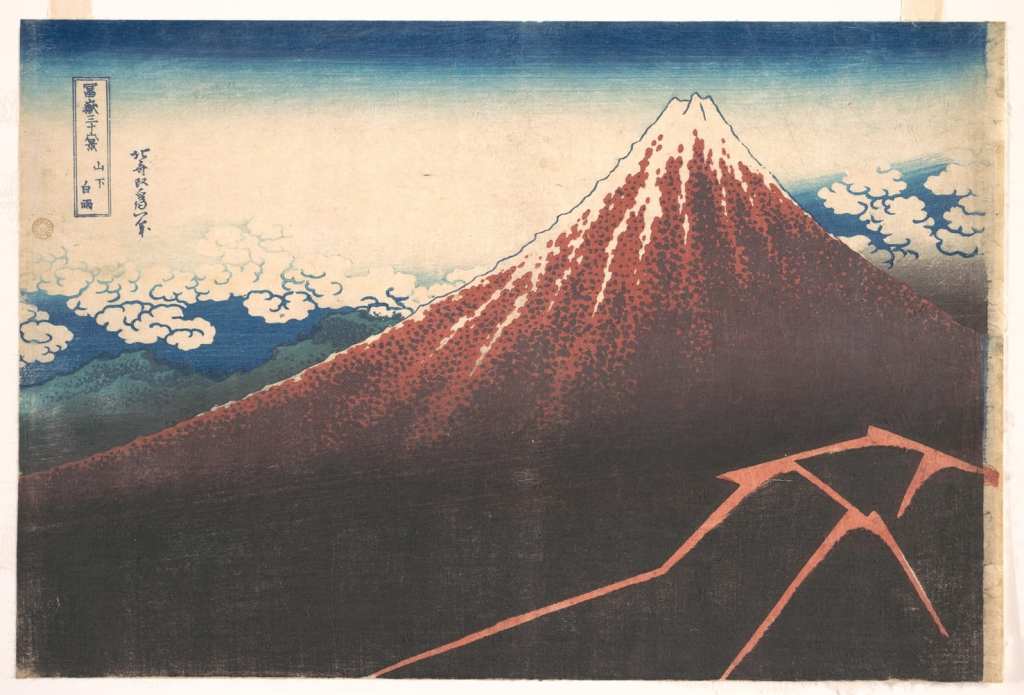
Even durable cherry is not immortal. Across a long edition the carved ridges slowly round and thin, fine lines drop out, and boards can split along the grain. Printers and publishers sometimes recut damaged areas or replaced whole blocks, and on popular designs this happened repeatedly. The consequence is direct: early impressions, pulled while the block was crisp, show sharp, unbroken lines and richer detail, while later impressions look softer or show breaks where the wood wore or cracked.
Katsushika Hokusai’s “Great Wave” is the textbook case. Many thousands of impressions were probably printed, and sources differ on the total. The key block wore most in the title cartouche, and specialists identify several wear states: the British Museum notes that a print with no breaks in its outlines is an early printing, and a recent study by Capucine Korenberg of 113 known copies narrowed the wear states to eight. Early impressions have outlines printed in blue from the key block, while later ones were printed with black outlines from the same block. The wood, in other words, is encoded in the print.
Reading an Impression
For anyone buying ukiyo-e, the material facts above reduce to a few practical questions: how early is this impression, how strong are its lines and colors, and what is the state of the paper. Specialists look at freshness of line, which indicates an early pull from an unworn block, strength and accuracy of color, and the paper: fading, foxing, trimming and backing all matter. Catalogue notes from the major auction houses often say whether an impression is early and well preserved, language that points straight back to the condition of the wood at the moment of printing. The same logic applies to twentieth-century shin-hanga prints by Kawase Hasui and Yoshida Hiroshi and sōsaku-hanga prints by Onchi Kōshirō and Munakata Shikō: lifetime impressions from fresh blocks are generally preferred to later restrikes.
Woodblock Prints in the Contemporary Interior
Beyond the saleroom, woodblock prints have a long second life on the walls of homes and hospitality spaces. A standard ōban sheet is intimate in scale, roughly 25 by 38 centimeters, so prints reward grouping, considered framing and placement where a viewer can come close.
Because these are water-based pigments on washi paper, they are light-sensitive. Direct sun will fade the indigos and reds that make a landscape sing, and humidity swings invite foxing and cockling. Sympathetic display means UV-filtering glazing, acid-free mounts, stable humidity and a wall away from harsh daylight, the same conservation common sense that protects any work on paper.
If learning how cherry blocks and washi shape a print has deepened your interest, the same appreciation for natural materials, paper and seasonal subject runs directly into Nihonga, Japanese-style painting built on mineral pigments and traditional supports, which offers a natural way to bring that lineage into a real room.
Discover Nihonga for Contemporary Spaces
Shop carefully selected Nihonga,
curated by experienced Japanese art dealers
for homes and commercial spaces worldwide.