
Ukiyo-e & Scrolls
Ukiyo-e in Cape Cod Homes: A Curated Style Guide

- Why Ukiyo-e Feels at Home in a Cape Cod House
- Choosing the Right Ukiyo-e Subjects for Cape Cod Interiors
- Originals, Restrikes, and Reproductions: What You Are Actually Buying
- Room-by-Room Placement and Framing for the Coast
- From Ukiyo-e to Nihonga: A Natural Extension for Cape Cod Collectors
- Discover Nihonga for Contemporary Spaces
A Cape Cod house — shingled, low-roofed, oriented to weather and water — is one of the most adaptable settings in American interior design for Japanese art. The restrained palette of weathered cedar, painted clapboard, sea-glass blues, and warm wood floors creates a visual register that ukiyo-e (浮世絵, “pictures of the floating world”) inhabits with unusual ease. For collectors and interior designers placing Japanese prints in coastal New England, the conversation between Edo-period printmaking and vernacular Cape architecture is more sympathetic than it might first appear.
This guide is for buyers thinking practically: which ukiyo-e subjects work in which rooms, what you are actually buying when you choose between an Edo-period original and a later restrike, and how to live with paper-and-pigment works in a humid coastal climate. It also opens onto a quieter territory beyond ukiyo-e — modern and contemporary Nihonga (日本画, Japanese-style painting) — that many Cape Cod collectors come to after their first prints settle on the wall.
Why Ukiyo-e Feels at Home in a Cape Cod House
The match isn’t accidental. Both Cape Cod design and the most enduring ukiyo-e imagery emerged from cultures shaped by sea, sky, and a working relationship with weather. The visual conventions that result — limited palette, flattened pictorial space, an attentiveness to atmosphere — are remarkably compatible. Designers who hesitate to introduce Japanese art into a traditional New England interior often discover that ukiyo-e is the easiest entry point.
Shared palette and restraint
Cape Cod interiors lean on a tightly held palette: whites and off-whites, smoky blues, soft greens, weathered grays, and the occasional warm note of mahogany or red oak. The classic ukiyo-e palette overlaps directly. Hokusai’s (葛飾北斎, 1760–1849) Berlin blue (bero-ai, ベロ藍) — the imported Prussian pigment that defined the iconic seascapes of the early 1830s — reads beautifully against painted shiplap or a pale linen sofa. The off-white kōzo paper itself, slightly toned with age, sits comfortably next to a whitewashed wall without looking imported.
A coastal sensibility
Hokusai’s “Thirty-six Views of Mount Fuji” (Fugaku Sanjūrokkei, 富嶽三十六景) and Hiroshige’s (歌川広重, 1797–1858) “Fifty-three Stations of the Tōkaidō” (Tōkaidō Gojūsan-tsugi, 東海道五十三次) are, at their core, weather pictures. Rain, snow, fog, and wind on water — the subject matter aligns with the lived experience of a barrier-beach town in a way that more decorative Japanese genres do not.
A traveler walking through driving rain at Shōno or a fishing boat dwarfed by a wave at Kanagawa is closer in spirit to a Wellfleet harbor in November than a metropolitan collector might assume. This shared sensibility — weather as subject, not backdrop — is the deepest reason ukiyo-e settles so naturally into a Cape interior.
Scale that suits low ceilings and shingled rooms
The standard ukiyo-e formats — ōban (大判, roughly 25 × 38 cm) and the vertical hashira-e (柱絵, pillar prints) — are modestly sized by Western fine-art standards. They were designed for residential viewing in rooms that were not large. A Cape’s lower ceilings and tighter wall planes, especially in original capes and three-quarter capes, suit these dimensions far better than a great hall in a contemporary build.
A single ōban print over a console, or a vertical pair flanking a doorway, frequently lands more confidently in such a setting than an oversized canvas would. Designers working in newer Cape-style construction with taller ceilings can compensate by hanging diptychs or triptychs, which were a native ukiyo-e format and read as a single composition rather than a salon arrangement.
Choosing the Right Ukiyo-e Subjects for Cape Cod Interiors
Source: The Metropolitan Museum of Art(https://www.metmuseum.org/art/collection/search/55095)
Ukiyo-e is not one thing. Across roughly two centuries, the genre developed distinct subject categories — landscape, beauty, actor, bird-and-flower, warrior, ghost — each with its own visual temperament. Some travel into a Cape Cod context more comfortably than others. The choice is not just about taste; it is about how a print reads from across the room and how it sits with the furniture and light it shares space with.
Hokusai and seascape prints
For most collectors furnishing a coastal home, landscape ukiyo-e is the natural place to start. Hokusai’s “Great Wave off Kanagawa” (Kanagawa-oki Nami-ura, 神奈川沖浪裏) is so familiar that it risks reading as a poster, but a fine impression — Edo-period or a respected later edition — carries the kind of subtle ink variation and registration that a reproduction cannot.
Other prints from the Mount Fuji series — “South Wind, Clear Sky” (Gaifū Kaisei, 凱風快晴, popularly known as “Red Fuji”) and “Rainstorm Beneath the Summit” (Sanka Hakuu, 山下白雨) — are quieter and often work better in a primary living space where the most famous image would dominate. The lesser-known views frequently make better long-term companions on a wall you sit with every day.
Hiroshige’s weather and coastal views
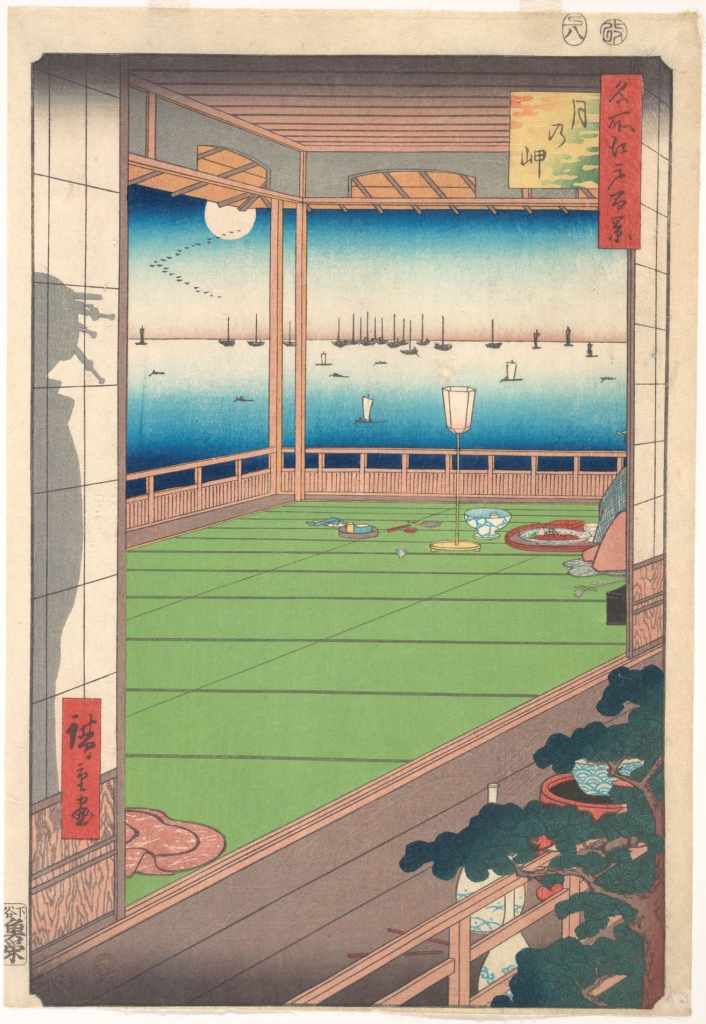
Hiroshige is, for many designers, the more livable artist of the two great Edo landscapists. His prints are atmospheric without being theatrical. The Tōkaidō series, the “Sixty-odd Provinces” (Rokujūyoshū Meisho Zue, 六十余州名所図会), and especially “One Hundred Famous Views of Edo” (Meisho Edo Hyakkei, 名所江戸百景, 1856–1858) contain dozens of compositions — moonrise over a marsh, snow on a coastal road, a sudden squall at Ōhashi — that read as nuanced weather paintings rather than tourist images.
These are prints that reward looking, which is what most homeowners actually want in a room they spend hours in. A Hiroshige night view above a sideboard ages well in the way a single graphic image does not.
Kachō-ga (bird-and-flower) for quieter walls
Kachō-ga (花鳥画) — the bird-and-flower print tradition — offers a different register: closer, more decorative, more openly beautiful. Hiroshige, Hokusai, and later shin-hanga (新版画, “new prints”) artists such as Ohara Koson (小原古邨, 1877–1945) produced bird-and-flower works that are exceptional for bedrooms, dressing rooms, and the small intimate spaces a Cape excels at.
A Koson egret against a pale ground, or a Hiroshige pair of sparrows in snow, brings nature inside without competing with the architecture. For homes that already have strong coastal references in textiles and furniture, kachō-ga adds a quieter botanical layer that doesn’t repeat the seascape note.
Bijin-ga and figural prints — selective placement
Bijin-ga (美人画), the genre of beauty prints associated with Kitagawa Utamaro (喜多川歌麿, c. 1753–1806), is more demanding in a Western interior. The flattened space, elaborate textiles, and intimate scale reward a contemplative setting — a study, a reading nook, a guest room — more than a primary living area.
Actor prints (yakusha-e, 役者絵) by Tōshūsai Sharaku (東洲斎写楽, active 1794–1795) or by Utagawa-school designers carry similar considerations. They are powerful but specific; they ask for the right corner. Used selectively, they punctuate a Cape interior; used broadly, they can begin to feel like a costume museum.
Originals, Restrikes, and Reproductions: What You Are Actually Buying
A meaningful share of buyer disappointment in ukiyo-e comes from misunderstanding what an impression is. A woodblock print is not a unique object in the sense a painting is; the same blocks may have produced impressions across decades, and the difference between an early Edo-period strike and a later restrike is enormous in both quality and value. Before you buy, it helps to understand the basic strata of the market.
Edo-period original impressions (1603–1868)
A fine Edo-period impression — printed during or close to the artist’s working life, from blocks not yet worn, with strong color and clean registration — is what serious ukiyo-e collectors pursue. For famous designs by Hokusai and Hiroshige, such impressions in good condition have realized prices ranging from roughly $5,000 into the mid five-figures, with iconic examples occasionally crossing into six figures at major sales by Christie’s, Sotheby’s, and Bonhams in recent years.
Less iconic designs and minor artists can be acquired for considerably less — sometimes in the $500 to $2,000 range for honest Edo-period impressions in honest condition. Condition is the variable that swings price most dramatically: trimmed margins, fading, foxing, and backing all matter.
Meiji and Taishō restrikes
After the original artists’ deaths, blocks were frequently reprinted through the Meiji (1868–1912) and Taishō (1912–1926) periods. These restrikes can still be technically accomplished and visually attractive, particularly for buyers who care more about how the image lives on a wall than about strict collecting hierarchy. Prices are correspondingly lower, often in the few hundred to low four-figure dollar range depending on artist, image, and condition. Honest dealers describe them clearly as later impressions.
Shōwa shin-hanga and twentieth-century editions
The shin-hanga (“new prints”) movement of the Shōwa era (1926–1989), led by publisher Watanabe Shōzaburō (渡邊庄三郎, 1885–1962), revived ukiyo-e techniques with new artists — Kawase Hasui (川瀬巴水, 1883–1957), Hiroshi Yoshida (吉田博, 1876–1950), Itō Shinsui (伊東深水, 1898–1972) — and produced original designs rather than restrikes of older works.
Hasui’s quiet snow and night scenes have become particularly sought after over the past decade. Lifetime impressions of his most desirable prints have traded in the low to mid four-figure range at auction, with exceptional examples reaching higher. For a Cape Cod interior, shin-hanga is often the sweet spot: original-design works at accessible prices, with imagery that reads naturally alongside coastal architecture.
Modern reproductions
At the bottom of the pyramid are modern reproductions: machine-printed or digitally produced images that imitate ukiyo-e without using the woodblock process. Some are honestly labeled and inexpensive, typically $50 to a few hundred dollars, and can serve a decorative purpose in spaces where an original would not be appropriate — a humid bathroom, a sun-flooded porch, a child’s room. They are not collectible in the sense the categories above are. The genuine risk is buying a reproduction at restrike or original prices because the labeling was vague.
| Category | Period | Typical Price Range (USD) | Best Residential Use |
|---|---|---|---|
| Edo-period original impressions | 1603–1868 | $500 – $50,000+ | Primary rooms, investment-grade collecting |
| Meiji / Taishō restrikes | 1868–1926 | $200 – $2,000 | Decorative collecting, secondary rooms |
| Shōwa shin-hanga (original designs) | 1915–1960s | $500 – $10,000+ | Bedrooms, studies, atmospheric interiors |
| Modern reproductions | Contemporary | $50 – $500 | Decorative use only; high-risk environments |
Source category: Christie’s, Sotheby’s, and Bonhams Japanese print sales, 2020–2024, alongside specialist dealer listings.
Room-by-Room Placement and Framing for the Coast
Where a print is hung matters as much as which print it is. Cape Cod interiors have characteristic light, characteristic ceiling heights, and a characteristic humidity profile that all affect how — and where — Japanese works on paper should be installed. A few principles travel across most projects.
Living rooms, sunrooms, and great rooms
The communal rooms of a Cape are usually where the most-photographed walls live, and they invite the most recognized images: a major Hokusai or Hiroshige landscape, perhaps in a horizontal triptych arrangement if the wall allows, or a strong vertical hashira-e above a console.
Sunrooms are tempting but problematic for original works on paper because of ultraviolet exposure. This is the room for a quality reproduction or a print mounted behind museum-grade UV-filtering glazing, not an Edo-period original. Even with UV glass, no irreplaceable impression should hang in direct sun for years; rotation between sunrooms and lower-light spaces is the conservation-minded approach.
Bedrooms and guest rooms
Bedrooms reward quieter prints. Kachō-ga, snow scenes by Hasui, or a softer Hiroshige night view bring atmosphere without becoming the focal point of the room. Above a bed, a single horizontal print or a vertical pair tends to feel more resolved than a cluster. The reduced light exposure in most bedrooms is also gentler on paper, making them appropriate rooms for more delicate impressions.
Entries, halls, and stairwells
Narrow Cape entries and stair walls are well suited to vertical formats — hashira-e pillar prints, kakemono-e (掛物絵, hanging-scroll-format prints), or a tightly arranged vertical pair. The eye is moving in these spaces, so the work is glanced rather than studied; bold, graphic compositions read more clearly here than delicate detail.
Framing and conservation in a humid climate
Coastal humidity is the practical issue most often underestimated by new collectors. Japanese paper expands and contracts with moisture, and salt air accelerates the breakdown of poor framing materials. Acid-free rag matting, conservation-grade hinging (Japanese paper hinges with reversible starch paste), and UV-filtering glazing — either museum glass or anti-reflective acrylic — are the baseline for any print of value.
Aluminum frames and sealed backings help in homes that are unheated or under-cooled for part of the year, which describes many seasonal Cape properties. Salt air is especially hard on raw steel and unsealed wood; aluminum and well-finished hardwoods perform better. A simple, narrow profile in matte black, dark walnut, or a soft whitewashed wood tends to bridge ukiyo-e and Cape Cod aesthetics more comfortably than an ornate gilt frame, which can read as imported European drama in a setting that doesn’t want it.
From Ukiyo-e to Nihonga: A Natural Extension for Cape Cod Collectors
Many collectors who begin with ukiyo-e for a Cape Cod home eventually find themselves curious about Nihonga — modern and contemporary Japanese-style painting that uses traditional materials (mineral pigments, sumi ink, gold and silver leaf) on washi paper or silk. Nihonga emerged in the late nineteenth century as Japanese painters consciously continued indigenous traditions in dialogue with Western art, and it has produced some of the most quietly beautiful work in the country’s twentieth-century and contemporary canon.
Why Nihonga reads well in a Cape Cod setting
Nihonga paintings tend to have the same qualities that make ukiyo-e work in coastal interiors: a restrained palette grounded in natural pigments (iwa-enogu, 岩絵具 — ground mineral colors derived from azurite, malachite, cinnabar, and other minerals), an atmospheric rather than dramatic sense of space, and an attentiveness to nature that resonates with a landscape of dunes, ponds, and sky.
The matte, slightly granular surface of mineral pigment on washi has a different presence than oil paint; it absorbs light rather than reflecting it, which suits the soft, often gray New England daylight better than a glossy varnish would. Where ukiyo-e is graphic, Nihonga is contemplative — a useful counterweight in a home that already has prints on the wall.
Format and scale
Nihonga ranges from small album leaves and shikishi (色紙, square paper panels) to room-scaling byōbu (屏風, folding screens) and fusuma (襖, sliding-door panels). The mid-sized framed formats — works on washi typically between roughly 40 × 50 cm and 80 × 100 cm — are particularly versatile for Cape Cod homes, sitting comfortably above mantels, on stair landings, or in dining rooms where a single contemplative image grounds the room.
Living with Nihonga in a coastal environment
Mineral pigments are themselves stable, but the washi support and any metallic leaf in the work require the same conservation thinking as ukiyo-e: UV-filtered glazing, controlled humidity where possible, and avoidance of direct salt-air exposure. Properly framed and reasonably sited, a Nihonga work will outlive most of the furniture in the room around it.
If ukiyo-e gave a Cape Cod interior its first dialogue with Japanese art, Nihonga is often the conversation that deepens over time. Both traditions reward an environment that respects light, scale, and weather — qualities a well-considered Cape Cod home already understands. Readers interested in continuing that conversation can explore curated Nihonga works selected with these same residential and commercial contexts in mind.
Discover Nihonga for Contemporary Spaces
Shop carefully selected Nihonga,
curated by experienced Japanese art dealers
for homes and commercial spaces worldwide.